
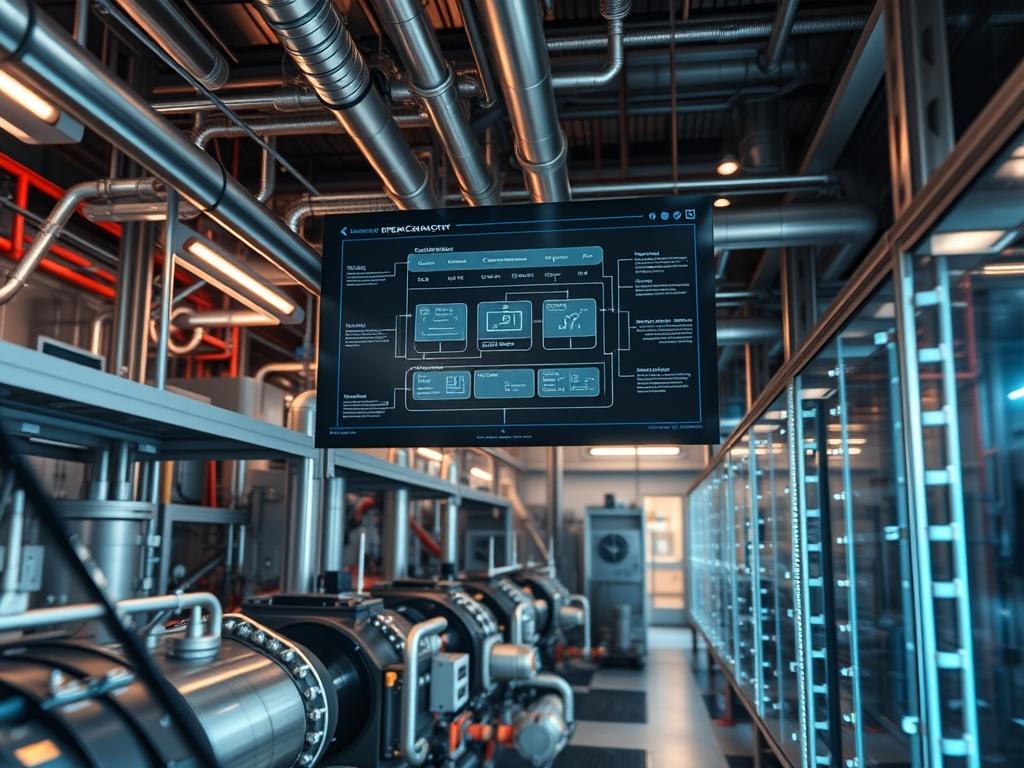
The GSHP Vapor Compression Cycle serves as the primary mechanism for high-efficiency thermal energy transfer within modern sustainable infrastructure. This system functions as a critical component of the environmental control layer; it facilitates the movement of thermal payloads between a subterranean reservoir and a building’s interior environment. In the broader technical stack of building automation and energy management systems, the ground source heat pump (GSHP) solves the “Variable Ambient Flux” problem. Unlike air-source systems that suffer from high latency and reduced throughput during extreme temperature peaks, the GSHP utilizes the stable thermal-inertia of the earth. This physical consistency allows for the maintenance of a high Coefficient of Performance (COP) regardless of atmospheric conditions. From an architectural perspective, the cycle represents an encapsulated thermal loop that leverages phase-change thermodynamics to achieve mechanical work with minimal energy overhead. The integration of this cycle into a Building Management System (BMS) requires precise synchronization between physical hardware components and digital logic controllers to ensure signal-attenuation does not interfere with sensor accuracy.
Technical Specifications
| Requirement | Default Port / Operating Range | Protocol / Standard | Impact Level (1-10) | Recommended Resources |
| :— | :— | :— | :— | :— |
| Refrigerant Media | R-410A / R-134a / R-32 | ASHRAE 15 / 34 | 10 | High Purity Grade |
| Suction Pressure | 100 PSI to 150 PSI | ISO 13256-1 | 08 | Pressure Transducer |
| Discharge Pressure | 300 PSI to 450 PSI | ASME BPVC Section VIII | 09 | Scroll Compressor |
| Power Supply | 208V / 230V / 460V AC | NEC Article 440 | 07 | 3-Phase Stable Grid |
| Control Logic | Modbus TCP / BACnet | IEEE 802.3 | 06 | PLC / 128MB RAM |
| Thermal Conductor | High-Density Polyethylene | ASTM D3350 | 09 | BHE Material Grade |
The Configuration Protocol
Environment Prerequisites:
1. Compliance with ASHRAE Standard 15 regarding refrigeration system safety and NEC Article 70 for electrical grounding.
2. Installation of a Borehole Heat Exchanger (BHE) field with confirmed thermal conductivity testing.
3. A Logic Controller (e.g., Siemens Desigo or Schneider EcoStruxure) running the latest firmware version to handle PID (Proportional-Integral-Derivative) loop calculations.
4. Administrative access to the BMS (Building Management System) head-end for real-time telemetry monitoring.
Section A: Implementation Logic:
The physics of the GSHP Vapor Compression Cycle rests on the manipulation of the boiling point of a refrigerant. By varying the pressure applied to the fluid, we control its ability to absorb or reject heat. The system is fundamentally idempotent in its logic: given a specific thermal load and ground temperature, the cycle must produce a consistent energy output. The “Problem” is the Second Law of Thermodynamics, which dictates that heat naturally flows from hot to cold. The “Solution” is the application of mechanical work via the Compressor to reverse this flow. The engineering design prioritizes low thermal-inertia in the heat exchangers to ensure rapid response to load changes while maintaining high throughput across the primary and secondary loops.
Step-By-Step Execution
1. Thermal Acquisition via Evaporation
The cycle initiates at the Evaporator, where the cold liquid refrigerant interacts with the warmer fluid from the ground loop. As the refrigerant absorbs the thermal payload, it undergoes a phase change from a low-pressure liquid to a low-pressure vapor.
System Note: The PLC monitors the Suction Line Thermistor; it calculates the “Superheat” value to ensure the refrigerant is fully vaporized before entry into the Compressor. This prevents liquid “slugging,” which would cause catastrophic mechanical failure of the kernel hardware.
2. High-Pressure Payload Encapsulation
The low-pressure vapor is drawn into the Compressor. The device utilizes mechanical work to decrease the volume of the vapor, which exponentially increases its pressure and temperature according to the Ideal Gas Law.
System Note: Use a Fluke-Multimeter to verify the Amperage Draw on the Compressor Motor. An unexpected spike in current indicates high head pressure or mechanical resistance within the Scroll assembly.
3. Isobaric Heat Rejection
The high-pressure, high-temperature vapor enters the Condenser. In this stage, the refrigerant is hotter than the interior distribution loop (e.g., radiant floor or forced-air coil). Heat is rejected into the building, and the refrigerant condenses back into a high-pressure liquid.
System Note: The BMS should trigger a Secondary Pump Service via systemctl restart bms-pump logic if the temperature differential (Delta T) falls below the calibrated threshold, ensuring maximum energy throughput.
4. Isenthalpic Expansion and Reset
The high-pressure liquid passes through the Thermal Expansion Valve (TXV). This component acts as a bottleneck; it forces the refrigerant through a small orifice, resulting in a sudden drop in pressure. This “Flash Evaporation” cools the refrigerant significantly, resetting it for the next cycle.
System Note: The TXV maintains the state of the system by adjusting flow in real-time based on the Evaporator load. This is a physical fail-safe mechanism that prevents the cycle from drifting into inefficiency or thermal runaway.
Section B: Dependency Fault-Lines:
The primary bottleneck in any GSHP Vapor Compression Cycle is the ground-loop interface. If the soil has low thermal conductivity, the “heat sink” becomes saturated. This leads to a degradation of the Coefficient of Performance (COP). Furthermore, any air ingress in the hydronic loops introduces packet-loss in the form of vapor bubbles; these bubbles reduce the surface area available for heat transfer and can cause pump cavitation. Software-side dependencies include calibrated Thermistor arrays; if a sensor drifts by more than 0.5 degrees, the PID loop will introduce oscillations, leading to excessive cycling and shortened hardware lifespan.
The Troubleshooting Matrix
Section C: Logs & Debugging:
When a fault occurs, the first step is to interrogate the BMS Error Logs located at /var/log/hvac/compressor_faults.log.
| Error String | Physical Component | Diagnostic Action |
| :— | :— | :— |
| `ERR_LOW_PRES_CUTOUT` | Evaporator / TXV | Check ground loop flow rate; inspect for refrigerant leaks using an ultrasonic leak detector. |
| `ERR_HIGH_HEAD_PRES` | Condenser | Verify building loop pump operation; check for air-binding in the hydronic lines. |
| `ERR_THERM_OVERLOAD` | Compressor Motor | Measure voltage imbalance between phases; inspect contactor for pitting or carbon deposits. |
| `ERR_SENSOR_OOR` | NTC Thermistor | Test resistance of the sensor at the terminal block; compare against the lookup table. |
Visualization of these errors often reveals a pattern: “Low Pressure” usually points to a source-side issue (the ground), whereas “High Pressure” points to a load-side issue (the building). Physical cues such as frost on the suction line indicate an “Over-feeding” TXV or insufficient airflow across the indoor coil.
Optimization & Hardening
Performance Tuning:
To increase thermal throughput, implement Variable Frequency Drives (VFD) on both the Compressor and the circulating pumps. By modulating the frequency (Hz) of the motors, the system can match the thermal load with surgical precision, reducing the overhead of on-off cycling. Tuning the PID constants (Proportional Gain and Integral Time) is essential for minimizing the latency between a thermostat call and the stabilization of the vapor cycle.
Security Hardening:
Physical hardening involves the installation of high-pressure and low-pressure manual reset switches that bypass the software layer. This ensures that if the PLC kernel crashes or if there is a network-based attack on the BMS, the hardware remains protected from physical destruction. For digital hardening, ensure that the Modbus Gateway is isolated behind a Firewall and that all Write Commands to the register require authenticated tokens.
Scaling Logic:
Scaling a GSHP infrastructure involves a “Modular Array” approach. Rather than installing one massive unit, deploy multiple smaller units in parallel. This configuration allows for “Lead-Lag” logic: the BMS rotates which unit is the “Lead” to equalize run-time across the fleet. This redundancy ensures that even during a component failure or a local packet-loss of telemetry, the remaining units can maintain the thermal baseline of the facility.
The Admin Desk
How do I verify the charge without breaking the seal?
Measure the “Subcooling” at the Condenser outlet and “Superheat” at the Evaporator inlet using external pipe clamps. If the subcooling is zero, you likely have a low refrigerant payload.
What causes the “Short-Cycling” behavior in the compressor?
Short-cycling is usually caused by an oversized system or a restricted Filter Drier. It can also occur if the Differential Setpoint in the PLC configuration is too narrow, causing the system to hunt for equilibrium.
Why is my Ground-Loop Delta-T decreasing over time?
This indicates thermal saturation of the soil. The ground is unable to dissipate the heat as fast as the system is injecting it. Consider increasing the loop length or adding a cooling tower to assist during peak loads.
Can I run the system if the BMS is offline?
Yes, most units feature a “Local Manual” mode. By jumping the R and Y terminals on the unit control board, you can force the Compressor to run, bypassing the network overhead for emergency cooling or heating.
Is it normal for the suction line to be sweating?
In cooling mode, yes. The suction line carries cold vapor back to the Compressor. This is a functional outcome of the Vapor Compression Cycle; however, excessive ice formation indicates a significant airflow or refrigerant restriction.