
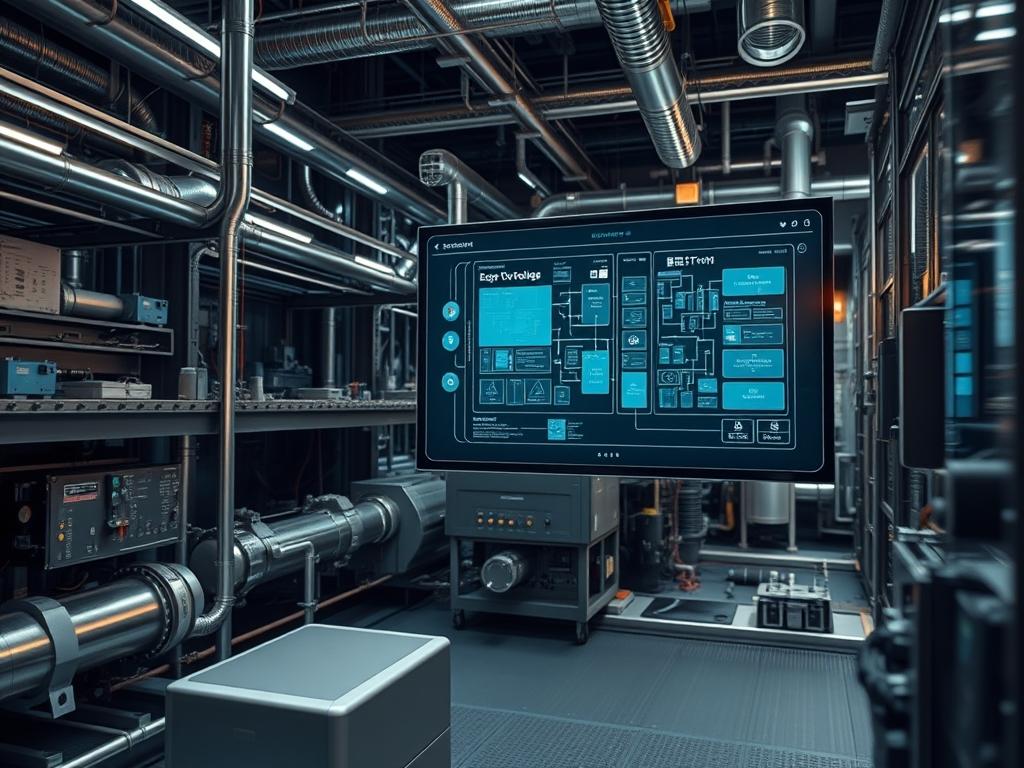
Ventilation Purge Cycle Logic serves as the primary governing mechanism for expelling stagnant, contaminated air from conditioned spaces during transition periods between active occupancy and standby modes. Within the broader technical stack of Building Automation Systems (BAS) and Net-Zero Energy infrastructure, this logic addresses the critical imbalance between ASHRAE 62.1 indoor air quality standards and the thermodynamic costs of high-volume mechanical ventilation. The core problem this logic solves is the accumulation of Volatile Organic Compounds (VOCs), Carbon Dioxide (CO2), and particulate matter during peak usage hours, which often linger due to aggressive energy-saving setbacks. By implementing an automated, sensor-driven purge sequence, architectures move from static scheduling to dynamic, demand-controlled ventilation. This ensures that the thermal-inertia of the building is managed effectively while restoring air freshness to baseline levels. This logic is typically encapsulated within the edge-controller layer; interfacing directly with Variable Frequency Drives (VFD), damper actuators, and air quality sensor arrays via standard fieldbus protocols.
Technical Specifications
| Requirement | Default Port/Operating Range | Protocol/Standard | Impact Level (1-10) | Recommended Resources |
| :— | :— | :— | :— | :— |
| CO2 Sensor Range | 400 to 2000 PPM | BACnet/IP or Modbus | 9 | High-precision Infrared |
| BACnet Signaling Port | Port 47808 | ASHRAE 135-2020 | 7 | 10/100 Mbps Ethernet |
| Damper Actuator Force | 45 in-lb to 360 in-lb | 2-10VDC / 4-20mA | 8 | 24VAC Class 2 Power |
| DDC Logic Processing | 100ms – 500ms Latency | IEEE 802.3 | 6 | 512MB RAM / 1GHz CPU |
| Fan VFD Frequency | 20Hz – 60Hz | Pulse Width Modulation | 10 | 3-Phase Power Feed |
THE CONFIGURATION PROTOCOL
Environment Prerequisites:
Successful execution of Ventilation Purge Cycle Logic requires a unified communication fabric and precise hardware calibration. The system must utilize a Direct Digital Control (DDC) platform compliant with BACnet/IP or Modbus TCP standards. Software dependencies include a logic engine capable of processing proportional-integral-derivative (PID) loops, typically running on a Linux-based kernel or a proprietary Real-Time Operating System (RTOS). Access requires administrative-level permissions on the Building Management System (BMS) head-end and a valid SSL/TLS Certificate for secure web-socket communication. Physical requirements include Differential Pressure Transducers installed across all filter banks and Global Outside Air Temperature (OAT) sensors calibrated within a 0.5-degree margin of error.
Section A: Implementation Logic:
The theoretical underpinning of the purge logic is the volumetric displacement of indoor air based on Calculated Air Changes per Hour (ACH). Unlike constant-volume systems, automated purge logic utilizes a “flush” period calculated by the control algorithm to replace 95 percent of the internal air volume before the next occupancy cycle. This process accounts for thermal-inertia; if the outdoor air is significantly colder or warmer than the setpoint, the logic modulates the Economizer Damper to utilize free cooling or heating, reducing the load on the secondary heat exchangers. The logic is designed to be idempotent; if a command is re-sent due to network latency, the actuator state remains consistent with the intended percentage of openness, preventing mechanical cycling and reducing wear on the NEMA-rated motor components.
Step-By-Step Execution
1. Initialize Sensor Data Aggregation
The first step involves identifying the Input/Output (I/O) points for the CO2, VOC, and Occupancy Sensors. Use the command bacnet-stack-scan –verbose to map all active nodes on the subnet.
System Note: This action registers the physical atmosphere-monitoring devices into the kernel-level message queue, ensuring that the logic engine has a real-time data stream for the decision-making matrix.
2. Define Setpoint Boundaries and Deadbands
Establish the baseline air quality thresholds using the set-point-config utility in the DDC environment. Define a high-limit CO2 ceiling of 800 PPM and a deadband of 50 PPM.
System Note: Setting a deadband prevents “chatter” in the Relay Logic, where the system rapidly toggles on and off as the sensor value fluctuates near the threshold; this protects the Magnetic Contactors in the fan housing.
3. Configure the PID Loop for VFD Modulation
Map the analog output (AO) of the controller to the Frequency Reference input of the Variable Frequency Drive (VFD). The PID constants should be tuned for low-latency response to avoid overshooting the target static pressure.
System Note: This step modulates the fan motor speed based on the delta between current air quality and the desired baseline, optimizing the electrical throughput of the system.
4. Implement Damper Interlock Logic
Using the logic builder, create an interlock between the Supply Fan Status and the Outside Air Damper (OAD). The OAD must reach a minimum position of 100 percent during the purge cycle regardless of the Return Air (RA) temperature.
System Note: This ensures that the system is not recirculating contaminated air; it forces a one-way path from the intake to the exhaust relief, maintaining the integrity of the purge.
5. Establish Post-Occupancy Trigger Conditions
Write a script to trigger the purge sequence exactly 30 minutes after the Passive Infrared (PIR) Occupancy Sensors report a “Vacant” state. Use the command chmod +x /usr/bin/purge_scheduler.sh to make the script executable.
System Note: Delaying the purge allows the thermal load to stabilize after occupants leave, ensuring that the air-change occurs when the building is at its most energy-efficient state for mechanical override.
6. Verify Static Pressure Limits
Monitor the Static Pressure Transducer values during the initial ramp-up. If the pressure exceeds 2.5 inches of water column (w.c.), the logic must trigger a “High-Limit Shutdown” to prevent ductwork damage.
System Note: This step protects the physical asset from structural failure caused by excessive force when dampers are moved at high velocities.
Section B: Dependency Fault-Lines:
System failure often originates from packet-loss in high-traffic MSTP (Master-Slave/Token-Passing) networks. If the token is lost, the Damper Actuator may freeze in its last known position, leading to either excessive energy loss or poor air quality. Another bottleneck is signal-attenuation in long-run RS-485 cabling; if a sensor returns “NaN” (Not a Number), the logic must default to an “Emergency Open” state. Verify that all Shielded Twisted Pair (STP) cables are grounded at a single point to prevent ground loops that interfere with the 4-20mA low-voltage signals.
THE TROUBLESHOOTING MATRIX
Section C: Logs & Debugging:
When the purge cycle fails to initiate, administrators should immediately inspect the system logs located at /var/log/bas/ventilation_logic.err. Common error strings such as “COMM_FAILURE: NODE_24” indicate a physical break in the communication trunk or a blown fuse on the DDC power supply. Physical fault codes on the VFD display (e.g., “F0001: Overcurrent”) suggest mechanical resistance in the fan belt or a locked rotor.
For sensor readout verification, use a Fluke-Multimeter to check the voltage at the Analog Input (AI) terminals. A reading of 0V on a 2-10V sensor indicates a “Broken-Wire” condition. If the software shows a “High-Limit CO2” warning but the room is empty, use a calibrated handheld CO2 Meter to check for “Sensor Drift.” Sensor drift requires a manual “Zero-Calibration” to be performed within the controller software to offset the aging infrared bulb characteristics.
OPTIMIZATION & HARDENING
Performance tuning of the Ventilation Purge Cycle Logic involves refining the concurrency of the air-handling units. In multi-zone deployments, staggering the start times of the fans by 60 to 120 seconds prevents a massive “Inrush Current” spike on the building’s electrical service. This reduces the primary peak-demand charges from the utility provider.
Security hardening is essential; the BACnet Port 47808 should never be exposed to the public internet. Implement a Stateful Firewall that only allows traffic from known MAC Addresses or specific VLANs designated for the infrastructure layer. Use Access Control Lists (ACLs) to restrict who can modify the PID setpoints, ensuring that local occupants cannot override the global energy-savings logic.
For scaling, move the logic from a localized controller to a Distributed Control System (DCS) with a supervisor layer. This allows the purge cycle to respond to “Grid-Level” signals, such as Demand Response (DR) events, where the building can delay its air-purge in exchange for utility financial incentives during periods of high grid-stress.
THE ADMIN DESK
How do I manually override a stuck purge cycle?
In the BMS interface, navigate to the Point Override menu. Search for the variable AHU_Purge_Mode and set the status to “Manual” before forcing the Binary Output (BO) for the fan to “On.”
Why is the purge fan making an audible hunting noise?
This indicates that the PID Loop is poorly tuned; the “P” (Proportional) gain is likely too high, causing the VFD to oscillate. Lower the gain in the Control Loop Config menu to smooth out the throughput.
What causes a “Log Buffer Overflow” error in the controller?
This occurs when the polling frequency of the CO2 sensors is set too high (under 1 second). Increase the sampling interval to 30 or 60 seconds to reduce the internal processing overhead.
Does the purge logic work during extreme outdoor temperatures?
The logic includes an Enthalpy Lockout feature. If outdoor temperatures are above 95F or below 10F, the purge cycle will run at “Minimum Ventilation” to protect the Hydronic Coils from freezing or overheating.