
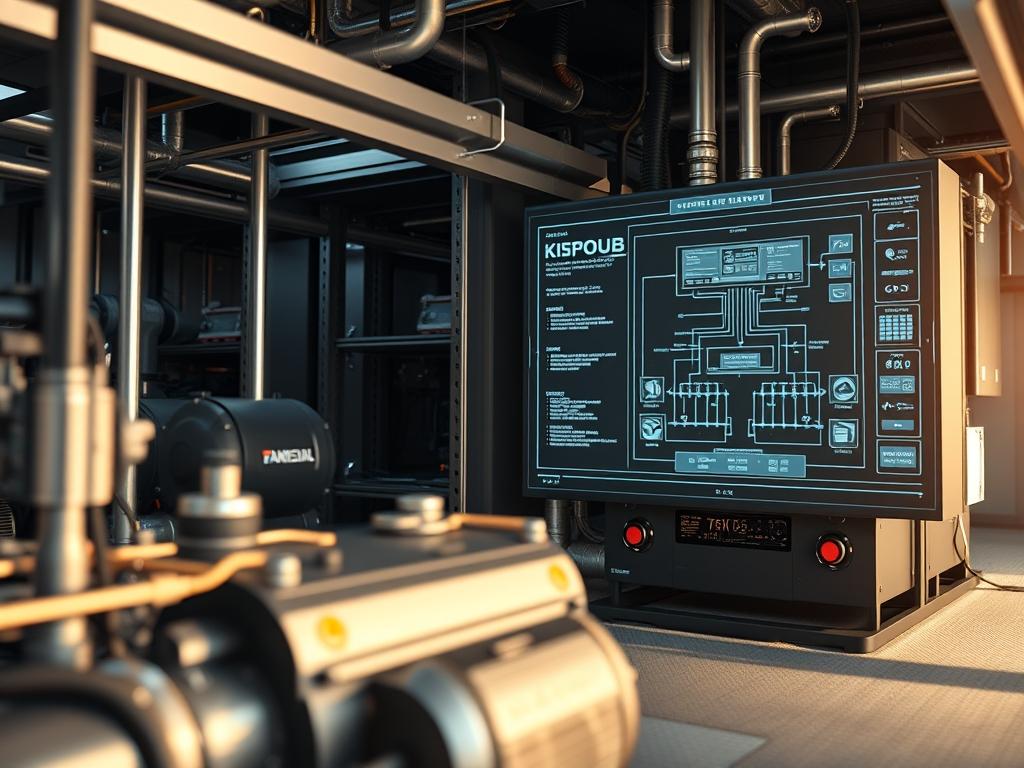
Compressor Startup Delay Logic serves as a critical mitigation layer within modern energy management systems and industrial automation stacks. This logic governs the temporal staggering of high-draw inductive loads to prevent localized grid instability and catastrophic voltage sags. In large-scale infrastructure, such as data center cooling loops or industrial refrigeration plants, the simultaneous activation of multiple compressors results in a massive inrush current that can exceed steady-state operating levels by five to seven times. Without precise Compressor Startup Delay Logic, the resulting aggregate current spike triggers circuit breakers, stresses transformer windings, and introduces significant electrical noise across the facility. By implementing an idempotent control sequence, systems architects ensure that every restart event follows a deterministic, staggered timeline regardless of the initial system state. This approach addresses the “Problem-Solution” context of high-demand peak charges and potential equipment failure due to low-voltage transients. The implementation of this logic effectively manages the thermal-inertia of the cooled environment while safeguarding the mechanical integrity of the Compressor motor and the electrical stability of the supply bus.
Technical Specifications
| Requirement | Default Port/Operating Range | Protocol/Standard | Impact Level (1-10) | Recommended Resources |
| :— | :— | :— | :— | :— |
| PLC Logic Controller | 0 to 600V AC Input | IEEE 519 / IEC 61131-3 | 9 | ARM Cortex-M4 / 512KB RAM |
| Modbus RTU/TCP | Port 502 (TCP) | Modbus Specification V1.1b | 7 | RS-485 Shielded Twisted Pair |
| Delay Interval | 30s to 600s | ANSI/ASHRAE Standard 135 | 8 | Non-Volatile Memory (EEPROM) |
| Inrush Monitoring | 0 to 5000A Sensing | NEC Article 430 | 10 | CT-Clamp (Current Transformer) |
| Cooling Capacity | 10 to 500 Tons | BTUh / SEER | 6 | Refrigerant-Grade Sensor |
The Configuration Protocol
Environment Prerequisites:
Successful deployment of Compressor Startup Delay Logic requires a high-performance Programmable Logic Controller (PLC) or an Edge-Gateway running a real-time operating system (RTOS). The hardware must adhere to NEC (National Electrical Code) standards for motor control circuits. Software dependencies include the OpenPLC runtime or vendor-specific environments like Studio 5000 or TIA Portal. Users must possess Administrative/Root permissions for the control interface and Level 3 Technician physical access for sensor integration. Firmware must be updated to an idempotent version that supports atomic writes to the Control_Register to prevent race conditions during sudden power restoration.
Section A: Implementation Logic:
The engineering design of Compressor Startup Delay Logic centers on the principle of temporal decoupling. When a “Call for Cooling” signal is broadcast across the BACnet or Modbus network, the Master_Controller does not immediately energize the Contactor coils. Instead, it places the request into a priority-queued Payload. The logic calculates the necessary offset based on the Current_Demand and the Transformer_Capacity. This staggering prevents the signal-attenuation that often occurs when massive electromagnetic fields are generated simultaneously by multiple motors. Theoretically, the logic manages the throughput of the electrical supply by ensuring that the total-amperage-sum never crosses the Peak_Threshold. This process utilizes encapsulation of individual unit statuses, allowing the system to scale without increasing the complexity of the central routine.
Step-By-Step Execution
1. Initialize System Monitoring Daemon
Access the system terminal and execute systemctl start hvac-logic-service to initiate the background monitoring of the Power_Distribution_Unit.
System Note: This command initializes the kernel-level polling of the Modbus registers, ensuring that the latency between a grid-state change and the logic response is minimized.
2. Define the Anti-Short Cycle Variable
Navigate to /etc/hvac/control.conf and set the MIN_OFF_TIME variable to 300. This ensures that the Compressor remains idle for at least five minutes between cycles.
System Note: Modifying this parameter at the configuration level prevents mechanical damage caused by pressure equalization issues; it acts as a software-defined fail-safe for the hardware’s physical thermal-inertia.
3. Configure Variable Stagger Offsets
Assign a unique START_DELAY_INDEX to each unit in the array within the /opt/hvac/nodes.xml file. Use a formula such as Index * 45s to create a deterministic gap.
System Note: Using a unique index for each asset prevents the concurrency of inrush events, effectively distributing the electrical overhead across a wider time window.
4. Calibration of the Phase-Loss Monitor
Utilize a fluke-multimeter to verify the output of the Phase_Monitor_Relay and map the digital input to the GPIO_PIN_12 on the Logic_Controller.
System Note: This physical-to-digital mapping allows the kernel to trigger an immediate e-stop if it detects unbalanced voltage, protecting the payload of the motor windings.
5. Deployment of the PID Control Loop
Update the control logic using ./deploy_logic.sh –target=all to push the updated PID_Parameters to the VFD (Variable Frequency Drive).
System Note: Implementing Variable Frequency Drive integration allows for a “Soft Start” alongside the delay logic, further reducing the packet-loss equivalent of electrical transients in the power system.
6. Verification of the Startup Sequence
Monitor the Tail_-f /var/log/hvac_startup.log file during a simulated power outage and restoration event.
System Note: Observing the logs in real-time confirms the latency between each unit’s activation and ensures the idempotent nature of the startup script under stress conditions.
Section B: Dependency Fault-Lines:
The most common point of failure in Compressor Startup Delay Logic is the reliance on volatile memory for timer storage. If the PLC loses power and resets its internal clock, it may enter a “Race Condition” where all units attempt to start immediately upon power return. Another bottleneck is signal-attenuation in the RS-485 communication line; if a “Delay” command is lost due to electromagnetic interference (EMI) from a running motor, the Slave_Unit may revert to its default hardware-coded behavior. Furthermore, tight throughput constraints on the local network can introduce latency in the “Call for Cooling” signal, causing the logic to miscalculate the required thermal-inertia compensation.
The Troubleshooting Matrix
Section C: Logs & Debugging:
When diagnosing failures, technicians should first examine /var/log/syslog for any “Segmentation Fault” errors related to the Logic_Controller service. Physical fault codes on the Compressor interface, such as “E04: Anti-Short Cycle Active,” indicate that the software logic is successfully holding the unit in a protective state. If the system fails to start in the correct order, check the Device_Registry path at /sys/class/hvac/nodes/ to ensure all hardware identifiers are correctly mapped. Use a logic-analyzer on the communication bus to detect packet-loss or signal-attenuation. If the Current_Transformer detects an aggregate load exceeding the Soft_Limit, the logs will generate a “High-Transient-Warning” string; this suggests that the START_DELAY_INDEX intervals are too short and must be expanded to compensate for the motor’s ramp-up time.
Optimization & Hardening
Performance tuning of Compressor Startup Delay Logic requires a deep understanding of thermal-inertia. By dynamically adjusting the delay based on the Ambient_Temperature and Zone_Priority, the system can optimize throughput for locations with high heat-load sensitivity. Tuning the VFD ramp-up speed alongside the delay logic creates a multi-layered defense against grid stress.
Security hardening is paramount in industrial environments. All Modbus/TCP traffic should be isolated within a dedicated VLAN and protected by iptables rules that only allow traffic from the Master_Controller IP address. Ensure that the PLC firmware is locked with a “Read-Only” hardware switch once the logic is validated to prevent unauthorized modification of the Compressor timing variables.
Scaling the setup involves moving from a centralized “Master-Slave” architecture to a “Distributed Consensus” model. In this setup, each Compressor node communicates its state to its peers using a protocol like MQTT. The nodes collaboratively negotiate their place in the startup queue based on Uptime and Mechanical_Wear metrics, ensuring that the system remains resilient even if the central Grid_Controller experiences a total loss of signal.
The Admin Desk
FAQ 1: Why does the system wait 5 minutes after a power flicker?
This is the “Anti-Short Cycle” timer within the Compressor Startup Delay Logic. It prevents the motor from starting against high head pressure, which protects the internal valves and mitigates excessive thermal-inertia build-up in the windings.
FAQ 2: Can I bypass the delay for emergency cooling needs?
Bypassing the logic is discouraged. Doing so creates a massive inrush payload that can destabilize the local bus. Instead, prioritize the critical zone by adjusting the START_DELAY_INDEX in the config.json file to a lower value.
FAQ 3: What happens if the communication cable is severed?
Most Logic_Controllers feature a “Fail-Safe” mode. If the controller detects packet-loss from the master, it defaults to a pre-defined hardware delay stored in its local EEPROM to ensure the grid remains protected from simultaneous starts.
FAQ 4: How do I reduce the electrical noise during startup?
Ensure that all RS-485 cables are shielded to prevent signal-attenuation. Additionally, combining Compressor Startup Delay Logic with Variable Frequency Drives (VFDs) minimizes the harmonic distortion and the overall amplitude of the inrush current.