
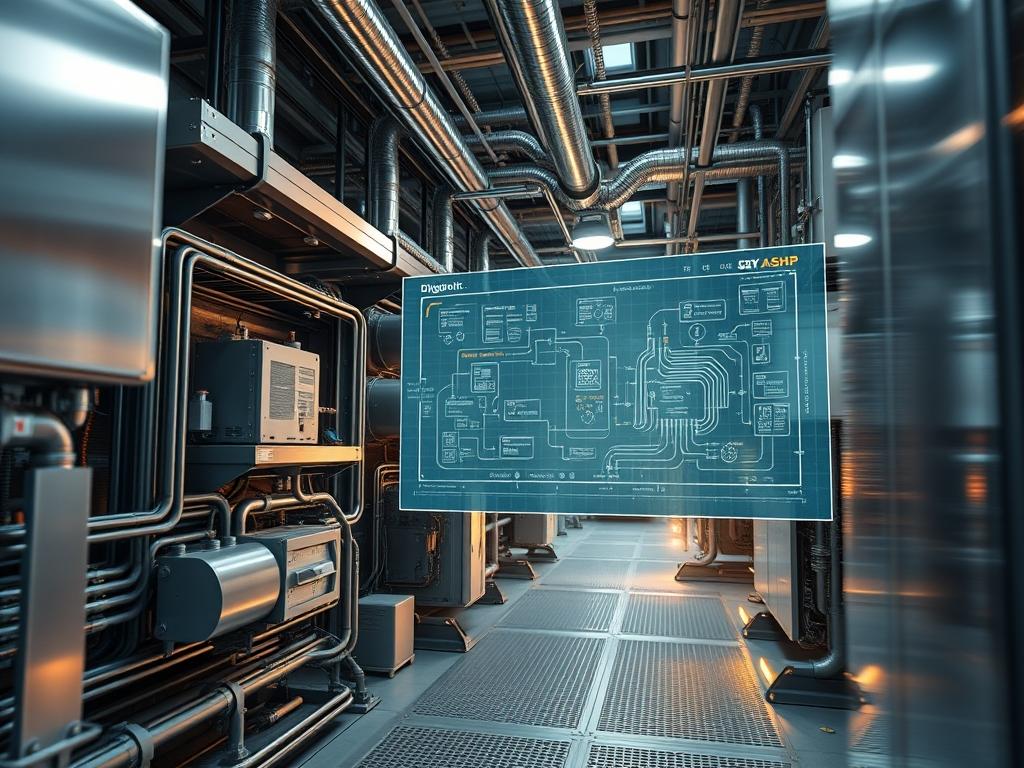
Air Source Heat Pump (ASHP) Multi Zone Split Systems represent the critical intersection of thermodynamics and distributed control systems within modern infrastructure. As building envelopes become more airtight, the requirement for high-precision thermal management shifts from bulk heating to granular, zone-specific modulation. These systems function as part of the broader energy infrastructure stack, often integrating with Building Automation Systems (BAS) via Modbus or BACnet protocols to optimize the thermal payload across diverse architectural layouts. The primary engineering challenge involves managing refrigerant flow concurrency and ensuring signal integrity across long-distance communication buses. Failure to account for the pressure drop or signal-attenuation in complex layouts leads to parasitic energy overhead and premature compressor failure. By deploying these systems, engineers solve the problem of thermal-inertia imbalances in localized environments, providing an idempotent response to external ambient fluctuations while maintaining extreme energy efficiency through inverter-driven compressor logic.
TECHNICAL SPECIFICATIONS
| Requirements | Default Port/Operating Range | Protocol/Standard | Impact Level (1-10) | Recommended Resources |
| :— | :— | :— | :— | :— |
| Refrigerant Line Length | 15m to 75m (Total) | ASTM B280 | 9 | Type L Copper / Armaflex |
| Communication Bus | 12V to 36V DC | RS-485 / Non-polar | 8 | 16/2 AWG Stranded Shielded |
| Power Supply | 208/230V Single Phase | NEC Article 440 | 10 | 30A to 50A Dedicated |
| Operating Ambient (Heat) | -15C to 24C | AHRI 210/240 | 7 | Low Ambient Wind Baffle |
| Control Logic Interconnect | Ports 1(L1), 2(L2), 3(S) | Proprietary Digital | 9 | 14/4 THHN / Shielded |
| System Vacuum Level | Below 500 Microns | HVAC Standard | 10 | Navac-Vacuum-Pump |
THE CONFIGURATION PROTOCOL
Environment Prerequisites:
Before assembly, ensure the structural substrate can support the static and dynamic loads of the Outdoor-Unit (ODU). Required dependencies include compliance with NFPA 70 (National Electrical Code) and local mechanical codes. The technician must possess a Section 608 Universal Certification for refrigerant handling. Hardware dependencies include a calibrated fluke-multimeter, a digital-manifold, and a nitrogen-regulator capable of 600 PSI. Permission sets must allow for administrative access to the Master-Controller-Interface to configure DIP switch settings for addressing.
Section A: Implementation Logic:
The engineering philosophy of ASHP Multi Zone Split Systems is based on Variable Refrigerant Flow (VRF) encapsulation. Unlike traditional single-stage systems, the multi-zone inverter compressor modulates its frequency based on the aggregate demand of all active Indoor-Units (IDU). The system treats each zone as a separate node in a distributed network. The logic controller calculates the necessary mass flow rate (throughput) by polling temperature sensors every 30 to 60 seconds. This avoids the high-latency thermal response of central air systems by delivering refrigerant directly to the point of evaporation or condensation. By managing the refrigerant state through pulse-modulated Electronic Expansion Valves (EEVs), the system maintains a high coefficient of performance even under partial load conditions.
Step-By-Step Execution
1. Architectural Zoning and Load Calculation
Determine the BTU requirements for each zone using Manual J calculations. Map the physical layout to ensure the Total-Equivalent-Length of piping does not exceed manufacturer specifications.
System Note: Accurate load calculation prevents short-cycling of the compressor; a process that increases mechanical overhead and reduces the MTBF (Mean Time Between Failure) of the Inverter-Drive-Board.
2. High-Side and Low-Side Manifold Installation
Install the Master-Manifold-Distributor or Branch-Box if the layout exceeds five zones. Connect the primary liquid and suction lines using oxygen-free brazing techniques while flowing nitrogen at 2-3 PSI through the lines.
System Note: Nitrogen displacement prevents the formation of cupric oxide inside the tubing; which if left unchecked, acts as a contaminant that can clog the EEV-Strainer and cause a high-pressure trip.
3. Communication Bus and Signal Integrity
Run 16/2-Stranded-Shielded wire from the ODU-Terminal-Block to each IDU in a daisy-chain or star topology as specified by the manufacturer. Ensure the shield is grounded only at the ODU to prevent ground loops.
System Note: Improper grounding or the use of solid-core wire increases signal-attenuation; leading to packet-loss in the serial communication between the PID-Controller and the IDU-Interface.
4. Triple Evacuation and Micron Decay Test
Connect the Navac-Vacuum-Pump to the service ports. Perform a triple evacuation: pull the system down to 1,500 microns, break with nitrogen to 5 PSI; pull to 1,000 microns, break with nitrogen; and finally pull below 500 microns.
System Note: This process ensures the removal of non-condensables and moisture; which are critical for preventing the acidification of the POE-Oil and protecting the Scroll-Compressor-Assembly.
5. Initialization and Address Mapping
Power on the system and enter the Function-Code-Menu on the ODU-Mainboard. Assign a unique hexadecimal or decimal address to each IDU. Perform a test run in “Charge-Mode” to stabilize the refrigerant state.
System Note: The idempotent nature of the addressing logic ensures that even after a power loss; the system maintains its network map without requiring a manual re-poll of the indoor nodes.
Section B: Dependency Fault-Lines:
The most frequent bottleneck in complex ASHP layouts is the Oil-Return-Logic. If an IDU is located significantly higher than the ODU, oil traps must be installed every 6 meters to prevent the compressor from running dry. Another fault-line is the Thermal-Expansion-Mismatch; where disparate zone demands cause the suction line temperature to drop too low, triggering a “freeze-protection” state that shuts down the entire local branch. Ensure that the Throughput-Balance is maintained by not exceeding 130 percent of the ODU rated capacity in total connected IDU capacity.
THE TROUBLESHOOTING MATRIX
Section C: Logs & Debugging:
Diagnostic data is typically accessed via the LED-Display on the ODU-Inverter-Board or through a connected Service-Tool-Laptop.
- Error Code E1 / F1: Communication failure. Check for DC voltage between terminals 2 and 3. If voltage fluctuates between 0V and 24V, the bus is active; if static, the Comm-Chip is likely fried.
- Error Code P4: Inverter compressor drive error. Inspect the IPM (Intelligent-Power-Module) for thermal paste degradation or capacitor swelling.
- Log Path: Access root/logs/history.csv on networked units to analyze the Superheat and Subcooling trends. Visual cues such as frosting on the Liquid-Line-Service-Valve indicate a low refrigerant payload or a restriction in the Filter-Drier.
- Sensor Verification: Use the fluke-multimeter in k-Ohm mode to test the Thermistor-Resistance. Compare values against the manufacturer’s R-T chart to identify drift.
OPTIMIZATION & HARDENING
To maximize Performance Tuning, adjust the Fan-Curve-Logic to provide higher static pressure if long duct runs are used for concealed IDUs. This increases air throughput and reduces the delta-T overhead. Implement Thermal-Inertia-Smoothing by programming the thermostats to use 0.5-degree deadbands; which prevents frequent inverter ramping and maintains a steady state.
For Security Hardening, if the ASHP is integrated into a Building-Management-System (BMS), place the HVAC gateway on a secluded VLAN. Disable any unencrypted HTTP interfaces on the Cloud-Bridge-Module and use VPN-Tunneling for remote technician access. Physically, harden the installation by installing Vibration-Isolation-Pads under the ODU to prevent structural resonance from affecting building occupants.
Scaling Logic: When expanding the system, utilize Branch-Provider-Boxes that allow for “master-slave” configurations. This enables the infrastructure to scale horizontally by adding ODU units in a lead-lag configuration; ensuring that the thermal load is distributed evenly across multiple compressors during peak demand.
THE ADMIN DESK
Q: Why is my communication bus reporting high error rates?
A: This usually stems from signal-attenuation caused by running data lines parallel to high-voltage AC lines. Ensure at least 200mm of separation or use shielded cable with the drain wire grounded at the ODU only.
Q: Can I mix different types of IDUs on one system?
A: Yes, as long as the aggregate capacity remains within the 50 percent to 130 percent window. The Inverter-Logic handles the varied payload requirements of high-wall, cassette, and ducted units concurrently.
Q: How often should the EEV strainers be checked?
A: Only during a major system breach or if the Troubleshooting-Matrix points to a localized “Refrigerant-Starvation” error. These are sealed components; opening the loop increases the risk of contamination.
Q: What is the most common cause of “P4” Inverter errors?
A: High thermal-overhead on the heat sink. Check for dust accumulation on the Inverter-Fin-Assembly or a failing DC condenser fan motor that is not providing enough airflow to cool the electronics.
Q: How does the system handle “Defrost-Latency”?
A: During cold-weather operation, the system enters a reverse-cycle defrost. It uses Thermal-Inertia from the indoor zones to melt outdoor coil ice. Ensure the Base-Pan-Heater is enabled to prevent ice-re-freezing at the drain ports.