
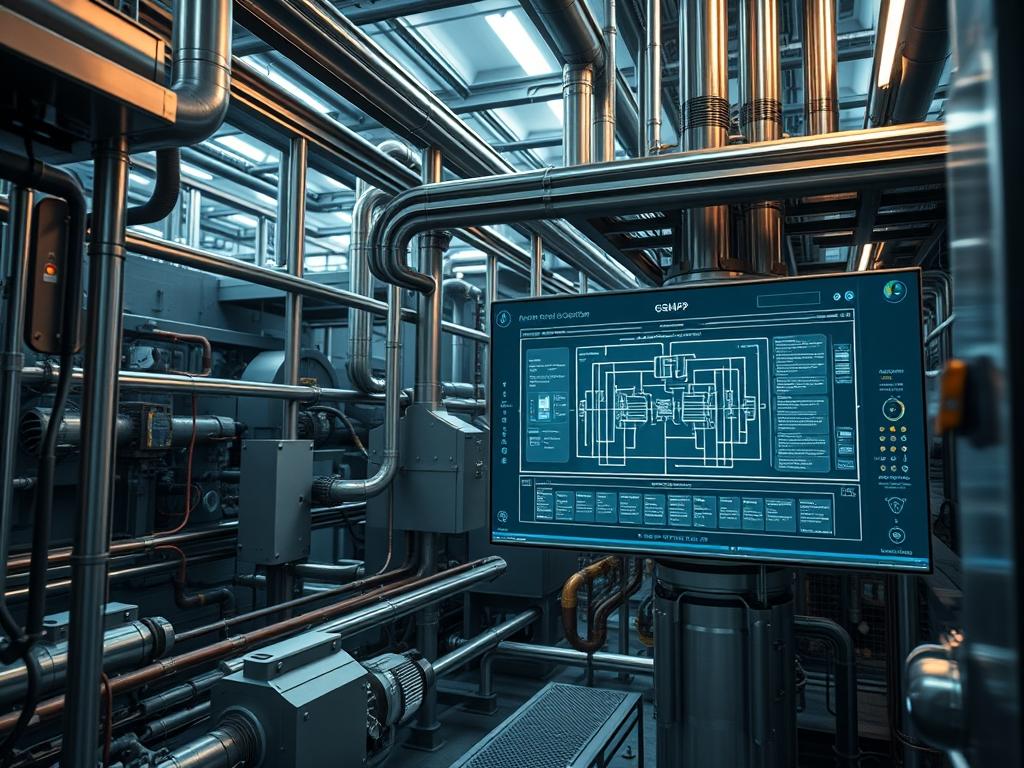
Ground Source Heat Pump (GSHP) systems represent the foundational thermal layer of sustainable infrastructure; they function as a heat exchanger between the building environment and the earth’s crust. Selecting between Closed Loop vs Open Loop GSHP configurations is a critical engineering decision that dictates long-term thermal-inertia and operational overhead. Closed loop systems utilize high-density polyethylene (HDPE) pipes buried in the ground, circulating a localized encapsulation of fluid typically consisting of water mixed with antifreeze. In contrast; open loop systems draw groundwater directly from an aquifer, pass it through a heat exchanger, and discharge it back into a separate well or surface body. This choice directly impacts the “Problem-Solution” context of facility management: open loops offer superior throughput and efficiency but face higher risks of mineral scaling and regulatory hurdles; while closed loops provide an idempotent thermal environment with minimal maintenance at the cost of higher initial drilling investments.
Technical Specifications
| Requirement | Operating Range | Protocol/Standard | Impact Level | Recommended Resources |
| :— | :— | :— | :— | :— |
| Loop Fluid Velocity | 2.0 to 4.0 FPS | ANSI/ASHRAE 13256-1 | 8 | PE4710 HDPE Piping |
| Heat Exchange Delta-T | 6F to 12F differential | NEC Article 440 | 7 | Variable Frequency Drive (VFD) |
| Groundwater Flow | 1.5 to 3.0 GPM/ton | EPA Class V Injection | 10 | Submersible Pump (1-5 HP) |
| Interface Control | -10V to +10V DC | BACnet / MODBUS | 9 | PLC / ARM Cortex-M4 |
| Thermal Conductivity | 0.8 to 1.8 Btu/hr-ft-F | IGSHPA Standards | 6 | Thermal Grout (Bentogrout) |
The Configuration Protocol
Environment Prerequisites:
Successful deployment requires a certified geotechnical survey to determine the thermal conductivity of the substrate. For open loop systems; hydrogeological reports must confirm aquifer capacity and water quality (pH, hardness, and mineral content). Hardware dependencies include NEMA 3R rated electrical enclosures for outdoor controllers; ASTM D3035 compliant piping; and a BMS (Building Management System) gateway supporting RS-485 or Ethernet connectivity. User permissions must include “Environmental Discharge” permits for open loop configurations and “Land Use” easements for horizontal closed loop fields.
Section A: Implementation Logic:
The engineering design is predicated on minimizing thermal latency. In a closed loop system; the payload of heat energy is moved through a continuous circuit. The design must account for the fluid’s specific heat capacity and the ground’s ability to dissipate or provide energy over 50-year cycles. For open loops; the logic shifts to fluid mechanics and chemistry. High throughput provides more efficient heat transfer because the “sink” (the aquifer) is constantly refreshed. However; the system must mitigate signal-attenuation in sensor data caused by mineral buildup on probe surfaces; which can lead to false readings in flow meters and thermocouples.
Step-By-Step Execution
1. Execute Site Mapping and Thermal Profiling
Utilize GIS software and LIDAR data to map the thermal field. For closed loops; mark borehole locations at 15-foot minimum intervals to prevent thermal interference. For open loops; identify the supply well and the injection well; ensuring they are separated by sufficient distance to prevent thermal “short-circuiting.”
System Note: This action initializes the physical layer of the thermal stack; ensuring the subterranean environment has the capacity to handle the projected heat load without saturating the soil’s thermal-inertia.
2. Physical Loop Installation and Grouting
Drill deep boreholes (200-500 feet) for vertical closed loops or clear the trench for horizontal configurations. Insert the U-bend HDPE pipe and immediately pump thermally enhanced grout from the bottom up using a tremie pipe.
System Note: This step establishes the primary heat exchange interface. Proper grouting is essential to eliminate air pockets which act as thermal insulators; causing high latency in heat transfer and reducing the overall Coefficient of Performance (COP).
3. Install Submersible Pump and Well Head (Open Loop Only)
Lower the submersible pump into the supply well and secure the well head with a Pitless Adapter. Install a Sand Separator or Spindown Filter before the heat exchanger to prevent particulate ingestion.
System Note: The pump acts as the “source” of the thermal payload. If the filter is restricted; the resulting packet-loss of fluid volume will trigger a low-flow shutdown in the heat pump’s internal protection logic.
4. Configure the Variable Frequency Drive (VFD)
Connect the VFD to the circulation pump motors. Access the controller via terminal using minicom or a proprietary interface. Set the ramp-up speed and the minimum frequency (typically 30Hz) to ensure motor cooling.
System Note: Running systemctl start bms-handler on the management server allows for the integration of the VFD into the global logic. The VFD modulates pump speed based on demand; significantly reducing electrical overhead during partial load conditions.
5. Loop Flushing and Purging
Use a high-volume flush cart to circulate water through the closed loop at 2 feet per second to remove air and debris. Verify that the system holds pressure by performing a hydrostatic test at 100 PSI for 60 minutes.
System Note: Trapped air in the system causes pump cavitation and erratic sensor data. This process ensures an idempotent fluid state before the introduction of glycol or other heat transfer fluids.
6. Controller Commissioning and Calibration
Connect the heat pump’s MODBUS interface to the central gateway. Calibrate the thermistors and flow meters. Use a Fluke-773 Process Meter to verify that 4-20mA signals from pressure sensors correspond accurately to the digital readouts on the BMS.
System Note: Accurate calibration prevents signal-attenuation in the feedback loop; allowing the PID (Proportional-Integral-Derivative) controllers to maintain tight temperature tolerances without oscillating.
Section B: Dependency Fault-Lines:
The most common mechanical bottleneck is the “Thermal Saturation” of the ground in improperly sized closed loops. If the extraction rate exceeds the ground’s recovery rate; the thermal-inertia is depleted; leading to system failure during peak seasons. In open loop systems; “Well Fouling” due to iron bacteria or calcium carbonate is the primary fault-line. These biological and chemical payloads can physically bridge the gaps in brazed plate heat exchangers; leading to a total loss of throughput.
THE TROUBLESHOOTING MATRIX
Section C: Logs & Debugging:
When a fault occurs; check the system logs located at /var/log/hvac/thermal-main.log or the local controller’s diagnostic screen.
- Error Code 0x01 (Low Flow): Check for a tripped circuit breaker on the pump or a clogged filter. In open loops; this often indicates a failing well pump or a dropping water table.
- Error Code 0x04 (High Pressure): Usually signifies a failure in the heat rejection side. For closed loops; verify that the loop circulator is active. In open loops; inspect the injection well for back-pressure issues.
- Packet-Loss Metaphor: If the BMS reports fluctuating pressures; it is likely air ingestion. Inspect all suction-side fittings.
- Sensor Drift: If the delta-T between the Entering Source Temperature (EST) and Leaving Source Temperature (LST) is less than 4F; the heat exchanger is likely fouled; or the flow rate is excessively high; resulting in low energy capture.
OPTIMIZATION & HARDENING
Performance Tuning:
To maximize efficiency; adjust the VFD logic to maintain a constant differential pressure rather than a constant speed. This allows the system to scale concurrency in multi-zone layouts. Tuning the PID coefficients for the pump speed can reduce energy consumption by up to 30 percent while maintaining optimal throughput for the refrigerants.
Security Hardening:
Industrial systems are vulnerable via the BACnet layer. Ensure the BMS is behind a hardware firewall and that all MODBUS traffic is segmented into a private VLAN. Disable unused ports (e.g.; Telnet, FTP) on the gateway controller. Use physical locks on the well head and manifold vaults to prevent unauthorized access or tampering with the loop integrity.
Scaling Logic:
Closed loops scale through “Modular Field Expansion.” New boreholes are added in parallel to the existing manifold to increase the total thermal-inertia. Open loops scale through “Well Clustering;” however; this requires complex hydrologic modeling to ensure that the “Cone of Depression” from multiple supply wells does not cause localized aquifer depletion or ground subsidence.
THE ADMIN DESK
Q: Can I use an open loop system with saltwater?
Saltwater requires a cupro-nickel or titanium heat exchanger to resist corrosion. Normal stainless steel components will experience rapid degradation and failure. The payload of corrosive ions necessitates specialized metallurgy.
Q: Why is my closed loop pressure dropping in winter?
Small pressure drops are normal due to the thermal contraction of the HDPE and the fluid. However; significant loss indicates a leak in the manifold or a failure in the fusion joints.
Q: How often should I check open loop filters?
In open loop systems; filter maintenance is not idempotent. High-sediment aquifers may require weekly inspections; while clean wells may only need quarterly checks. Use a pressure differential gauge to automate alerts.
Q: What is the benefit of a hybrid closed loop?
Hybrid systems integrate a cooling tower or boiler to handle peak loads. This reduces the total drilling overhead by allowing the ground loop to be sized for the base load rather than the extreme peak.
Q: Can I use a pond as an open loop?
Ponds are generally configured as closed loops using “Slinky” coils submerged at the bottom. True open loop pond systems (draw and dump) are rare due to the high risk of biological foulants entering the equipment.