
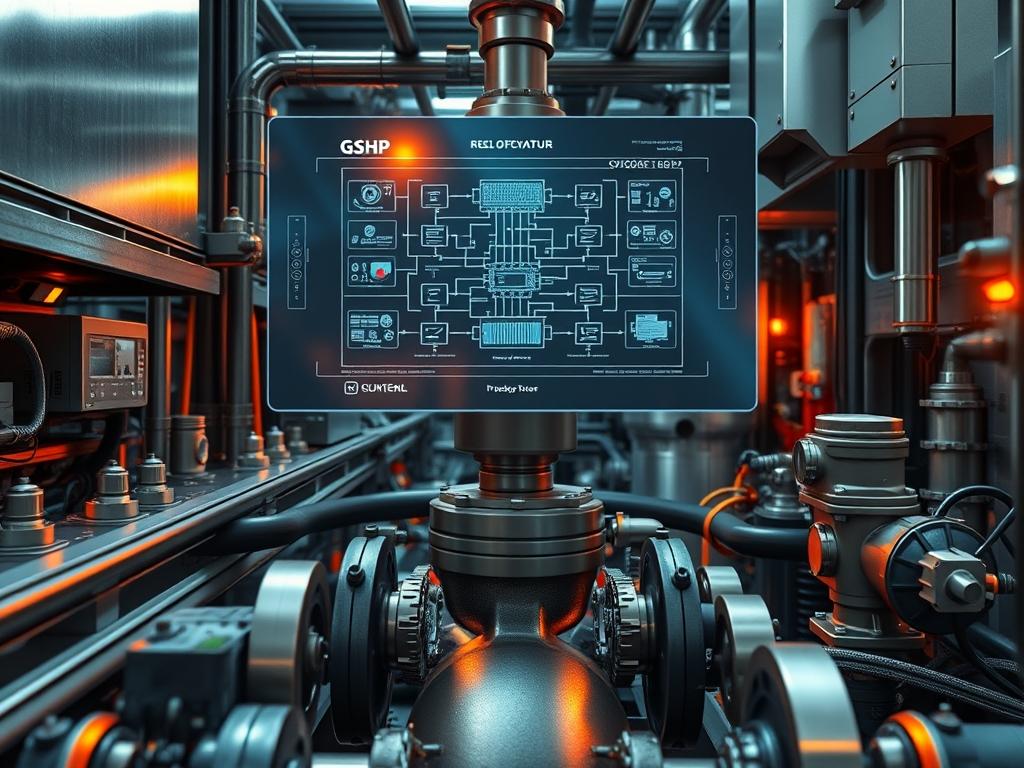
Ground source heat pump (GSHP) systems represent a cornerstone of sustainable thermal management within modern industrial and residential infrastructure. The GSHP Reversing Valve Operation is the critical mechanism that enables a single system to provide both heating and cooling by redirecting the flow of refrigerant. This operation effectively swaps the functions of the internal and external heat exchangers; the evaporator becomes the condenser, and vice versa. Within a large scale technical stack, the reversing valve serves as the physical toggle between seasonal load profiles. Its management is not merely a mechanical task but a complex orchestration of electrical signaling, fluid dynamics, and thermodynamic state changes. Ensuring the reliability of this component is essential for preventing downtime in climate controlled environments such as data centers or medical facilities. When the system initiates a seasonal shift, it must overcome significant thermal inertia and high pressure differentials to ensure a smooth transition without compromising the compressor unit.
Technical Specifications
| Requirement | Default Port/Operating Range | Protocol/Standard | Impact Level (1-10) | Recommended Resources |
| :— | :— | :— | :— | :— |
| Control Voltage | 24VAC / 24VDC | NEC Class 2 | 9 | Min 40VA Transformer |
| Refrigerant Type | R-410A / R-454B / R-32 | ASHRAE 34 | 10 | Type K Hard Copper |
| Max Operating Pressure | 450 PSI to 650 PSI | UL 60335-2-40 | 8 | Schedule 80 Fittings |
| Logic Signal | O (Cooling) / B (Heating) | IEEE 802.15.4 (BAS) | 7 | 18AWG Shielded Wire |
| Terminal Resistance | 12 to 60 Ohms (Coil) | IEC 60335 | 6 | Logic-Controller I/O |
The Configuration Protocol
Environment Prerequisites:
Successful GSHP Reversing Valve Operation requires a stabilized ground loop with a verified flow rate of at least 3 gallons per minute per ton. All electrical connections must adhere to NEC Article 440 standards. The operator must possess a valid EPA 608 certification if refrigerant charge adjustments are required. Logic controllers, such as a Honeywell-T775 or a Siemens-Desigo-PX, must be updated to the latest firmware to support specific solenoid dwell times and prevent short cycling.
Section A: Implementation Logic:
The engineering design of a reversing valve utilizes a four-way pilot-operated sliding mechanism. The “Why” behind this design is the need for an idempotent state change under high-pressure conditions. The valve does not rely solely on the electromagnetic force of the solenoid to move the main slide. Instead, the solenoid triggers a small pilot valve that creates a pressure differential between the two ends of the main slide. The high-pressure discharge gas from the compressor-output then pushes the slide to the desired position. This method ensures that the valve can shift even when significant friction or pressure is present. During a seasonal shift, the system must manage the payload of latent heat within the refrigerant. Transitioning too quickly can lead to liquid slugging at the suction-side-accumulator, which threatens the mechanical integrity of the compressor.
Step-By-Step Execution
1. Verification of Logic Signal Output
Access the Building-Automation-System-Terminal and force a seasonal mode change. Use a fluke-multimeter to measure the voltage across the O/B-terminals at the heat pump control board.
System Note: This action confirms that the central kernel of the HVAC logic is successfully dispatching the actuation command to the physical layer. If voltage is absent, the issue resides in the software logic or the wiring harness.
2. Monitoring Solenoid Coil Impedance
Disconnect the leads to the reversing-valve-solenoid-coil and measure the resistance. A reading of “OL” indicates an open circuit, while a reading near zero indicates a short.
System Note: Measuring the impedance ensures the electromagnetic driver is capable of actuating the pilot valve. This prevents a “No-Shift” condition where the system attempts to heat while the valve remains in the cooling position.
3. Pressure Equalization and Transition
Observe the high-side-pressure-gauge and low-side-pressure-gauge as the valve shifts. There should be a momentary equalization of pressures as the slide traverses the center position.
System Note: The transition phase allows for the redistribution of the refrigerant payload. A failure to see a momentary dip in the discharge pressure suggests that the slide is physically stuck or the pilot capillary tubes are obstructed by debris.
4. Thermal Delta-T Validation
Check the temperature of the liquid-line and the suction-line using a dual-input-thermometer. Verify that the temperature gradient has inverted compared to the previous seasonal state.
System Note: This validates the actual thermodynamic output. It confirms that the GSHP Reversing Valve Operation has successfully reconfigured the heat exchangers, ensuring that the thermal-inertia of the ground loop is being utilized correctly for the new season.
Section B: Dependency Fault-Lines:
Mechanical bottlenecks often occur due to “stuck” valves during the first seasonal shift of the year. This is frequently caused by the migration of compressor oil or particulate matter into the pilot tubes. Another common failure is signal-attenuation in long runs of unshielded 24V wiring, where induced EMF from high-voltage lines interferes with the solenoid signal. Additionally, a low refrigerant charge can prevent the pressure differential required to move the slide, resulting in a system that “hisses” but never completes the shift.
THE TROUBLESHOOTING MATRIX
Section C: Logs & Debugging:
When analyzing failures, begin by reviewing the error-log-history in the local controller. Look for codes such as “H-5” (High Pressure Trip) or “L-4” (Low Delta-T).
- Error Code: RE-VALVE-FAIL: This indicates the logic controller detected a temperature rise on the suction line during a cooling call. Check the solenoid-coil-voltage and physical debris in the pilot-lines.
- Path for Logs: On most Linux based BAS, logs can be found at /var/log/hvac/reversing_valve.log. Use the command tail -f /var/log/hvac/system.log | grep “RV” to monitor real time actuation.
- Visual Cues: A frosted suction line during a heating call indicates the valve is stuck in the cooling position; conversely, a hot suction line during a cooling call suggests the valve is stuck in the heating position.
- Acoustic Analysis: A loud “clunk” followed by a steady “whoosh” is normal. A continuous “hissing” without a mode change indicates a leaking internal slide or a failed pilot seat.
OPTIMIZATION & HARDENING
Performance Tuning: To maximize throughput and efficiency, implement a “Soft-Shift” delay. Program the micro-controller to shut down the compressor for 180 seconds before the reversing valve actuates. This allows pressures to equalize naturally, reducing the mechanical stress on the valve slide and extending its service life. Minimize latency in the control loop by ensuring the thermistor-sampling-rate is set to a 30-second interval.
Security Hardening: Secure the physical 24V control lines within EMT-conduit to prevent tampering or accidental severing. At the network level, ensure that the BACnet-IP-Gateway is behind a robust firewall. Restrict write access to the “Seasonal Changeover” object to high-level administrative credentials only; this prevents unauthorized users from cycling the valve repeatedly, which could lead to compressor overheat.
Scaling Logic: In large-scale installations with multiple GSHP units (e.g., a “Heat Pump Forest”), implement a staggered start-up sequence. Instead of shifting all 50 units simultaneously, use a concurrency-limit-logic to shift units in blocks of five. This prevents massive surges in electrical demand and stabilizes the ground loop fluid temperature, preventing thermal shock to the system.
THE ADMIN DESK
How do I test the valve without a thermostat?
Jump the R-terminal to the O-terminal (or B) directly on the defrost board using a jumper wire. This bypasses the software stack to test the physical solenoid and slide. System Note: Keep the compressor off to avoid high pressure spikes.
Why does my valve shift back to heating every night?
Check the “Fail-Safe” configuration. Most valves default to heating (B-type) if the solenoid-coil loses power. A faulty transformer or a loose wire in the 24V circuit will cause the valve to drop back to its “Normally Closed” state.
What is the “Hissing” sound during a shift?
That is the sound of high-pressure discharge gas bypassing into the low-pressure suction side through the valve ports. It should be temporary. If it persists, the internal slide has likely failed to seat, causing a massive loss in volumetric efficiency.
Can I replace just the solenoid coil?
Yes, if the internal slide is functioning. Unscrew the retaining nut on the reversing-valve-assembly and swap the electromagnetic-coil. This is a non-invasive procedure that does not require recovering the refrigerant or cutting any copper lines.
Is there a way to unstick a valve manually?
While the system is running, briefly tap the body of the valve with a plastic mallet while cycling the O/B-signal. The vibration, combined with the pressure differential, can sometimes dislodge a slide that is stuck due to oil sludge or fine particulates.