
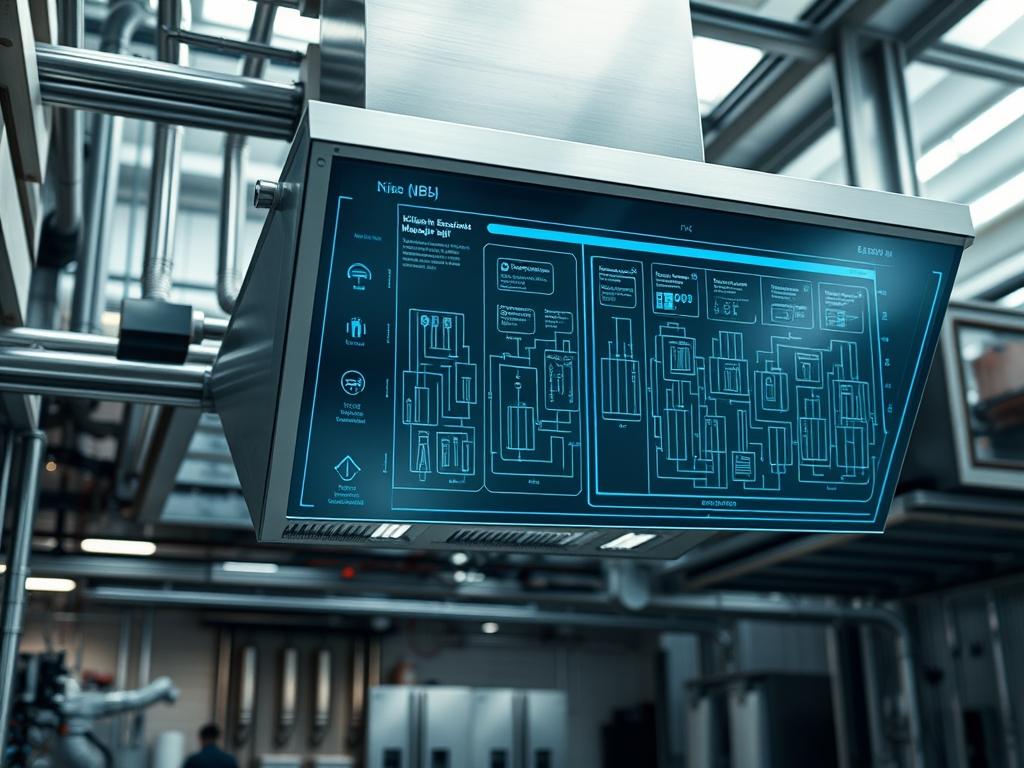
Kitchen Exhaust Hood Makeup Air systems represent the critical balancing component within the mechanical infrastructure of commercial kitchen environments. Their primary function is to replace the air volume extracted by high-velocity commercial exhaust systems; this maintains a controlled pressure differential between the kitchen and adjacent occupancy zones. Within the technical stack of building energy and environmental services; the makeup air unit (MAU) serves as the primary ingress point for treated or untreated fresh air. It mitigates the systemic risks of backdrafting in atmospheric-vented gas appliances; prevents the infiltration of unfiltered air through structural gaps; and ensures the thermal-inertia of the space remains stable during peak operational cycles. In heavy-duty cooking applications; the payload of the exhaust stream contains significant grease particulates and thermal energy; necessitating a precise replacement strategy where the makeup air volume typically reflects 80 to 90 percent of the total cubic feet per minute (CFM) of the exhaust. Failure to implement a robust solution results in excessive negative pressure; leading to door-swing hazards; smoke-capture failures; and increased latency in the response of the primary building HVAC system.
TECHNICAL SPECIFICATIONS (H3)
| Requirement | Operating Range / Port | Protocol / Standard | Impact Level | Resources / Materials |
| :— | :— | :— | :— | :— |
| Airflow Volume | 500 – 15,000 CFM | NFPA 96 | 10 | G90 Galvanized Steel |
| Control Signal | 0-10V DC / 4-20mA | Modbus RTU / BACnet | 8 | 18/2 Shielded Cable |
| Static Pressure | 0.05″ to 0.15″ WC | ASHRAE 62.1 | 9 | Differential Transducer |
| Network Node | Port 47808 | BACnet/IP | 6 | ARM-based Controller |
| Interlock Logic | 24V AC/DC | NEC Class 2 | 10 | Magnetic Contactor |
| Thermal Range | -20F to 100F | AMCA 210 | 7 | Indirect Gas Fired Burner |
THE CONFIGURATION PROTOCOL (H3)
Environment Prerequisites:
1. Compliance with NFPA 96 for ventilation control and grease removal.
2. Hardwired interlock between the Exhaust Fan Starter and the Makeup Air Unit (MAU) VFD.
3. Installation of a Current Sensing Relay (CSR) on the exhaust motor load side.
4. Access to a Linux-based Building Automation System (BAS) with systemctl privileges for managing local control services if utilizing a digital gateway.
5. Calibrated Differential Pressure Transducer installed with the high-pressure port sensing the kitchen atmosphere and the low-pressure port sensing the exterior or reference zone.
Section A: Implementation Logic:
The engineering design of Kitchen Exhaust Hood Makeup Air relies on the principle of volumetric conservation. Because the exhaust fan operates as a constant or variable mass flow extractor; the makeup air system must function in an idempotent manner; ensuring that for every cubic foot of air removed; a corresponding and slightly lower volume is introduced. This creates a controlled negative pressure environment. The logic-controllers manage the ramp-up speed of the Variable Frequency Drive (VFD) to match the exhaust demand. By utilizing a proportional-integral-derivative (PID) loop; the system minimizes the latency between the moment the cook initiates the exhaust and the point of air replacement. This prevents “slugs” of cold air from entering during winter cycles; preserving the thermal-inertia of the kitchen.
Step-By-Step Execution (H3)
1. Initialize VFD Parameters and Comm-Port
Connect the fluke-multimeter to the control terminals of the VFD to verify the 24V power supply. Access the drive’s internal menu and set the control source to Terminal or Modbus depending on the integration path.
System Note: This action sets the hardware kernel of the motor controller to listen for external voltage signals or data packets; rather than local keypad commands.
2. Configure Interlock Logic on logic-controllers
On the PLC or Universal Controller; map the input from the Current Sensing Relay (CSR) to the Exhaust_Status variable. Write a script to trigger the MAU_Start command whenever Exhaust_Status is TRUE.
System Note: The interlock ensures the makeup air is dependent on the exhaust flow; preventing the kitchen from becoming pressurized; which would force grease-laden vapors into the dining area.
3. Establish PID Loop for Pressure Differential
Define the setpoint at -0.02″ WC (Water Column). Map the 0-10V input from the Pressure Transducer to the Process_Variable. Tune the P-gain and I-gain to prevent oscillation during fan ramp-up.
System Note: Tuning the PID loop reduces signal-attenuation in the mechanical response; ensuring the through-put of air matches the extraction rate without overshooting the pressure target.
4. Deploy BAS Monitoring Service
On the building management gateway; use sudo systemctl start bas-collector.service to initiate data logging of the air balance. Verify that BACnet objects are discovering the new MAU node on the network.
System Note: This command initiates the background daemon responsible for telemetry; allowing the auditor to track the concurrency of exhaust and supply cycles over time.
5. Calibrate Thermal-Payload Discharge
Adjust the Gas Modulating Valve or SCR-controlled Electric Heater to maintain a discharge air temperature (DAT) of 65F. Check the Burner Controller for any flame-rectification errors using a micro-ammeter.
System Note: Managing the payload of the heating section prevents the incoming air from stripping thermal energy from the kitchen’s ambient environment; which reduces the strain on the primary HVAC.
Section B: Dependency Fault-Lines:
Electronic interference on the 0-10V signal line often causes “chatter” in the VFD; this is typically due to a lack of shielded cabling or improper grounding. If the Modbus communication fails; verify the baud-rate and parity settings on the logic-controller; mismatches here lead to massive packet-loss and system timeouts. Mechanically; a common bottleneck is the clogging of the Inlet Filters on the MAU; which increases the static pressure overhead and forces the fan to work outside its calibrated efficiency curve.
THE TROUBLESHOOTING MATRIX (H3)
Section C: Logs & Debugging:
When the system fails to maintain pressure; the lead architect must examine the syslog or the BAS Alarm Console for specific fault codes.
1. Error: “Static Pressure Low Bound”: This indicates the MUA is not providing enough air. Check the VFD for an “Overcurrent” or “Phase Loss” fault. Verify the Belt Tension on the centrifugal blower.
2. Error: “Interlock Latency Timeout”: The MAU failed to start within 30 seconds of the exhaust fan. Inspect the Current Sensing Relay on the exhaust fan circuit; verify the trip threshold is set below the motor’s idle amperage.
3. Log Path: /var/log/bas/mau_controller_debug.log. Search for “Timeout” or “NaN” values in the sensor readouts. If the sensor returns 4mA or 0V consistently; the Signal Wire is likely severed or the Transducer has lost its 24V excitation voltage.
4. Physical Cue: If the kitchen doors are difficult to open; the negative pressure is excessive. Inspect the Intake Dampers to ensure they are fully retracted. Signal-attenuation in the sensor line may be reporting a “False Positive” for pressure; calibrate the Transducer using a handheld Manometer.
OPTIMIZATION & HARDENING (H3)
– Performance Tuning: To maximize throughput and minimize energy overhead; implement a Demand Control Ventilation (DCV) strategy. Use Optical Sensors or Temperature Probes in the hood duct to detect actual cooking activity. Adjust the VFD frequency dynamically; reducing air volume during prep hours to save on heating and cooling costs. This approach optimizes the thermal-inertia of the building by avoiding unnecessary air exchange.
– Security Hardening: Ensure all logic-controllers are isolated from the public internet. Change default BACnet device IDs and passwords. Configure the Firewall on the BAS gateway to only allow traffic from known MAC addresses of the maintenance workstations. Implement a physical fail-safe where a Fire Suppression System activation immediately cuts power to the MAU via a Shunt Trip Breaker to avoid feeding oxygen to a potential flame.
– Scaling Logic: When expanding the kitchen with additional hoods; use a Global Pressure Reference. Instead of individual MUAs for every hood; utilize a large-scale Dedicated Outdoor Air System (DOAS) that communicates via a common RS-485 bus. This allows for higher concurrency in airflow management and reduces the total equipment footprint.
THE ADMIN DESK (H3)
FAQ 1: Why is the MUA fan vibrating during startup?
This is often caused by the fan operating in a “Stall” condition due to high static pressure. Check that the Fire Dampers are open and the Intake Filters are clear. Ensure the VFD ramp-up time is set to at least 15 seconds.
FAQ 2: Can I run the exhaust without the Makeup Air?
Technically possible but highly discouraged. Doing so creates massive negative pressure; which can pull sewer gases through floor drains or cause backdrafting of water heaters. The interlock should prevent this state by design.
FAQ 3: How does the system handle extreme humidity?
High-end MUAs utilize a Dehumidification Cycle or a Desiccant Wheel. In basic units; the thermal-payload of the cooling coil must be sufficiently sized to reach the dew point and remove latent heat from the intake air.
FAQ 4: What is the ideal pressure for a commercial kitchen?
The industry standard is a slightly negative pressure; typically between -0.01″ and -0.05″ WC relative to the dining room. This ensures odors are encapsulated within the kitchen while preventing the building from becoming a vacuum.
FAQ 5: Is it normal for the MAU to shut off during a fire alarm?
Yes. Modern codes require the MAU to shut down to prevent the introduction of fresh oxygen into a fire zone. This is achieved via a dedicated contact on the Fire Alarm Control Panel wired to the MAU safety circuit.