
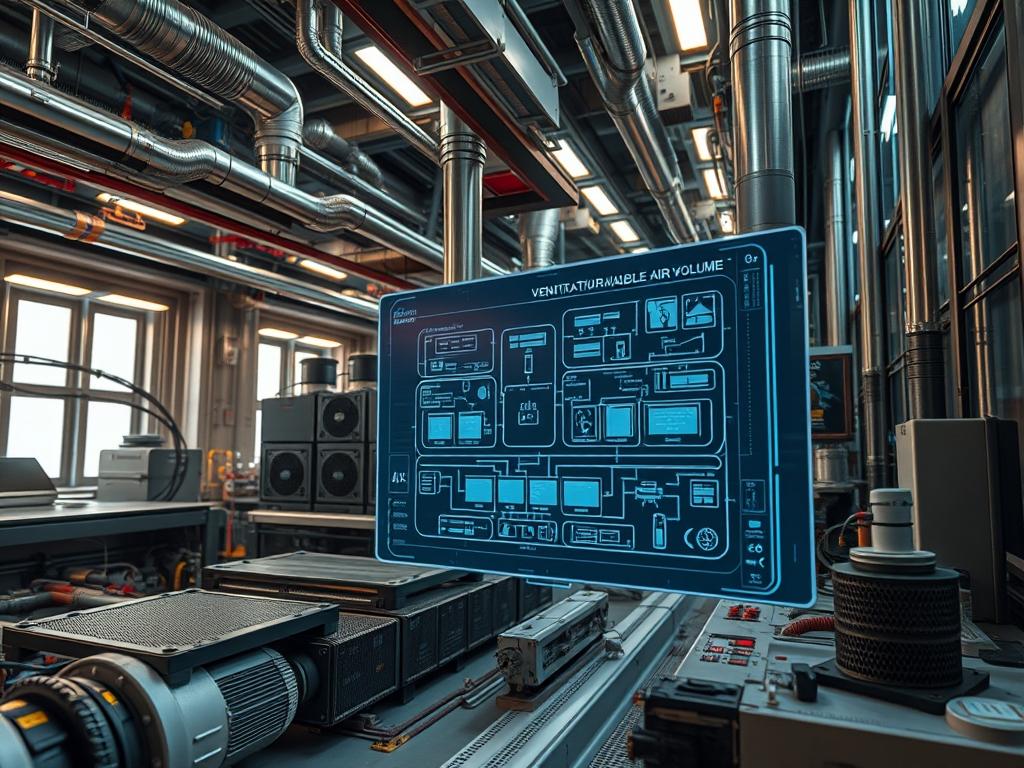
Ventilation Variable Air Volume (VAV) systems represent the primary mechanism for regulating thermal delivery and indoor air quality within high performance infrastructure environments. Unlike traditional Constant Air Volume (CAV) architectures that rely on binary operation or manual dampers; VAV systems utilize sophisticated logic controllers to modulate air throughput based on real time telemetry. This technology functions as the physical layer load balancer for climate control; it optimizes the distribution of conditioned air (the payload) across various zones (the endpoints) to minimize energy overhead while maintaining tight tolerances for atmospheric stability. In the context of large scale systems architecture, VAV integration is not merely a mechanical task: it is a data driven optimization problem. The goal is to synchronize central air handling unit (AHU) output with localized demand to prevent static pressure buildup and minimize signal attenuation in the thermal distribution network. This manual provides the technical framework for scaling these systems within a robust, enterprise grade infrastructure.
TECHNICAL SPECIFICATIONS
| Requirement | Default Operating Range | Protocol/Standard | Impact Level (1-10) | Recommended Resources |
| :— | :— | :— | :— | :— |
| Duct Static Pressure | 0.5 to 2.5 inches w.c. | ASHRAE 90.1 | 9 | High-Torque Actuator |
| Data Communication | 9600 to 115200 bps | BACnet/Modbus | 7 | Shielded Twisted Pair |
| Power Supply | 24VAC (Class 2) | IEEE/NEC 70 | 8 | 40VA Transformer |
| Flow Logic | 0 to 100% Modulation | PID Control Loop | 10 | 32-bit Logic Controller |
| Signal Input | 0 to 10 VDC / 4-20 mA | Analog/Digital | 6 | 18 AWG Minimum |
THE CONFIGURATION PROTOCOL
Environment Prerequisites:
Implementation requires adherence to ASHRAE Standard 62.1 for ventilation rates and ASHRAE 90.1 for energy efficiency. All electrical terminations must comply with NEC Class 2 circuit requirements. Software requirements include a Building-Management-System (BMS) interface with support for BACnet/IP or MSTP (Master-Slave/Token-Passing) protocols. The hardware must be provisioned with a dedicated Micro-Controller-Unit (MCU) capable of executing floating point arithmetic for complex flow calculations.
Section A: Implementation Logic:
The theoretical foundation of Ventilation Variable Air Volume scaling is rooted in the “Pressure Independent” control logic. In older architectures, the flow rate through a terminal unit was dependent on the duct static pressure; however, modern VAV units utilize a Flow-Cross-Sensor to measure the actual velocity pressure. This measurement is converted into a volumetric flow rate (CFM) using the formula: Area K-Factor sqrt(Velocity-Pressure). By decoupling the local flow from the main trunk pressure, we ensure that the system response is idempotent. Any change in the central AHU fan speed does not cause an unintended surge or drop in individual zones. The logic controller maintains a setpoint by continuously adjusting the Damper-Actuator position via a Proportional-Integral-Derivative (PID) loop. This approach mitigates thermal inertia and ensures that the throughput is precisely matched to the current latent and sensible heat loads of the zone.
Step-By-Step Execution
1. Initialize Controller Registry and Identity
Assign a unique BACnet-Object-ID and MAC-Address to each VAV-Terminal-Unit. This step ensures that the central supervisor can address each node without packet collisions on the RS-485 or Ethernet bus.
System Note: This action establishes the network identity at the data link layer; it prevents address conflicts that could lead to intermittent packet loss during discovery.
2. Calibrate Velocity Pressure Transducer
Connect a fluke-multimeter and a digital manometer to the Flow-Sensor-Ports. Zero the sensor while the air handler is in a state of zero-flow to eliminate atmospheric offset. Once zeroed; command the damper to a 100% open position and verify the maximum throughput against the design specifications.
System Note: High accuracy at the sensor level is critical; signal attenuation or sensor drift can cause the PID loop to oscillate, leading to mechanical fatigue of the Damper-Shaft.
3. Configure PID Loop Parameters
Access the controller configuration via the bms-console or a local serial connection. Set the Proportional-Gain (Kp) to a value that provides a rapid response, the Integral-Time (Ti) to eliminate steady state error, and the Derivative-Rate (Td) to dampen overshoot.
System Note: Incorrect PID tuning creates a “hunting” effect where the actuator over-modulates; this increases the latency of the thermal response and degrades the lifespan of the Belimo-Actuator.
4. Establish Static Pressure Reset Logic
Implement a global logic block in the Central-Plant-Controller that polls all VAV-Damper-Positions. If all dampers are below 70% open, the system must trigger a systemctl-restart-fan-logic to lower the VFD (Variable Frequency Drive) speed.
System Note: This strategy, known as Static Pressure Reset, reduces the system overhead by ensuring the central fan only works hard enough to satisfy the most demanding zone.
5. Validate Fail-Safe Operational Modes
Configure the Damper-Actuator to a “Fail-Open” or “Fail-Closed” state according to the life safety requirements of the facility. Use the chmod-config-secure equivalent in the firmware to lock the safety parameters.
System Note: In the event of a power loss or signal failure; the physical asset must default to a state that prevents duct over-pressurization or smoke accumulation.
Section B: Dependency Fault-Lines:
Software conflicts frequently arise when BACnet-Broadcast-Messages overwhelm a congested MSTP segment. This “Broadcast Storm” can lead to high latency in damper response. Mechanically, the primary bottleneck is often “Damper-Binding,” where physical debris or poor installation causes the Actuator-Torque to exceed its limit. System architects must also watch for “Starvation,” which occurs when the central AHU cannot maintain the duct static pressure required by the furthest downstream VAV-Box. This is a scaling failure often caused by adding more zones than the fan’s Brake-Horsepower (BHP) can support.
THE TROUBLESHOOTING MATRIX
Section C: Logs & Debugging:
When a zone fails to reach the setpoint, the first diagnostic step is to inspect the BMS-Error-Logs at /var/log/hvac/vav_errors.log. Look for error strings such as ERR_FLOW_DEVIATION_HIGH or SIGNAL_INPUT_OUT_OF_RANGE.
– Error Code 0x01 (No Communication): Inspect the RS-485-Bus for a short circuit or reversed polarity. Check the End-of-Line (EOL) resistor; its absence causes signal reflection.
– Error Code 0x04 (Low Flow Limit): Physically inspect the Flow-Probe for dust accumulation or disconnected Polyurethane-Tubing.
– Visual Cues: A rapidly oscillating damper indicator on the VAV-Shell suggests the Kp value is too high in the PID configuration.
– Reboot Protocol: If the controller becomes unresponsive; use the system-reset-button to clear the volatile memory and reload the configuration from the EEPROM.
OPTIMIZATION & HARDENING
Performance Tuning:
To optimize throughput, implement Deadband-Logic of +/- 1.0 degree Fahrenheit. This prevents the system from reacting to minute, insignificant temperature fluctuations, thereby reducing Actuator-Cycles. Use Cascaded-Control for zones with high thermal inertia; where the temperature loop provides a flow setpoint to the inner flow loop, ensuring rapid stabilization during high occupancy events.
Security Hardening:
The BMS network should be physically and logically air-gapped from the corporate LAN. Use a Stateful-Inspection-Firewall to allow only Port-47808 (BACnet) and Port-502 (Modbus) traffic. Hardening the controller involves disabling unused services like Telnet or FTP and implementing MAC-Address-Filtering on the management switch. Ensure all Field-Bus-Wires are in grounded conduit to prevent Electromagnetic-Interference (EMI) from corrupting the analog signals.
Scaling Logic:
As the infrastructure expands, transition from MSTP (serial) to BACnet-over-IP. This allows for a hierarchical network topology where local IP-based controllers aggregate data from serial sub-networks. This encapsulation of data reduces the collision domain and allows for massive concurrency. Use a BBMD (BACnet-Broadcast-Management-Device) to manage cross-subnet communication, ensuring that the global scaling does not degrade the latency of individual zone responses.
THE ADMIN DESK
Why is my VAV box whistling?
This usually indicates high static pressure or a leaking Damper-Seal. The velocity of the air is exceeding the acoustic threshold of the terminal unit. Check the Static-Pressure-Setpoint in the AHU logic and lower it if possible.
How do I fix “Hunting” actuators?
Hunting is caused by aggressive PID gains. Lower the Proportional-Gain and increase the Integral-Time. This slows the response but increases stability; ensuring the actuator does not oscillate around the setpoint and wear out the gears.
What is the K-factor for?
The K-Factor is a constant unique to the size and shape of the VAV-Inlet. It calibrates the velocity pressure sensor to the actual volumetric flow. Without a correct K-factor; the reported CFM is mathematically invalid.
Can I run BACnet over Wi-Fi?
While possible, it is not recommended for critical infrastructure due to signal attenuation and latency. Hardwired Twisted-Pair or Ethernet remains the gold standard for high availability Ventilation Variable Air Volume systems where reliability is the priority.
What does “Pressure Independent” mean?
It means the VAV-Controller uses a dedicated flow sensor to maintain the CFM setpoint regardless of fluctuations in the main duct pressure. This provides idempotent control, preventing upstream changes from affecting the local zone’s atmospheric stability.