
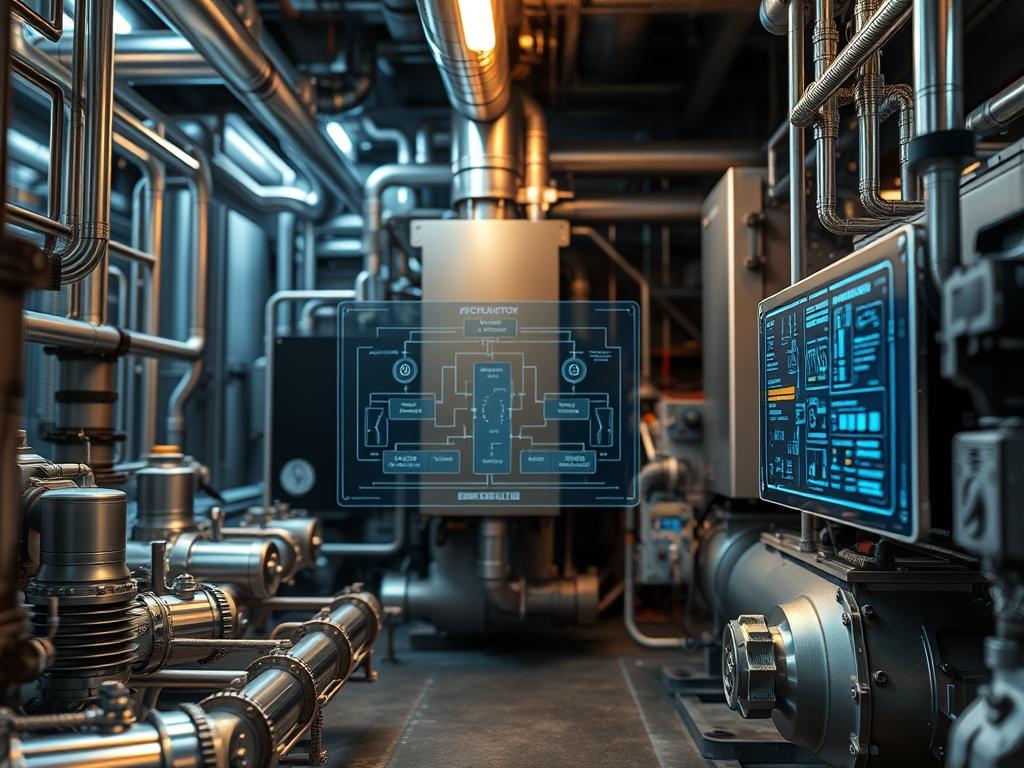
Compressor Heat Recovery Logic constitutes a sophisticated intersection of thermodynamic reclamation and automated process control. In modern industrial infrastructures; specifically those managing high-capacity air or gas compression; over 90 percent of electrical energy input is converted into thermal waste. By implementing a standardized logic framework for heat recovery, engineers can redirect this byproduct into secondary heating loops, boiler pre-heating systems, or facility-wide climate control. This logic exists within the Supervisory Control and Data Acquisition (SCADA) layer: bridging the gap between physical mechanical assets and the digital energy management stack. The core problem this technology addresses is the systemic inefficiency of air compressors that lack thermal-inertia management. Without precise Compressor Heat Recovery Logic, heat energy is vented into the atmosphere via cooling towers or exhaust fans, representative of massive operational overhead. By capturing this energy, organizations reduce their carbon footprint and lower the net demand on local power grids; creating an idempotent thermal cycle where the waste of one process fuels the requirements of another.
Technical Specifications
| Requirement | Default Port/Operating Range | Protocol/Standard | Impact Level (1-10) | Recommended Resources |
| :— | :— | :— | :— | :— |
| PLC Interface | Port 502 (Modbus/TCP) | IEC 61131-3 | 9 | 512MB RAM / Dual Core CPU |
| Thermal Sensors | -40C to 250C Range | 4-20mA Current Loop | 10 | Class A RTD / PT100 |
| Communication | IEEE 802.3 (Ethernet) | OPC UA / MQTT | 7 | CAT6a Shielded Cabling |
| Coolant Rate | 10 to 150 GPM | ANSI/ISA S5.1 | 8 | Flow-meter Grade Industrial |
| Valve Control | 24VDC PWM | Modbus RTU / RS-485 | 9 | 18AWG Twisted Pair |
The Configuration Protocol
Environment Prerequisites:
Implementation requires a controlled environment with specific hardware and firmware dependencies. All Programmable Logic Controllers (PLCs) must run firmware versions compliant with IEC 61131-3 standards. The physical infrastructure must permit the installation of a secondary oil-to-water or air-to-water heat exchanger within the compressor’s internal lubricant circuit. User permissions for the control interface must be set to LEVEL_4_ADMIN to modify PID_VARIABLES. Furthermore; the network must support VLAN_TAGGING to isolate industrial traffic from enterprise data, ensuring no packet-loss occurs during high-frequency polling cycles of the thermal sensors.
Section A: Implementation Logic:
The engineering design relies on the principle of Delta-T (temperature difference) management. The Compressor Heat Recovery Logic monitors the discharge temperature of the compressor lubricant. When the lubricant exceeds the THRESHOLD_RECOVERY_POINT, the logic triggers a diversion valve. This valve redirects hot oil through a brazed-plate heat exchanger. Within this exchanger, cross-flow occurs: transfering kinetic thermal energy to a secondary water loop. The logic must account for thermal-inertia; preventing the compressor from cooling too rapidly, which would cause condensation and lubricant emulsification. The goal is to maximize throughput of heat energy while maintaining an idempotent state for the compressor’s primary cooling requirements.
Step-By-Step Execution
1. Initialize Physical Sensor Array
Verify the orientation and seating of all PT100 RTD sensors at the compressor discharge port and the recovery loop inlet. Use a FLUKE-724 or similar calibrator to ensure the 4-20mA signal accurately represents the thermal range.
System Note: This action establishes the baseline telemetry for the KERNEL_POLLING_SERVICE. Accurate signal transduction is vital to prevent oscillation in the control loop.
2. Configure PLC Network Parameters
Log into the PLC terminal and navigate to /etc/network/interfaces.d/ or the equivalent vendor-specific configuration block. Set a static IP for the ETH0 interface and enable the MODBUS_TCP daemon using systemctl enable mbusd.
System Note: Establishing a static network footprint prevents signal-attenuation and ensures the SCADA master can maintain persistent concurrency with the recovery module.
3. Define The PID Control Loop
Access the logic editor and define the PROPORTIONAL, INTEGRAL, and DERIVATIVE constants for the diversion valve. Set the variable CMD_VALVE_POS to scale based on the AI_TEMP_OIL input. Use the command SET_PARAM_IDOT 0.05 to establish a minimum movement threshold.
System Note: This creates the mathematical model for valve modulation. The integrity of the PID loop determines the efficiency of the heat capture payload.
4. Implement Fail-Safe Thermal Interlocks
Execute a script to monitor the HIGH_LIMIT_ALARM. If the temperature on the secondary loop exceeds 85C, the logic must force VALVE_BYPASS_MODE to TRUE. Use chmod 700 /var/logic/security_locks to prevent unauthorized changes to this safety routine.
System Note: This logic layer prevents system-wide overheating. If the secondary loop cannot reject heat, the compressor must return to its primary cooling circuit to avoid catastrophic mechanical failure.
5. Enable MQTT Data Streaming
Map the local register map to the MQTT_PUBLISH_BROKER. Use the variable HEAT_RECOVERY_BTU_H to calculate real-time energy capture. Run mosquitto_pub -h broker_ip -t compressor/recovery/stats -m “INIT_SUCCESS” to confirm connectivity.
System Note: This provides the telemetry necessary for long-term analytical review and optimization of the thermal-inertia capture rate.
Section B: Dependency Fault-Lines:
Software conflicts frequently arise when the logic controller attempts to poll sensors at a frequency higher than the physical response time of the RTD devices; creating a race condition in the data buffer. Mechanically; the primary bottleneck is often the buildup of scale within the heat exchanger. This fouling acts as an insulator; reducing the thermal-conductivity and increasing the throughput resistance. Additionally; firmware version mismatches between the MODBUS_GATEWAY and the VALVE_ACTUATOR can lead to command-latency, where the physical hardware lags behind the digital logic, causing significant temperature overshoots.
THE TROUBLESHOOTING MATRIX
Section C: Logs & Debugging:
When the system fails to engage the recovery loop, the first point of audit is the logic log located at /var/log/hvac/recovery_logic.log. Look for error string ERR_THR_MISMATCH; this indicates the logic threshold is set lower than the compressor’s minimum operating temperature, preventing the diversion valve from opening. If the physical sensors show a reading of -32768 or MAX_INT, it signifies an open-loop fault or a disconnected 4-20mA lead.
Inspect the physical LED status on the IO_MODULE. A rapid red blink (2Hz) typically denotes a CRC_ERROR on the RS-485 bus. Verify the termination resistor is set to 120_OHMS. In cases of erratic valve behavior; use a logic analyzer to check for signal-attenuation caused by proximity to high-voltage motor leads. Path-specific analysis should focus on the file /sys/class/thermal/cooling_device0/cur_state to ensure the operating system recognizes the active cooling state of the compressor.
OPTIMIZATION & HARDENING
Performance Tuning requires the adjustment of the hysteresis window. Increasing the hysteresis prevents “hunting,” where the valve oscillates rapidly between open and closed states. By setting a 3K to 5K dead-band; you ensure the system only shifts state when a significant thermal load is available, maximizing the recovery payload. Throughput can be further optimized by integrating a Variable Frequency Drive (VFD) on the secondary pump, allowing the logic to modulate water flow in direct proportion to compressor load.
Security Hardening is a critical requirement given the vulnerability of industrial protocols. All Modbus traffic must be encapsulated within a VPN or SSH tunnel if traversing the enterprise network. Implement a hardware-based Read-Only switch on the PLC for the critical safety logic to prevent remote tampering. Firewall rules should be restricted to IP_ALLOW_LIST only, permitting traffic solely from the authorized SCADA workstation.
Scaling Logic involves the deployment of a master-controller for multi-compressor installations. By using a LEAD-LAG algorithm, the Compressor Heat Recovery Logic can prioritize the most efficient machine for heat capture. As the demand for recovered heat increases; the logic automatically sequences additional compressors into the recovery loop, ensuring the facility’s thermal requirements are met without engaging supplemental boilers.
THE ADMIN DESK
What happens if the power fails during recovery?
The system is designed with a spring-return actuator on the diversion valve. In the event of a total power loss; the valve automatically defaults to the “Bypass” position; ensuring the compressor continues to use its primary, internal cooling system to prevent damage.
How can I verify the actual energy saved?
The logic calculates energy capture using the formula: Flow_Rate x Delta_T x Specific_Heat. This value is stored in the RECOVERY_TOTALIZER register. Compare this against your primary fuel billing or meter data to quantify exact savings.
Is it possible to recover heat from air-cooled compressors?
Yes. For air-cooled units; the logic controls motorized louvers or ducting dampers. When heat is requested; the logic redirects the exhaust air from the compressor into the facility’s HVAC ductwork rather than venting it outside.
Will this logic void my compressor’s warranty?
Most manufacturers support heat recovery provided the logic maintains the lubricant temperature within the factory-specified OPERATING_ENVELOPE. Always ensure the HIGH_TEMP_CUTOUT remains controlled by the original manufacturer’s internal safety circuit as an overriding master.
Why is my recovery efficiency dropping over time?
Check for thermal-inertia lag or physical fouling in the heat exchanger. If the DELTA_P (pressure drop) across the exchanger increases while heat transfer decreases; it usually indicates a need for chemical descaling or a physical cleaning of the plates.