
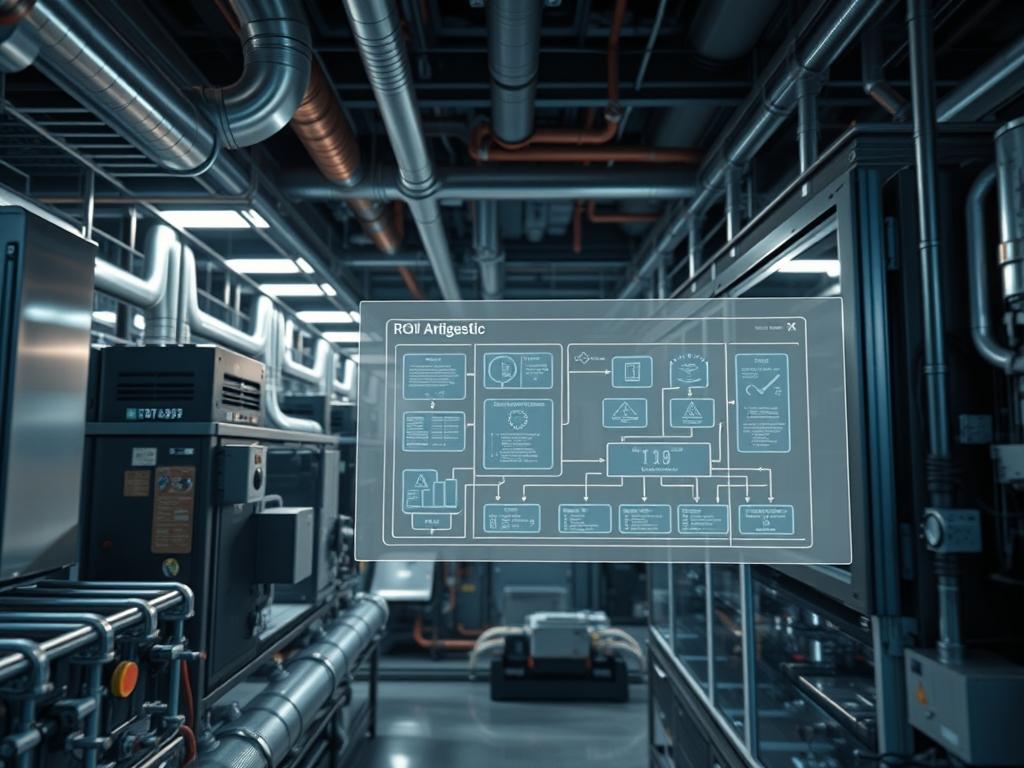
Industrial refrigeration systems represent a significant portion of the total energy overhead in cold storage and pharmaceutical manufacturing facilities. Achieving a definitive Refrigeration System ROI Analysis requires more than simple cost-accounting; it necessitates a deep technical integration between the thermodynamic physical layer and the financial modeling application layer. This manual outlines the architectural framework for building a high-fidelity model that tracks capital expenditure against operational performance. By quantifying factors such as compressor efficiency, heat exchanger fouling, and utility rate volatility, the system provides a deterministic view of the total cost of ownership. The model operates within a multi-disciplinary stack involving PLC data acquisition, cloud-based data warehouses, and localized edge computing. The objective is to eliminate the latency between physical performance degradation and financial reporting, allowing for proactive maintenance and capital replacement. Through rigorous data encapsulation and the modeling of thermal-inertia, this analysis identifies the precise point where equipment depreciation exceeds the cost of a high-efficiency technology refresh.
Technical Specifications (H3)
| Requirement | Default Port/Operating Range | Protocol/Standard | Impact Level (1-10) | Recommended Resources |
| :— | :— | :— | :— | :— |
| PLC Data Polling | Port 502 (Modbus) | Modbus-TCP / Ethernet | 9 | 4GB RAM / Quad-Core CPU |
| Sensor Accuracy | -40C to +40C | NIST Traceable / ASHRAE | 8 | PT1000 RTD Sensors |
| API Integration | Port 443 (HTTPS) | REST / JSON Payload | 7 | 100 Mbps Upstream |
| Data Persistence | SQL Server / InfluxDB | ACID Compliant | 9 | 100GB SSD (RAID 10) |
| Thermal Calculation | ISO 50001 Framework | SAE J639 Standard | 6 | Python 3.10+ / NumPy |
The Configuration Protocol (H3)
Environment Prerequisites:
The deployment environment must satisfy several hardware and software dependencies to ensure data integrity. All automation controllers must adhere to IEEE 802.3 standards for network stability. Software dependencies include Python 3.10 or higher for the modeling engine; specifically, the Pandas and NumPy libraries for high-throughput matrix operations. Users must possess Root or Sudo privileges to modify system systemd services and read/write permissions for the /var/lib/refrigeration_data/ directory. Physical assets must be equipped with calibrated sensors for suction pressure, discharge pressure, and motor current, verified via a Fluke-789 ProcessMeter.
Section A: Implementation Logic:
The logic of this ROI analysis is built on the principle of thermal-inertia and energy encapsulation. Unlike generic financial models, this framework treats the refrigeration plant as a closed-loop thermodynamic system where energy ingress directly correlates to financial egress. The model utilizes an idempotent data ingestion pipeline; this ensures that if a data packet is processed multiple times due to network latency, the financial output remains consistent. By calculating the real-time Coefficient of Performance (COP) and comparing it against the manufacturer baseline, the system derives an efficiency-gap cost. This gap represents the hidden overhead: the delta between the “as-built” design and current operational reality. The model encapsulates these physical delta variables into a financial NPV (Net Present Value) calculation, allowing stakeholders to see the real-time erosion of their ROI.
Step-By-Step Execution (H3)
1. Establish Data Linkage via Modbus-TCP:
Configure the primary gateway to poll the compressor rack PLC using systemctl start industrial-gateway.service. Ensure the IP_ADDRESS and SLAVE_ID variables are correctly mapped in /etc/gateway/config.yaml.
System Note: This action opens a persistent socket in the kernel networking stack, allowing the high-frequency polling of registers that store motor amperage and refrigerant flow rates.
2. Define the Thermodynamic Baseline:
Execute the baseline script located at /usr/bin/roi-engine/calc_baseline.py –unit-id RACK_01. This script pulls historical data to establish the standard energy consumption curve for the specific compressor types.
System Note: This process performs intensive floating-point calculations on the CPU to generate a polynomial regression of the system’s thermal-inertia under varying load conditions.
3. Implement Payload Encapsulation:
Wrap the raw sensor data in a JSON payload for transport to the financial modeling database. Use the command curl -X POST -d @payload.json https://finance-api.internal/v1/ingest.
System Note: Encapsulation ensures that data packets remain intact during transmission across the corporate VLAN, preventing packet-loss from corrupting the financial ledger.
4. Run the NPV Sensitivity Analysis:
Initiate the financial simulation by running python3 roi_simulator.py –discount-rate 0.08 –ten-year-projection. This command calculates the projected ROI based on local utility tariffs and maintenance schedules.
System Note: This step utilizes significant system memory to manage the concurrency of thousands of potential market scenarios, testing the financial model against volatile energy price inputs.
5. Verify Signal Integrity:
Use a Fluke-multimeter at the terminal block of the VFD (Variable Frequency Drive) to ensure the 4-20mA signal matches the digital readout in the ROI dashboard.
System Note: Verification of the physical signaling prevents signal-attenuation from introducing systematic bias into the financial model: a fault that could lead to an incorrect CAPEX recommendation.
Section B: Dependency Fault-Lines:
Project failures typically stem from three areas: network latency, signal-attenuation, and non-idempotent data handling. High latency in the communication between the Logic-Controller and the database can cause the ROI model to miss peak-shaving events, under-reporting energy savings. Signal-attenuation often occurs when low-voltage sensor wires are run adjacent to high-voltage power lines, inducing electromagnetic interference that skews the thermal data. Furthermore, if the ROI calculation scripts are not idempotent, a simple server reboot could result in the double-counting of energy expenditures, rendering the final audit invalid.
THE TROUBLESHOOTING MATRIX (H3)
Section C: Logs & Debugging:
When the model produces anomalous results, the first point of inspection is the system log located at /var/log/roi_engine/error.log. Common error strings such as E_LATENCY_THRESHOLD_EXCEEDED indicate that the network throughput is insufficient for the polling frequency. If the log displays E_DATA_COHERENCE_FAILURE, the checksums of the incoming payload do not match the sender’s signature, suggesting corrupt segments in the database.
For physical faults, examine the Log-Controller diagnostic screen for code F-042, which indicates an open-circuit in the pressure transducer. This hardware failure will manifest in the financial model as a sudden, impossible spike in COP, as the software calculates based on a default (and incorrect) atmospheric pressure value. Link these visual cues from the dashboard to the physical wiring diagrams located in the Main-Control-Panel. If the model output shows zero ROI despite high energy savings, verify the Utility_Tariff_Variable in the config file; an incorrect decimal placement here can effectively nullify the calculated throughput of savings.
OPTIMIZATION & HARDENING (H3)
– Performance Tuning: To increase the throughput of the ROI data pipeline, enable concurrency in the data polling script. By utilizing asynchronous I/O (AsyncIO in Python), the system can poll multiple VFDs and Sensors simultaneously without increasing the total latency of the loop. Adjust the tcp_nodelay setting in the kernel to ensure small packets are sent immediately, which is critical for real-time ROI tracking.
– Security Hardening: Secure the data acquisition layer by implementing strict firewall rules. Use iptables -A INPUT -p tcp –dport 502 -s [PLC_IP_ADDRESS] -j ACCEPT to ensure that only the authorized industrial gateway can access the refrigeration controllers. Additionally, encapsulate all financial data transmissions within an SSH tunnel or a dedicated VPN to prevent unauthorized access to sensitive facility cost structures.
– Scaling Logic: As the facility expands with more refrigeration racks, the model must maintain its accuracy. Use a microservices architecture where each compressor rack has its own dedicated containerized ROI worker. This allows the system to scale horizontally; if a new rack is added, simply deploy a new instance of the roi-worker-image. This approach prevents the central CPU from becoming a bottleneck during high-load periods when thermal-inertia is highest.
THE ADMIN DESK (H3)
How do I refresh the energy tariff data?
Access the config.json file in the root directory. Update the current_kwh_rate variable and restart the service using systemctl restart roi-engine. The system will automatically re-calculate the NPV for the current fiscal year without losing historical data.
What causes the “Throughput Mismatch” error?
This error occurs when the number of Modbus packets received does not match the expected frequency defined in the polling_interval. Check for signal-attenuation in the RS-485 to Ethernet converter or inspect the physical network cable for damage.
How is thermal-inertia accounted for in the NPV?
The model uses a delayed cooling-effect variable. This ensures that energy spent reducing the temperature of a massive slab of frozen product is amortized over the period that the product retains that thermal energy; providing a more accurate ROI.
Can I export the ROI data to CSV?
Yes. Run the command roi-cli export –format csv –output /reports/roi_report_q1.csv. This command triggers a read-only query of the SQL database and formats the payload for use in external accounting software or executive presentations.
What happens if the sensor loses power?
The system will default to the last known “safe” value and log a warning to /var/log/roi_engine/sensor.log. To maintain financial accuracy, the model will mark this time period as “Estimated Data” in the final ROI report.