
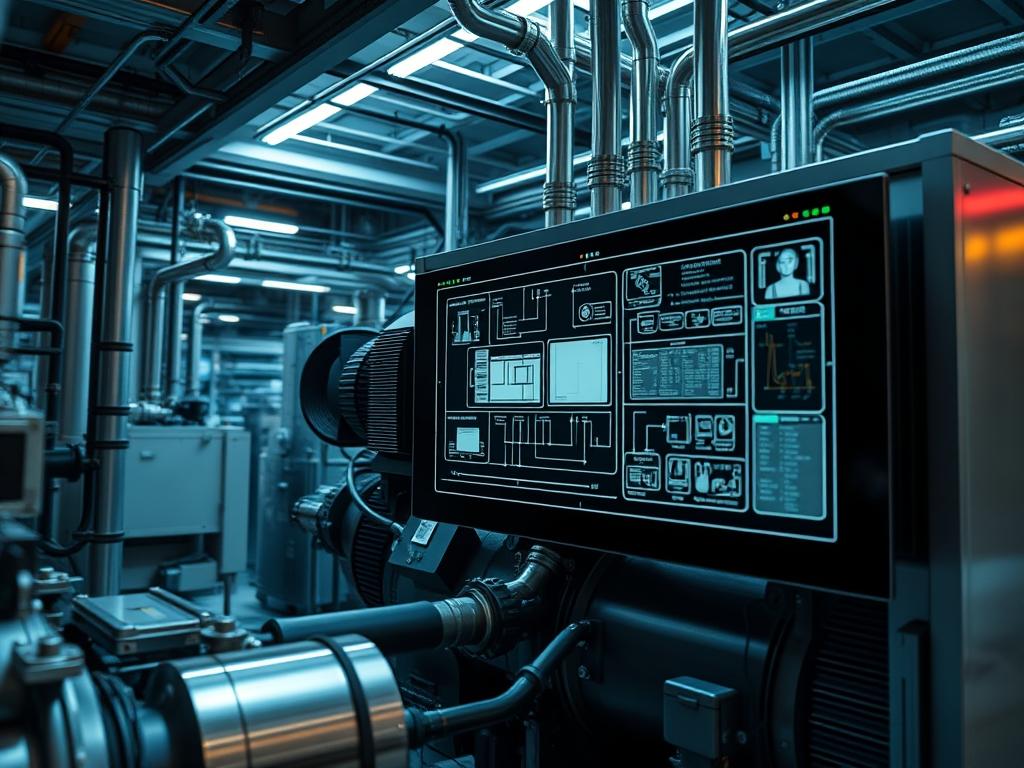
Compressor Power Factor Correction constitutes a critical engineering requirement within heavy industrial and energy sectors; specifically where large inductive motor loads dominate the power landscape. Most industrial compressors utilize induction motors that rely on electromagnetic fields to function. These fields create a lag between the voltage and the current; this displacement is known as a lagging power factor. As the power factor drops, the electrical system’s efficiency decreases, leading to increased overhead in the form of reactive power that performs no actual work but occupies system capacity. This inefficiency manifests as increased thermal-inertia in distribution lines and upstream transformers. Grid compliance mandates target a power factor as close to unity as possible to minimize signal-attenuation and harmonic distortion across the microgrid or utility bridge. By implementing active or passive correction, systems architects ensure that the payload of energy delivered directly translates into mechanical throughput without excessive waste. This manual outlines the architecture for integrating capacitor banks and intelligent controllers to stabilize the grid and ensure idempotent performance states across all compressor cycles.
Technical Specifications
| Requirement | Operating Range | Protocol/Standard | Impact Level (1-10) | Recommended Resources |
| :— | :— | :— | :— | :— |
| Target Power Factor | 0.92 to 0.99 pf | IEEE 519 / NEC 460 | 10 | Low-Loss Capacitors |
| Harmonic Mitigation | < 5% THD | IEC 61000-3-2 | 8 | Detuned Reactors |
| Response Latency | < 50ms | Modbus TCP/IP | 7 | 32MB Flash / 64MB RAM |
| Voltage Tolerance | +/- 10% Nom | ANSI C84.1 | 9 | Industrial PLC |
| Thermal Operating Range | -20C to +60C | NEMA Rating | 6 | Active Cooling / Heat Sinks |
The Configuration Protocol
Environment Prerequisites:
Successful deployment requires strict adherence to the National Electrical Code (NEC) Article 460 for capacitor installations. The local environment must support a Modbus-TCP or BACnet interface for real-time telemetry. All hardware must be rated for the specific KVA capacity of the compressor motor with a 125 percent safety margin. Administrative access to the Programmable Logic Controller (PLC) and the Energy Management System (EMS) is mandatory to adjust setpoints and polling intervals.
Section A: Implementation Logic:
The engineering design rests on the principle of reactive compensation. Since a compressor motor is an inductive load, it requires a “magnetizing current” that lags the voltage. By introducing a capacitive load in parallel, we provide a leading current that cancels the lag. This encapsulation of reactive power within the local circuit prevents it from drawing from the utility grid. The logic is designed to be idempotent; repeated triggers of the correction circuit should not result in over-correction or “leading” power factors, which would otherwise cause voltage instability and potential equipment damage.
Step-By-Step Execution
1. Primary Load Analysis and Baseline Profiling
Conduct a comprehensive power quality audit using a fluke-435-ii or equivalent high-frequency power quality analyzer. Measure the existing displacement power factor, total harmonic distortion (THD), and peak kVAR demand during compressor startup.
System Note: This action establishes the initial state in the system-kernel of the energy monitor; it allows the auditor to calculate the exact capacitance needed to reach the target throughput and avoid over-correction.
2. Physical Isolation and LOTO Procedures
Disconnect the compressor from the primary-bus and apply Lockout/Tagout (LOTO) protocols to all circuit-breakers. Verify zero energy state across all three phases using a non-contact-voltage-tester.
System Note: This ensures no back-feed occurs into the logic-controller during the hardware integration phase; it protects the physical integrity of the semiconductor-switches.
3. Capacitor Bank Integration and Sizing
Install the polypropylene-film-capacitors in a dedicated NEMA-4X-enclosure. Connect the banks to the load side of the compressor contactor to ensure they are only energized when the motor is running.
System Note: Connecting on the load side reduces the latency of the correction response and ensures that the system does not inject leading kVAR into the grid during idle periods.
4. Controller Logic Configuration
Access the logic-controller via ssh or a dedicated HMI-panel. Define the core variables: TARGET_PF=0.96, STEP_DELAY=500ms, and MAX_THD_THRESHOLD=5%. Upload the configuration script to the firmware-storage.
System Note: These variables govern the concurrency of capacitor step engagement; it prevents hunting and reduces mechanical wear on the switching-relays.
5. Telemetry and Communication Setup
Configure the Modbus-TCP gateway to export data to the centralized EMS. Set the polling rate to 1000ms to ensure real-time visibility into the power factor payload. Use the command systemctl restart mbus-daemon to apply changes.
System Note: High-frequency polling minimizes the risk of packet-loss in the monitoring stream; it provides early warning for potential signal-attenuation in the sensing leads.
6. Dynamic Testing and Validation
Re-energize the system and initiate the compressor startup sequence. Observe the power-factor-meter to verify that the value transitions from the baseline (e.g., 0.82) to the target (0.97) within the specified STEP_DELAY.
System Note: This step validates the throughput efficiency of the correction logic; it confirms that the correction is active and synchronized with the motor’s inductive demand.
Section B: Dependency Fault-Lines:
The most common failure point in PFC systems is harmonic resonance. If the capacitive reactance equalizes with the inductive reactance of the upstream transformer at a harmonic frequency, current can surge beyond safe limits. This results in fuse-failure or capacitor-case-rupture. Another bottleneck is high latency in the controller response; if the controller is too slow, the compressor may cycle off before the correction is applied, leading to utility penalties. Ensure that all current-transformers (CTs) are installed with the correct polarity; reversed CTs will cause the controller to read the power factor as leading, triggering an immediate shutdown of the correction banks.
THE TROUBLESHOOTING MATRIX
Section C: Logs & Debugging:
Log files located at /var/log/pfc/controller.log provide the first line of defense against system instability. Monitor these logs for specific error strings such as ERR_RESONANCE_DETECTED or SIGNAL_LOW_VOLTAGE. If the physical LED-indicators on the capacitor-modules flash amber, it indicates a loss of capacitance or an internal thermal trip.
- Error Code 0x01 (Low PF Delta): Indicates that the correction banks are energized but the measured PF has not improved.
* Action: Check for a blown HRC-fuse in the capacitor cabinet or a failed vacuum-contactor.
- Error Code 0x05 (High THD): Indicates harmonic levels exceed the 5% limit.
* Action: Inspect the detuned-reactors for signs of overheating or saturation.
- Log Entry “Communication Timeout”: Check the ethernet-cabling for EMI/RFI interference or verify the IP-address in the network-config.
* System Path: /etc/network/interfaces.d/pfc-modbus.conf.
OPTIMIZATION & HARDENING
– Performance Tuning: To maximize throughput, implement “Zero-Voltage Switching” (ZVS). By timing the engagement of the thyristor-switches to the zero-crossing point of the AC waveform, you eliminate inrush currents. This minimizes thermal-inertia and extends the lifespan of the capacitor-elements.
– Security Hardening: Ensure the PLC and HMI are on a segmented VLAN with no direct internet access. Apply strict firewall rules using iptables to allow only authorized MAC-addresses to access the Modbus port. Disable all unused services such as telnet or ftp to reduce the attack surface.
– Scaling Logic: When adding multiple compressors to the system, move from a static displacement correction model to a centralized, “Step-Controlled” bank. Use a “Master-Slave” architecture where the primary logic-controller calculates the total system kVAR demand and distributes the load across all available capacitor-stages to ensure even wear-leveling.
THE ADMIN DESK
How do I handle over-correction during low-load periods?
Set the logic-controller to “Auto-Disconnect” when the compressor motor’s current drops below 10 percent of its rated capacity. This prevents leading power factors, which can cause voltage spikes and damage sensitive cloud-infrastructure components sharing the same bus.
Is it possible to correct for harmonic distortion and power factor simultaneously?
Yes. You must deploy Active Power Filters (APF). Unlike passive banks, APFs use high-speed IGBTs to inject compensating current that cancels out harmonics and reactive power in real-time. This reduces signal-attenuation significantly.
What is the primary indicator of capacitor degradation?
Monitor the phase-current-imbalance. If the current drawn by the capacitor-bank across the three phases varies by more than 5 percent, it indicates internal cell failure. Replace the module immediately to maintain system throughput.
Why is my controller reporting “Lead” instead of “Lag”?
This is usually caused by reversed Current Transformer (CT) leads. Power Factor is a directional measurement. If the logic-controller interprets the current flow in reverse, it will calculate a leading state. Check the S1/S2-terminals on the CT-block.