
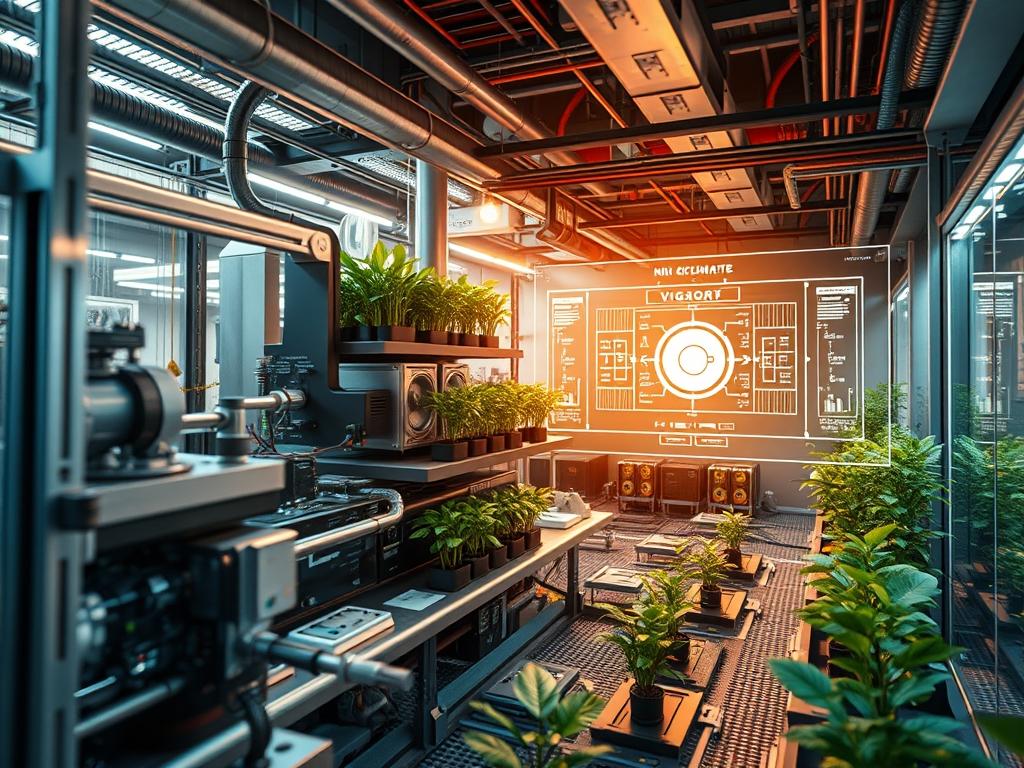
Vegetation for Microclimate serves as a primary physical layer optimization within the high-density infrastructure stack. It functions as a bio-mechanical heat-sink designed to mitigate the Urban Heat Island (UHI) effect while reducing the cooling-load requirements of adjacent facility hardware. By deploying a multi-layered canopy and substrate system; systems architects can effectively decouple the facility envelope from ambient solar radiation. This technical integration treats biological assets as functional components of the site thermal management system. Unlike traditional mechanical cooling which relies on high-energy throughput; Vegetation for Microclimate utilizes latent heat of vaporization through evapotranspiration and solar shading to provide a passive cooling buffer. This deployment strategy addresses the core problem of thermal accumulation in dense mechanical environments where air intake temperatures often exceed equipment operating specifications. By optimizing the external conditions; engineers can significantly decrease the power-draw of HVAC units and improve the overall efficiency of the infrastructure lifecycle.
Technical Specifications
| Requirement | Default Operating Range | Protocol/Standard | Impact Level (1-10) | Recommended Resources |
| :— | :— | :— | :— | :— |
| Leaf Area Index (LAI) | 3.0 to 6.5 m2/m2 | ASHRAE 189.1 | 8 | High-density broadleaf |
| Substrate Depth | 150mm to 600mm | FLL Green Roof | 7 | Engineered lightweight soil |
| Albedo Coefficient | 0.20 to 0.35 | ASTM E1918 | 9 | C3/C4 Photosynthetic path |
| Transpiration Rate | 2.5 to 8.0 mm/day | ISO 14046 | 6 | Automated irrigation-bus |
| Load Capacity | 1.5 to 4.5 kN/m2 | ASCE 7-16 | 10 | Reinforced structural slab |
| Sensor Accuracy | +/- 0.5 Degrees C | NIST Traceable | 5 | RTD-PT100 Sensors |
The Configuration Protocol
Environment Prerequisites:
Before initiating the deployment of Vegetation for Microclimate; the infrastructure must meet specific architectural and digital prerequisites. All structural load-bearing components must verify compliance with local building codes for live-load and dead-load variables. Electrical subsystems require a dedicated 24V-DC power supply for the logic-controllers and sensor arrays. Software dependencies include a compatible Building Management System (BMS) or an IoT gateway running Home-Assistant or a custom Python-based monitoring script. Minimum firmware for the irrigation-logic-controller must be version 4.2 or higher to support volumetric water content (VWC) thresholds. Access permissions require “Admin” level rights to the site automation gateway and physical access to the roof or exterior facade for sensor calibration.
Section A: Implementation Logic:
The engineering design relies on the principle of thermal-inertia and latent heat flux. Vegetation for Microclimate acts as a low-pass filter for temperature fluctuations. During peak solar radiation; the vegetation layer absorbs the payload of shortwave radiation; converting it into chemical energy and latent heat via transpiration. This prevents the building envelope from reaching the high radiant temperatures that cause thermal-bridge failures in mechanical systems. The substrate layer provides additional encapsulation; effectively insulating the structure from thermal gain. By maintaining a constant transpiration-buffer; the system maintains an external microclimate that is consistently 5 to 10 degrees Celsius cooler than the surrounding asphalt-heavy environment. This reduces the enthalpy of the air entering the facility air-handling units; resulting in higher thermodynamic efficiency and reduced compressor cycling.
Step-By-Step Execution
1. Execute Site Thermal Baseline Analysis
Conduct a high-resolution thermal scan of the target installation area using a fluke-62-max-plus infrared thermometer or a thermal imaging camera. Log the initial temperatures of the building skin at 12:00; 15:00; and 18:00 hours.
System Note: This step establishes the “Status Quo” telemetry data against which all future cooling performance will be measured. It identifies the high-radiation hot-spots that require the densest vegetation payload.
2. Configure Sensor Array and Logic Controllers
Install soil moisture sensors and ambient temperature probes across the planned deployment zone. Connect these sensors to the esp32-logic-controller or the centralized PLC. Run chmod +x /usr/bin/irrigation-daemon to ensure the automated script has execution permissions on the management server.
System Note: The logic controller uses these sensors to determine the moisture-latency of the substrate. If VWC falls below the 20% threshold; the system triggers a hydration event to maintain the transpiration-buffer.
3. Apply Proofing and Drainage Encapsulation
Install an idempotent root-barrier and a multi-ply waterproofing membrane over the structural deck. Verify the slope of the drainage layer using a laser level to ensure a minimum 2% gradient toward the primary scuppers.
System Note: This hardware layer protects the underlying structural kernel from moisture ingress and biological degradation. Failure to verify the integrity of this layer can lead to systemic structural failure during high-saturation events.
4. Deploy Engineered Substrate and Vegetation Modules
Layer the engineered growth medium to the specified depth. Install the selected vegetation (Payload) according to the density requirements identified in the baseline analysis. Ensure all irrigation lines are integrated into the root zone.
System Note: The substrate acts as a physical buffer and thermal mass. The vegetation serves as the active cooling interface. This configuration creates a redundant cooling layer that operates independently of mechanical power; provided the hydration-bus remains active.
5. Initialize the Automated Hydration Service
Enable the irrigation service by running systemctl start irrigation-service.target. Monitor the initial cycle to ensure uniform distribution of the water payload. Use a fluke-multimeter to verify the solenoid valve voltage is within the 24V-AC/DC operating range.
System Note: This command initializes the active cooling maintenance cycle. The system will now automatically adjust the microclimate based on real-time sensor feedback; optimizing water usage while maximizing thermal-inertia.
Section B: Dependency Fault-Lines:
The most common failure in a Vegetation for Microclimate deployment is “Hydration Latency” where the irrigation-bus fails to deliver the water payload during peak thermal loads. This is often caused by a mechanical blockage in the filtration system or a logic error in the esp32 controller. Another critical fault-line is “Structural Overload”; occurring when the substrate exceeds its saturated weight capacity of 4.5 kN/m2 during extreme rain events. If the drainage throughput is insufficient; the “packet loss” of water exiting the roof causes a backlog; increasing the dead-load on the building structure. Finally; “Biological Packet Loss” occurs when selected plant species fail to adapt to the local micro-conditions; leading to canopy thinning and a loss of shading effectiveness.
THE TROUBLESHOOTING MATRIX
Section C: Logs & Debugging:
When a thermal discrepancy is detected; primary diagnostics should begin at the log path /var/log/microclimate/sensor_data.log. Analyze the timestamped data for gaps in telemetry or anomalous temperature spikes.
Error Code: THERM-01 indicates that the leaf-surface temperature has exceeded the ambient air temperature by more than 2 degrees. This usually identifies “Stomatal Closure” due to lack of water.
Check: Inspect the solenoid valve at Port 4 and verify the water pressure at the main header.
Error Code: MOIST-LOW indicates a sensor readout below the 15% VWC threshold.
Check: Verify the connectivity of the i2c-bus connecting the moisture sensors to the master controller. Use i2cdetect -y 1 to scan for active sensor addresses.
Physical Verification: If the visual canopy shows signs of chlorosis or wilting; it indicates a failure in the nutrient delivery or a root-zone hypoxia. Use a soil probe to check for standing water at the drainage interface; which suggests a “Throughput Bottleneck” in the primary drainage layer.
OPTIMIZATION & HARDENING
Performance Tuning:
To increase the throughput of the cooling system; optimize the Leaf Area Index (LAI) by introducing vertical trellises. This increases the surface area for evapotranspiration without increasing the footprint of the substrate. Additionally; configure the logic-controller to execute “Pre-emptive Hydration” cycles at 04:00 hours. This saturates the substrate during the lowest period of thermal stress; maximizing the thermal-inertia available for the midday peak load.
Security Hardening:
Secure the digital control layer by closing all unnecessary ports on the RTU or PLC. Implement firewalld rules to allow only authorized traffic from the BMS IP address. On the physical layer; install “Root-Stop” secondary membranes around all penetrations (vents, drains, and electrical conduits) to prevent biological intrusion into the building infrastructure kernel. All irrigation controllers should be housed in NEMA-4X rated enclosures to protect against environmental degradation.
Scaling Logic:
As the infrastructure expands; the microclimate system can be scaled by adding “Nodes” of vegetation. These nodes should be linked via an RS-485 or LoRaWAN network for unified management. Scaling requires an audit of the total water-header capacity to ensure that adding new zones does not result in “Signal Attenuation” of water pressure across the furthermost nodes. Use a decentralized controller architecture to ensure that a single point of failure in one controller does not degrade the microclimate across the entire facility.
THE ADMIN DESK
Quick-Fix FAQs:
What is the minimum uptime for the hydration system?
The hydration-bus must maintain 99.9% availability during the summer season. A downtime exceeding 48 hours can lead to irreversible “Canopy Depreciation” and a total failure of the microclimate cooling layer.
How does thermal-inertia affect HVAC cycles?
By increasing the thermal-mass of the exterior envelope; Vegetation for Microclimate shifts the peak thermal load into the late evening. This allows the HVAC system to operate during cooler ambient conditions; significantly reducing high-load concurrency issues.
Can I run the control logic on a standard Linux server?
Yes; provided the server has a hardware interface for the sensor bus. Most systems use a Raspberry Pi or an industrial PLC running a hardened Linux kernel to handle the real-time sensor interrupts and GPIO signals.
What is the primary indicator of system health?
The “Delta-T” between the vegetated surface and a nearby control surface (like bare concrete). A healthy system should maintain a Delta-T of at least -15 degrees Celsius during peak solar radiation periods.
Does this system require specialized root-access?
Physically; yes; the root-barrier must be inspected annually for penetrations. Digitally; root-access to the irrigation-daemon is required for updating the VWC thresholds and modifying the watering schedule-logic during drought conditions.