
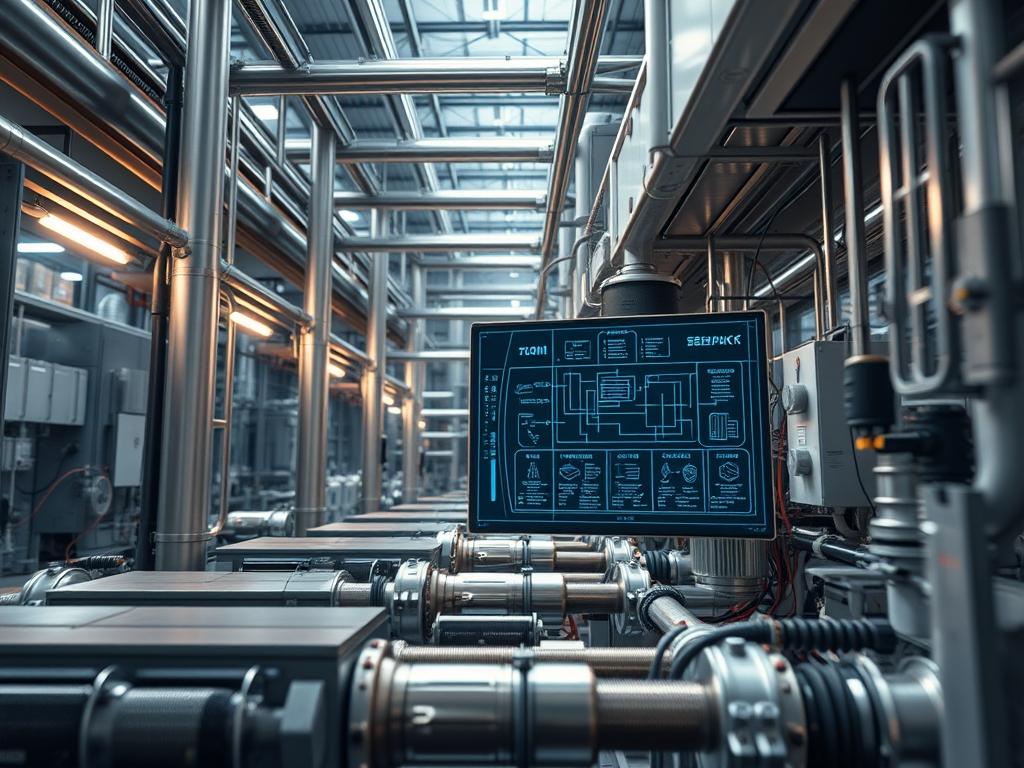
Ammonia Charge Reduction Logic functions as a critical safety abstraction layer within modern industrial cold storage and processing facilities. The primary objective of this logic is the minimization of total anhydrous ammonia volume without compromising the cooling throughput of the plant. Traditionally, ammonia systems relied on massive flooded evaporators and high-pressure receivers; these presented significant liability due to the high toxicity of the refrigerant. By implementing Ammonia Charge Reduction Logic, engineers transition from bulk-storage models to high-velocity, low-volume distribution cycles. This transition relies heavily on the encapsulation of control parameters within a Programmable Logic Controller or Distributed Control System. The logic must account for the high thermal-inertia of the system while ensuring that liquid ammonia is only present where active heat transfer occurs. Consequently, the payload of the system is reduced by up to 90 percent compared to vintage designs. This reduction simplifies compliance with Process Safety Management standards and reduces the potential impact radius during a catastrophic rupture. From a systems perspective, this logic acts as the primary governor for refrigerant flow, utilizing complex algorithms to manage liquid-to-vapor ratios in real-time.
Technical Specifications
| Requirement | Default Port/Operating Range | Protocol/Standard | Impact Level | Recommended Resources |
| :— | :— | :— | :— | :— |
| Pressure Transducers | 4-20 mA / 0-400 PSI | ISA-5.1 / Modbus | 9 | Stainless Steel 316L |
| PLC Controller | 24V DC / 1.5A | EtherNet/IP / Profinet | 10 | 1.5GHz Quad-Core / 4GB RAM |
| Electronic Expansion Valves | 0-10V / PWM | IEC 60534 | 8 | Cast Steel / PTFE Seals |
| SCADA Integration | Port 502 / 443 | MQTT / OPC-UA | 7 | 8-Core CPU / 16GB RAM / NVMe |
| Temperature Sensors | RTD Pt100 / -50C to 100C | IEC 60751 | 8 | Class A Thin Film |
The Configuration Protocol
Environment Prerequisites:
Successful deployment of Ammonia Charge Reduction Logic requires adherence to the International Institute of Ammonia Refrigeration (IIAR-2) and the National Electrical Code (NEC) Class I Division 2 requirements. The underlying control hardware must support high-speed analog-to-digital conversion to minimize latency in valve positioning. Software dependencies include a real-time operating system or a hardened Linux kernel capable of running high-priority tasks with minimal jitter. User permissions for the supervisory layer must be restricted via Role-Based Access Control; specifically, only senior engineers should possess sudo or Admin privileges over the PID tuning registers. All hardware communication should occur over a segregated OT (Operational Technology) network to prevent external interference or packet-loss from general office traffic.
Section A: Implementation Logic:
The engineering philosophy behind this configuration is the replacement of static liquid levels with dynamic flow management. In a traditional flooded system, a large volume of liquid ammonia sits in a vessel, creating significant overhead and potential hazard. Ammonia Charge Reduction Logic utilizes the “Direct Expansion” or “Optimized Recirculation” method where the quantity of liquid is strictly limited to what can be vaporized by the current heat load. The “Why” behind this engineering design involves the reduction of the Reynolds number within the evaporator tubes to promote efficient boiling while minimizing the liquid slugging risk. By calculating the exact superheat (the difference between the actual temperature and the saturation temperature), the logic maintains a minimal liquid film on the interior of the heat exchanger pipes. This ensures that the thermal-inertia of the system is managed through velocity rather than mass. The logic is idempotent; regardless of the starting state of the system, the controllers will always drive the refrigerant volume toward the minimum safe operating threshold defined by the setpoints.
Step-By-Step Execution
I. Initialize Transducer Calibration
The first phase involves the precise calibration of all pressure and temperature sensors. Use a fluke-multimeter to verify the 4-20 mA loop integrity for each sensor across the cold-side infrastructure.
System Note: Ensure that the analog-input-module on the PLC is configured for high-resolution sampling. This action calibrates the raw signal input at the hardware abstraction layer, ensuring that the kernel-level data used for scaling is accurate to +/- 0.1 percent.
II. Provision Local Control Registers
Access the PLC programming environment and define the address space for the Ammonia Charge Reduction Logic. Map physical I/O to symbolic variables such as r717_suction_pressure and r717_evap_temp.
System Note: This step creates the data structures in the PLC memory heap. Use chmod style permissions within the SCADA software to lock these registers from unauthorized write operations.
III. Configure Electronic Expansion Valve (EEV) Logic
Implement the PID control block specifically for the EEV. Set the proportional gain high enough to provide responsive cooling but low enough to avoid oscillation.
System Note: The EEV driver uses Pulse-Width Modulation (PWM) to control the orifice opening. Frequent adjustments to these parameters affect the thermal-inertia calculations; the controller service must prioritize this task to avoid signal-attenuation in high-noise environments.
IV. Establish Fail-Safe Interlocks
Define the “Hard-Stop” parameters. If the suction pressure drops below the min_suction_threshold, the logic must trigger an instantaneous closure of all liquid feed valves.
System Note: Use a watchdog-timer circuit that operates independently of the main CPU loop. If the logic-controller crashes, the physical valves must default to a “Normally Closed” state to prevent uncontrolled liquid migration.
V. Deploy Superheat Monitoring Algorithms
Calculate the real-time superheat by subtracting the saturated temperature (derived from pressure) from the actual suction line temperature.
System Note: This calculation happens at the application layer of the controller. High latency in this loop can lead to liquid carryover; ensure the task cycle time is set to under 50ms to maintain system stability.
VI. Validate Network Telemetry
Establish the connection between the PLC and the SCADA head-end using the OPC-UA protocol. Verify that there is zero packet-loss between the machine-room sensors and the dashboard.
System Note: Use netstat -an | grep 502 to verify that the Modbus TCP port is listening and that there are no unauthorized concurrent connections attempting to intercept the payload.
Section B: Dependency Fault-Lines:
The most common mechanical bottleneck in Ammonia Charge Reduction Logic is the accumulation of compressor oil within the low-charge evaporators. Unlike flooded systems, low-charge systems do not have large vessels where oil can easily settle and be drained. This results in reduced heat transfer efficiency and can trigger false sensor readings. Furthermore, library conflicts in the SCADA software often arise when older DLL files are not compatible with new encrypted communication drivers. If the throughput of the network drops, the PID loops may experience “integral windup,” leading to unstable valve hunting. Ensure that all Cat6a cabling is shielded to prevent signal-attenuation caused by the Variable Frequency Drives located near the control panels.
The Troubleshooting Matrix
Section C: Logs & Debugging:
When a system fault occurs, examine the log located at /var/log/industrial/acr_logic.log. Look for error strings such as “ERR_VALVE_SATURATION” or “SIG_FLOAT_OVERFLOW”. Visual cues from the SCADA HMI, such as a “hunting” valve graphic, typically point to a misconfigured derivative term in the PID settings.
| Error Code | Description | Probable Cause | Resolution Path |
| :— | :— | :— | :— |
| E01-COMM | Timeout on Port 502 | Network Congestion / Packet-loss | Check switch VLAN tags and cable integrity. |
| E04-SENSOR | Signal-attenuation on 4-20mA | Wire shielding failure / Ground loop | Re-route sensor cables away from high-voltage lines. |
| E11-OOR | Transducer Out of Range | Physical leak or sensor failure | Verify pressure with analog-gauge; replace sensor. |
| E22-SAT | PID Saturation | Undersized EEV or extreme heat load | Audit thermal load; check EEV sizing parameters. |
Diagnostic commands such as ping -s 1024 [PLC_IP] should be used to test the network’s ability to handle the communication payload without dropping frames. If the logs indicate high latency, check the concurrency settings on the data aggregator node.
Optimization & Hardening
– Performance Tuning: To maximize thermal efficiency, implement a “Floating Suction” strategy. This adjusts the suction pressure setpoint upward based on the warmest zone requirement, reducing compressor work and increasing overall throughput. Monitor the compressor discharge temperatures to ensure that reduced ammonia mass does not lead to overheating of the machine internals.
– Security Hardening: Apply strict firewall rules to the PLC gateway. Only allow traffic from known MAC addresses and disable unused services like FTP or Telnet. Ensure all control logic is backed up to an immutable storage volume; utilize sha256sum to verify the integrity of the logic files after every update. Physical hardening includes locking all local J-boxes and using tamper-evident seals on the pressure transducer housings.
– Scaling Logic: When expanding the plant, utilize a modular “Cellular” approach. Each new evaporator should have its own dedicated Ammonia Charge Reduction Logic controller rather than adding I/O to a single massive central PLC. This reduces the “Blast Radius” of a single controller failure and maintains low latency across the distributed network.
The Admin Desk
How do I reset the EEV after a hard-stop?
Locate the reset_interlock bit in the PLC register map. Ensure the suction pressure has stabilized above the minimum threshold. Navigate to the Manual_Override screen in SCADA and toggle the bit from 0 to 1 to clear the fault.
Why is my ammonia charge higher than the design spec?
Check for liquid pooling in the suction mains. Verify that the defrost_sequence is fully evacuating the evaporators before returning to cooling mode. Inefficient oil recovery also displaces ammonia space, leading to an artificially high liquid level reading.
Can I run this logic on a generic IoT gateway?
Negative. Industrial ammonia systems require hardware with high MTBF ratings and real-time execution kernels. Generic IoT gateways often suffer from high jitter and lack the necessary electrical isolation for 24V industrial signaling environments.
How does ACRL affect energy consumption?
By optimizing the superheat for minimal charge, the system runs with a more efficient “wetted” surface area in the evaporators. This improves the heat transfer coefficient and allows the compressors to operate at higher suction pressures, reducing kilowatt-per-ton consumption.
What is the “Minimum Charge” per ton of refrigeration?
In an optimized ACRL environment, the target is 0.5 to 2.0 lbs of ammonia per ton of cooling. Flooded systems often exceed 20 lbs per ton. Achieving these lower numbers requires strict adherence to the dynamic valve sequencing outlined in this manual.