
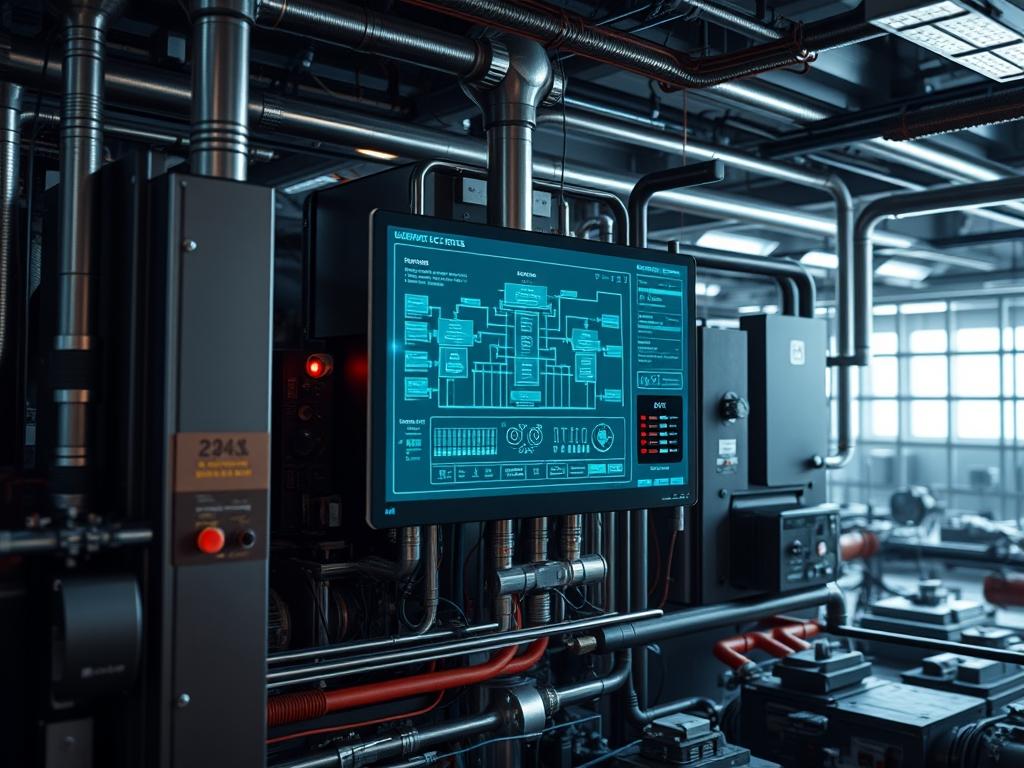
Geothermal Heat Pump Controls represent the critical decision making layer within modern renewable energy infrastructure. Positioned at the intersection of thermodynamic engineering and industrial automation; these controls manage the heat exchange process between the terrestrial subsurface and the internal building environment. In the broader technical stack, they function as the bridge between localized physical assets and centralized Building Management Systems (BMS). The primary problem these systems solve is the mitigation of thermal-inertia; the lag between energy demand and ground-loop response. Without sophisticated logic integration, systems suffer from excessive compressor cycling and suboptimal COP (Coefficient of Performance). By implementing modern logic protocols, architects can ensure that energy distribution is both idempotent and responsive to real-time load variations. This integration typically involves encapsulated data payloads moving across Modbus or BACnet networks to provide high-resolution telemetry of ground loop temperatures, refrigerant pressures, and pump flow rates.
TECHNICAL SPECIFICATIONS
| Requirement | Default Port/Operating Range | Protocol/Standard | Impact Level (1-10) | Recommended Resources |
| :— | :— | :— | :— | :— |
| Network Communication | Port 502 (Modbus TCP) | IEEE 802.3 | 9 | 512MB RAM / 100Mbps NIC |
| Analog Signal Sampling | 4-20mA or 0-10VDC | IEC 61131-3 | 8 | 16-bit ADC Resolution |
| Data Encapsulation | JSON over MQTT / BACnet | ISO 16484-5 | 7 | Dual-core 1.2GHz CPU |
| Ground Loop Delta-T | 5F to 10F (Standard) | ANSI/ASHRAE 194 | 10 | High-Flow Circulator |
| Command Latency | < 100ms | Real-time OS (RTOS) | 6 | Shielded Twisted Pair (STP) |
THE CONFIGURATION PROTOCOL
Environment Prerequisites:
Successful integration requires adherence to strict hardware and software baselines. Engineering teams must verify compliance with NEC Article 440 for electrical safety and ASHRAE 90.1 for energy efficiency standards. The controller environment must support Python 3.9+ or a native PLC runtime such as CODESYS v3.5. User permissions for the integration gateway must be set to allow read/write access to the Modbus Register Map; specifically, the user must have sudo privileges on the gateway OS to modify firewall rules for port 502 or 47808.
Section A: Implementation Logic:
The theoretical foundation of Geothermal Heat Pump Controls rests on predictive PID (Proportional-Integral-Derivative) loops. Unlike air-source systems, geothermal systems manage a massive thermal reservoir with high thermal-inertia. The engineering design must prioritize the encapsulation of environmental variables into a coherent control payload. This ensures that every command sent to the VFD (Variable Frequency Drive) for the circulator pump is calculated based on the differential between the Entering Source Temperature (EST) and the Leaving Source Temperature (LST). By treating the ground loop as a low-latency heat sink; the logic minimizes the overhead of compressor startup cycles.
Step-By-Step Execution
1. Physical Layer Validation
Use a Fluke-multimeter or a Logic-analyzer to verify the electrical integrity of the sensor array. Measure the resistance across the 10k Ohm Thermistors located at the heat exchanger inlets and outlets.
System Note: This ensures that signal-attenuation does not introduce false variables into the PID calculation; preventing the controller from making decisions based on ghost data.
2. Provisioning the Modbus Gateway
Access the controller via SSH and navigate to /etc/network/interfaces to assign a static IP address. Open the required ports using ufw allow 502/tcp.
System Note: Establishing a static IP is necessary for persistent polling by the BMS; ensuring that packet-loss does not result in a loss of thermal state visibility.
3. Logic Script Deployment
Copy the control logic file to the service directory: cp heat_pump_logic.py /opt/hvac/logic/. Set the execution permissions using chmod +x /opt/hvac/logic/heat_pump_logic.py.
System Note: This step moves the high-level decision making code into the active service path; allowing the underlying kernel to execute thermal management routines.
4. Initialization of the Control Service
Create a systemd service unit at /etc/systemd/system/hvac.service and start the process using systemctl start hvac.service. Enable it on boot with systemctl enable hvac.service.
System Note: Wrapping the logic in a systemd service ensures that the geothermal controls automatically recover from power failures or unexpected crashes; maintaining the system’s idempotent state.
5. Loop Tuning and Calibration
Monitor the live telemetry using tail -f /var/log/hvac_control.log while adjusting the Kp (Proportional) and Ki (Integral) constants in the configuration file located at /etc/hvac/config.yaml.
System Note: Real-time logging allows the technician to observe how the heat pump reacts to load changes; ensuring that the compressor throughput matches the building’s thermal demand without overshooting the setpoint.
Section B: Dependency Fault-Lines:
The most frequent failure point in Geothermal Heat Pump Controls is the corruption of the Modbus registers due to electromagnetic interference (EMI). High-voltage lines running parallel to communication cables cause significant signal-attenuation. Furthermore; if the logic assumes a linear thermal response from the ground loop, it will fail during peak winter/summer loads when the ground’s thermal-inertia reaches its limit. Software-side conflicts often arise when multiple masters attempt to write to the same register; leading to concurrency errors and unstable hardware behavior.
THE TROUBLESHOOTING MATRIX
Section C: Logs & Debugging:
When the system fails to hit thermal setpoints, the first point of inspection is the /var/log/syslog for network-related errors and the application-specific log at /opt/hvac/logs/error.log. Search for the string “ECONNREFUSED” which indicates the gateway cannot reach the PLC. If the sensors return a value of -999; this points to an open circuit in the thermistor chain.
Check the Modbus register map at address 40001 for the compressor status. A value of “0” when the demand is high suggests a safety lockout. To clear this; use the command modpoll -m tcp -r 40001 -p 502 [IP_ADDRESS] 1 to manually attempt a reset. If the manual override fails; inspect the physical high-pressure switch on the refrigerant line using a manifold-gauge-set to verify the mechanical health of the compressor. Physical fault codes are often mirrored in the Modbus Holding Registers between 40100 and 40120.
OPTIMIZATION & HARDENING
– Performance Tuning: To maximize thermal efficiency; implement a “Lead-Lag” logic for installations with multiple heat pumps. This rotates the primary unit based on runtime hours; which is tracked in the NVRAM of the controller. Increasing the polling frequency of the EST sensors to 500ms reduces the latency of the PID response; thereby tightening the temperature deadband.
– Security Hardening: Modern Geothermal Heat Pump Controls are vulnerable to network-based attacks. Apply strict iptables rules to restrict port 502 access to the BMS IP address only. Disable unused services like Telnet or FTP on the gateway hardware. Ensure that the logic script does not run with root privileges; instead; create a dedicated hvac_user with limited filesystem access.
– Scaling Logic: For district heating applications; the control logic must transition from a single-node model to a distributed cluster. Use a message broker like Mosquitto (MQTT) to handle the concurrency of data payloads from hundreds of ground-loop sensors. This allows the system to balance the thermal load across the entire field; preventing the “thermal mining” of specific boreholes.
THE ADMIN DESK
How do I handle a “Sensor Timeout” error?
Check the physical connection at the Analog Input terminal block. Ensure that the shielding is grounded at one end only to prevent ground loops. Verify that the polling frequency in config.yaml does not exceed the sensor recovery time.
What causes high latency in command execution?
Network congestion on the RS-485 or Ethernet segment usually causes this. Transition to a switched network topology or reduce the number of devices on a single Modbus RTU daisy-chain to improve packet throughput and reduce collisions.
How do I update the control logic without downtime?
Implement a blue-green deployment strategy. Run the new logic version on a secondary container or thread; then flip the idempotent control bit in the PLC to switch the active controller once the new data stream is validated.
Why is my compressor short-cycling?
The differential (deadband) settings are likely too narrow. Increase the temperature threshold in the logic to allow for a wider range before the compressor engages. This accounts for the high thermal-inertia of the heat exchange fluid.
Can I integrate these controls with a cloud platform?
Yes; use an IoT Gateway to encapsulate Modbus data into MQTT payloads. Ensure all outgoing traffic is encrypted via TLS 1.3 to maintain infrastructure security while allowing for remote telemetry and predictive maintenance.