
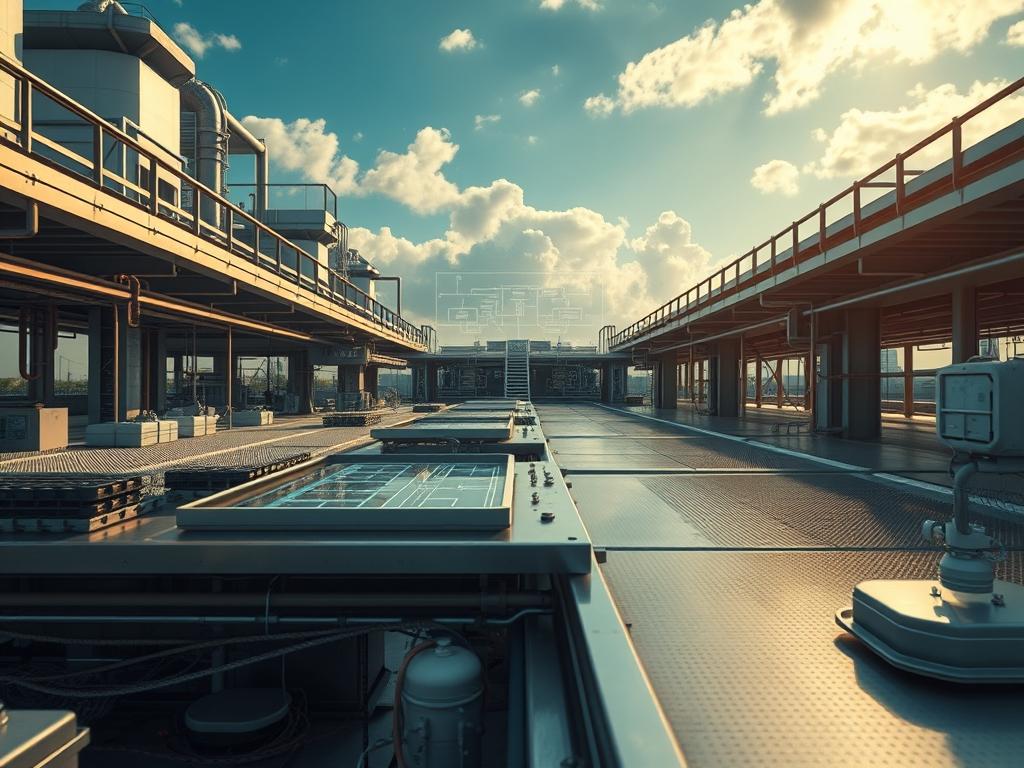
Radiative Cooling Roof Design represents a critical advancement in passive thermal management for high-density infrastructure; it addresses the significant energy overhead associated with active cooling systems. In the context of data centers, industrial manufacturing, and large scale storage facilities, heat rejection is traditionally achieved through mechanical refrigeration, which consumes vast quantities of electricity and water. Radiative cooling disrupts this model by leveraging the atmospheric transparency window, specifically the 8 to 13 micron wavelength range, to emit thermal energy directly into deep space. This process occurs without external power input, effectively treating the cold vacuum of space as a primary heat sink. By optimizing the surface emissivity and solar reflectance of the roof structure, engineers can achieve sub-ambient temperatures even under direct sunlight. This manual outlines the integration of these materials into the broader infrastructure stack, focusing on the reduction of thermal-inertia and the improvement of overall system throughput by mitigating the heat island effect within sensitive hardware environments.
TECHNICAL SPECIFICATIONS
| Requirement | Default Operating Range | Protocol/Standard | Impact Level (1-10) | Recommended Resources |
| :— | :— | :— | :— | :— |
| Solar Reflectance (SR) | 0.88 to 0.97 | ASTM E903 / E1918 | 10 | High-Albedo Polymer / Silver-Silicon |
| Thermal Emissivity | > 0.90 (8-13 microns) | ASTM C1371 / E408 | 9 | Metamaterials / PDMS Coatings |
| Thermal Conductivity | < 0.05 W/mK | ISO 22007 | 7 | Aerogel / XPS Insulation Layers |
| Interface Integration | 4-20mA or 0-10V DC | Modbus-TCP / BACnet | 6 | BMS-PLC-Controller |
| Signal Attenuation | < 2.5 dB | IEEE 802.11 / Zigbee | 4 | LoRaWAN-Gateway |
| Surface Durability | 15 – 25 Years | ASTM G154 (UV Aging) | 8 | Fluoro-Polymer Protective Film |
THE CONFIGURATION PROTOCOL
Environment Prerequisites:
Successful deployment of a Radiative Cooling Roof Design requires strict adherence to physical and digital environment standards. The structural substrate must comply with NEC-Article-300 for wiring and ASTM-D4258 for surface cleanliness. Software-side requirements involve a Building Management System (BMS) capable of polling thermal sensors at a high sampling frequency; a minimum of python3.8+ with scipy and numpy for thermal modeling, and administrative access to the Master-Control-Unit (MCU) via SSH or RS-485. Hardware dependencies include thermal-resistance detectors (RTDs) and a high-resolution meteorological station to correlate ambient conditions with cooling performance.
Section A: Implementation Logic:
The engineering logic behind radiative cooling is centered on the principle of radiative heat transfer. Unlike conduction or convection, which rely on a temperature gradient between the surface and the surrounding air, radiative cooling exploits the transparency of the Earth’s atmosphere to long-wave infrared (LWIR) radiation. By selecting materials that exhibit high emissivity in the atmospheric window, the rooftop acts as a radiator that sends “payloads” of thermal energy past the greenhouse gases. This creates a net loss of energy, resulting in a temperature drop below the ambient air temperature. The goal is to maximize the throughput of rejected heat while minimizing the solar payload absorbed during peak daylight. This reduction in heat flux provides a lower baseline for internal HVAC systems, effectively reducing the duty cycle of compressors and secondary pumps.
Step-By-Step Execution
1. Site Calibration and Baseline Assessment
Utilize a fluke-ti480-pro thermal imager to map existing heat signatures and identify thermal bridges. Document the current solar irradiance using a pyranometer connected to the DATA-LOG-01 module.
System Note: This baseline establishes the control variable for the thermal-inertia calculations. It allows the BMS-Kernel to calculate the delta between legacy performance and radiative cooling efficiency once the deployment is complete.
2. Substrate Surface Preparation
Execute a comprehensive cleaning of the roof membrane using the ASTM-D4258 protocol. All biological growth and industrial pollutants must be removed. Apply an adhesive primer specified for TPO-Membrane or EPDM-Surface types.
System Note: Surface contaminants increase the absorption of short-wave radiation; minimizing this ensures that the radiative coating maintains high spectral selectivity. Any residue left behind will act as a thermal insulator, increasing the latency of heat rejection.
3. Installation of the Radiative Metamaterial Layer
Apply the radiative coating or film using a uniform spray technique or mechanical rollers. If using a multi-layer metamaterial, ensure the silver-reflective layer is perfectly encapsulated to prevent oxidation. Use a mil-thickness-gauge to verify a uniform coating of 0.25mm to 0.50mm.
System Note: This layer acts as the primary heat-rejection engine. It performs the encapsulation of thermal energy into the required 8 to 13 micron wavelengths. Correct thickness is vital to prevent signal-attenuation of the infrared emission.
4. Integration of Thermal Sensor Array
Install PT100-RTD sensors at three levels: 5cm above the surface, on the material surface, and 5cm below the roof deck. Wire these into the BMS-Analog-Input-Card. Configure the modbus-tcp registers to map these values to the Thermal-Analytics-Dashboard.
System Note: This setup monitors the concurrency of heat flux. By comparing surface temperature against ambient temperature, the logic-controller can verify if the system has achieved sub-ambient cooling status.
5. Commissioning the Control Logic
Initialize the monitoring script located at /usr/local/bin/thermal_monitor.py. Set the polling frequency to 60s to minimize overhead on the MCU-Bus. Validate the data stream using systemctl status thermal-monitor.service.
System Note: The control logic uses these real-time data packets to adjust the active HVAC setpoints. If the radiative roof is performing at peak efficiency, the HVAC-Compressor-State will be set to IDLE, significantly reducing energy consumption.
Section B: Dependency Fault-Lines:
The primary failure point in Radiative Cooling Roof Design is atmospheric opacity. High humidity or dense cloud cover increases atmospheric back-radiation, effectively “closing” the atmospheric window. This creates a bottleneck in heat rejection throughput. Another critical dependency is the integrity of the reflective layer. If the silver or aluminum backing of a metamaterial film delaminates, the material will begin to absorb solar payloads, turning the cooling system into a passive heater. Ensure that the UV-Protective-Layer is checked annually for degradation. Finally, packet-loss in the sensor network from the roof to the BMS can lead to incorrect thermal assumptions, potentially causing the HVAC system to over-cycle.
THE TROUBLESHOOTING MATRIX
Section C: Logs & Debugging:
System diagnostic logs are stored at /var/log/bms/thermal_engine.log. Review these logs for specific error strings such as ERR_TEMP_DELTA_NODE_04, which indicates a failed sensor or a disconnected lead on the Analog-Expansion-Module.
If the system reports sub-optimal cooling despite clear skies, perform a visual inspection for dust accumulation. Use a spectrophotometer to measure the Solar Reflectance Index (SRI). A reading below 0.80 indicates surface contamination.
Physical fault codes on the BMS-Controller:
– Code E01: Surface sensor open circuit. Check the wiring-junction-box-A1.
– Code E05: Ambient irradiance exceedance. Possible sensor saturated by direct reflection.
– Code E09: Divergence error. The roof temperature is >5C higher than predicted by the NWP-Model (Numerical Weather Prediction).
Check the crontab to ensure the clean_data.sh script is running daily; this script removes noise from the sensor readings caused by transient shading from maintenance personnel or birds.
OPTIMIZATION & HARDENING
Performance Tuning:
To maximize heat rejection, integrate the radiative surface with a fluid loop. By pumping a heat-transfer fluid (glycol/water mix) through pipes embedded behind the radiative panel, you can increase thermal throughput. Use a variable frequency drive (VFD) on the pump to match the flow rate with the available radiative flux. This reduces the thermal-inertia of the entire building envelope.
Security Hardening:
The BMS-Controller must be isolated on its own VLAN to prevent lateral movement from the corporate network. Disable all unused ports on the Gateway-Router. All firmware updates for the PLC must be signed and verified before deployment. Physical access to the rooftop sensors and junction boxes should be protected by tamper-evident-seals and monitored via CCTV.
Scaling Logic:
When expanding the radiative cooling footprint across multiple buildings, use a centralized Thermal-Management-Server. Each satellite MCU should report via MQTT to the central broker. This allows for idempotent configuration deployments across the entire campus. As the total square footage increases, the cumulative cooling capacity can be traded as “Negawatts” in energy markets or used to justify higher density server racks within the facility.
THE ADMIN DESK
Q: Can Radiative Cooling Roof Design work in high-humidity zones?
A: Efficiency is reduced by atmospheric moisture. While sub-ambient cooling is harder to achieve in tropics, the system still rejects significant heat compared to standard roofs. The thermal-inertia remains lower, reducing peak demand.
Q: What is the maintenance cycle for the coatings?
A: Surfaces should be pressure washed every 6 to 12 months. Dust and soot accumulation degrade the “payload” of emitted photons. Periodically check the BMS-Logs for a drift in the reflectance-to-emissivity ratio.
Q: How does the system handle snow or freezing rain?
A: Snow serves as an insulator and a high-albedo surface. While radiative cooling continues through the snow layer, the primary concern is structural load. The BMS-Controller should be programmed to ignore sub-zero delta readings.
Q: Can this be integrated with existing solar PV arrays?
A: Yes. Radiative cooling can be applied to the backside of PV panels to lower their operating temperature. This increases the solar conversion efficiency by reducing the internal resistance and thermal-clipping of the inverters.
Q: What is the expected ROI for data center applications?
A: Most facilities see a 15 to 25 percent reduction in annual cooling costs. The ROI is typically achieved within 24 to 36 months, depending on local utility rates and the baseline efficiency of the existing chillers.