
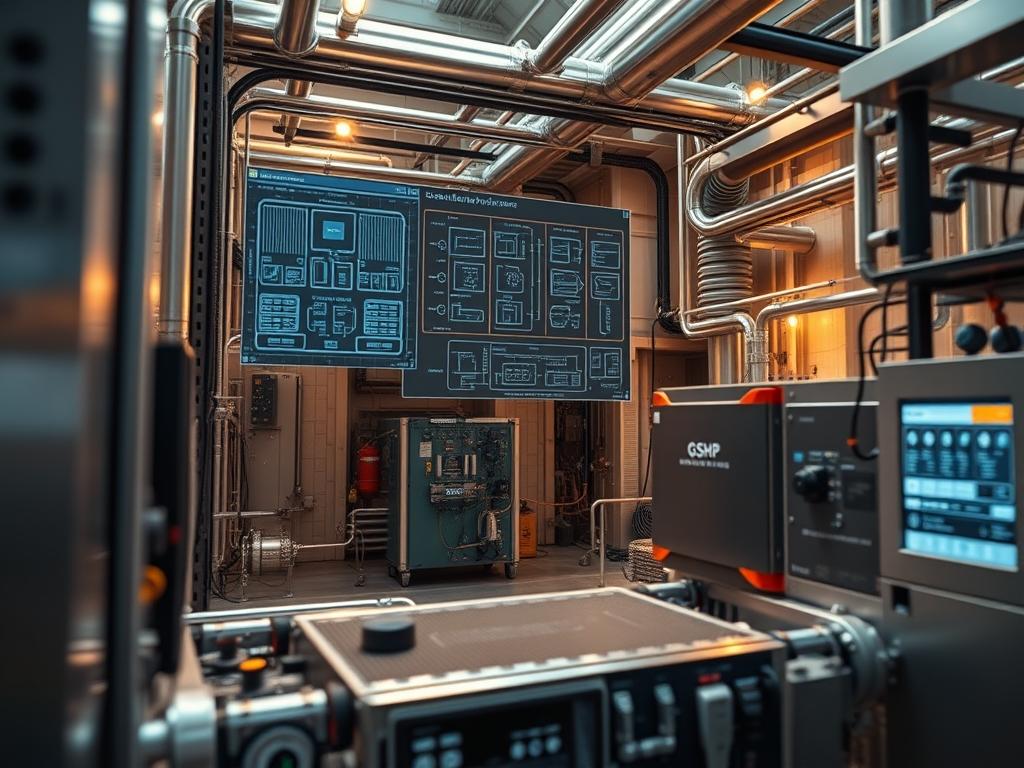
Ground source heat pump (GSHP) systems rely on the thermal exchange efficiency of the ground loop, specifically quantified by the GSHP Source Side Delta T. This metric defines the temperature differential between the entering source fluid (ESF) and the leaving source fluid (LSF). In contemporary energy infrastructure, this serves as the primary thermal-inertia regulator. If the delta is too narrow, the system experiences excessive pumping overhead without a corresponding increase in thermal throughput; if the delta is too wide, the heat pump may trigger low-pressure faults or suffer localized freezing. Optimizing this variable is essential for maintaining a high Coefficient of Performance (COP) and ensuring the long-term stability of the geothermal field. By tuning the source side flow rates, engineers balance the payload of heat energy against the energy consumed by circulator pumps, reaching an idempotent state where thermal extraction is maximized relative to operational cost. This manual outlines the technical framework for auditing and tuning these parameters.
Technical Specifications
| Requirement | Default Operating Range | Protocol/Standard | Impact Level | Recommended Resources |
| :— | :— | :— | :— | :— |
| Flow Rate | 2.5 to 3.0 GPM per Ton | ASHRAE 90.1 | 10 | VFD-driven Circulator |
| Delta T (Heating) | 6 F to 10 F (3.3 C to 5.5 C) | IGSHPA Section 5 | 9 | PT1000 RTD Sensors |
| Delta T (Cooling) | 10 F to 14 F (5.5 C to 7.7 C) | IEEE 519 (VFD) | 8 | Schedule 80 PVC/HDPE |
| Fluid Viscosity | 15 percent to 30 percent Propylene Glycol | ASTM D3306 | 7 | Refractometer |
| Signal Logic | 0 to 10V / 4 to 20mA | Modbus/BACnet | 6 | PLC/Logic Controller |
| Monitoring Port | TCP Port 502 (Modbus) | IPv4/Standard Stack | 5 | 1GB RAM / ARMv7 CPU |
The Configuration Protocol
Environment Prerequisites:
Successful optimization requires adherence to IGSHPA design standards and NEC electrical compliance for localized controller wiring. The system must utilize high-accuracy immersion sensors rather than strap-on thermistors to prevent signal-attenuation caused by pipe wall insulation properties. Access permissions for the Building Automation System (BAS) or the local PLC (Programmable Logic Controller) are required; specifically, the user must have write-access to the VFD (Variable Frequency Drive) speed registers and the PID setpoint parameters.
Section A: Implementation Logic:
The engineering goal is to maintain a Delta T that ensures turbulent flow within the ground loop while minimizing the latency of the thermal response. Heat transfer efficiency is governed by the Reynolds number; flow must remain above the critical transition point (typically 2,500 to 4,000) to ensure the fluid is not acting as an insulator through laminar stratification. However, once turbulence is achieved, increasing the flow rate further yields diminishing returns in thermal throughput while increasing electrical overhead exponentially according to the pump affinity laws. We treat the ground loop as a high-latency energy storage system where idempotent control inputs result in predictable thermal extraction rates.
Step-By-Step Execution
1. Establish Baseline Thermal Telemetry
Utilize a calibrated Fluke-52-II dual-input thermometer to measure the ESF and LSF at the manifold headers. Simultaneously, query the system controller for the current pump frequency in Hertz.
System Note: This step establishes the initial thermal payload transfer rate. Checking the raw sensor values against the BAS console ensures there is no signal-attenuation or sensor drift affecting the controller logic.
2. Verify Flow Rate Idempotency
Use a non-invasive ultrasonic flow meter to correlate GPM with pump Power (kW). Modulate the pump speed via the PLC manual override in 5Hz increments, recording the Delta T at each stage until the system reaches a steady state.
System Note: Modifying the frequency register directly affects the VFD output voltage and frequency; this determines the kinetic energy applied to the fluid. We are seeking the “knee” of the curve where Delta T begins to compress without a significant increase in heat extraction.
3. Configure Variable Speed PID Logic
Access the thermal management service via SSH and navigate to the configuration directory: /etc/hvac/control_logic.conf. Update the proportional, integral, and derivative constants to target the desired GSHP Source Side Delta T.
System Note: Executing a systemctl restart hvac-pid command forces the kernel to reload the instruction set. The PID loop manages the concurrency of multiple heat pump stages by adjusting the pump speed to maintain the Delta T setpoint regardless of the active load.
4. Calibrate the Low-Temperature Cutoff
Set the freeze protection logic within the Logic-Controller firmware. If using a 20 percent glycol mixture, set the LFT alarm at 25 F (-3.8 C) and the hard-shutdown at 20 F (-6.6 C).
System Note: This creates a fail-safe physical logic gate. If the Delta T becomes too wide because of a flow restriction, the controller will execute an emergency stop to prevent ice expansion from rupturing the heat exchanger encapsulation.
5. Validate Communication Throughput
Run a diagnostic on the Modbus network to ensure that Delta T data packets are being received by the master controller without significant latency. Use the command modbus-cli –read –address 40001 –count 10.
System Note: High packet-loss or latency in the control network can lead to “hunting,” where the pump speed oscillates rapidly because of delayed temperature feedback. This reduces the mechanical lifespan of the pump and the VFD.
Section B: Dependency Fault-Lines:
Tuning the Delta T is often hampered by mechanical bottlenecks. A common failure point is the presence of air pockets in the ground loop; air reduces the effective cross-sectional area of the pipe, leading to high pressure drops and erratic Delta T readings. If the pump cannot achieve the required GPM even at 60Hz, check the debris strainer. Another fault-line involves the fluid viscosity. If the glycol concentration is too high, the fluid moves into the laminar flow regime at higher temperatures, causing the Delta T to spike despite high pump speeds. Library conflicts in the PLC firmware can also occur if the Modbus map addresses for the VFD do not align with the sensor input registers, resulting in “null” values for the Delta T calculation.
THE TROUBLESHOOTING MATRIX
Section C: Logs & Debugging:
When the system fails to maintain the targeted GSHP Source Side Delta T, the operator must first verify the integrity of the data stream. Logs are typically stored in /var/log/hvac/thermal_engine.log.
- Error Code E04 (Low Delta T): Indicates excessive flow or a failed compressor stage. Check if the compressor is drawing the rated amperage using a Fluke-376-FC clamp meter.
- Error Code E12 (High Delta T): Indicates low flow or loop obstruction. Verify the VFD status; if the drive is at 60Hz but flow is low, investigate the pump impeller or check for closed header valves.
Erratic Delta T (Fluctuations): Often a symptom of packet-loss* in the RS-485 serial chain or air in the lines. Inspect the shielding on the sensor wires to minimize electromagnetic interference (EMI).
- Sensor Drift (Static Delta T): If the Delta T remains constant regardless of pump speed, the sensors may have failed. Verification is done by placing both ESF and LSF sensors in an ice bath to check for 32 F (0 C) calibration.
OPTIMIZATION & HARDENING
Performance Tuning
To maximize throughput, implement a “Reset Logic” based on outdoor ambient temperatures. During peak winter, the Delta T can be stretched to 10 F to prioritize heat extraction, while in shoulder seasons, the Delta T should be narrowed to 6 F to maximize the COP of the compressor. This dynamic setpoint adjustment reduces the cumulative overhead of the pump over the annual cycle. Ensure that the latency of the PID response is tuned so that the pump does not over-correct during stage transitions.
Security Hardening
The control interface for the GSHP Source Side Delta T must be isolated from the public internet. Ensure the PLC resides on a dedicated VLAN with strict firewall rules; only the head-end server should be allowed to communicate over Port 502 (Modbus). Physically, all sensor wiring should be in grounded EMT conduit to prevent signal hijacking or noise injection. Implement “Passphrase-Level” access for any setpoint changes in the HMI (Human-Machine Interface).
Scaling Logic
For multi-megawatt installations, the “Master-Slave” manifold architecture is used. In this configuration, the primary pump logic treats the entire ground loop field as a single thermal payload. As additional heat pumps are brought online (concurrency), the master controller calculates the instantaneous BTU demand and scales the VFD frequency of the central pump station. This ensures that the Delta T remains consistent across the entire infrastructure, preventing thermal “short-circuiting” where one loop is over-taxed while another remains stagnant.
THE ADMIN DESK
Why is my Delta T staying below 3 degrees?
This usually indicates a “short-circuit” in the piping where fluid is bypassing the main heat exchanger. Check for open cross-over valves or a stuck internal bypass. It may also mean the pump is significantly oversized for the thermal load.
Can I run the system with a 15 degree Delta T?
While this reduces pumping overhead, it increases the risk of the refrigerant-to-water heat exchanger freezing. Most manufacturers forbid a Delta T this wide because it lowers the evaporating temperature, which significantly degrades the system COP and longevity.
How does fluid viscosity affect the Delta T?
As temperatures drop, glycol becomes more viscous. This increases the friction per foot of pipe, requiring more power to maintain the same flow. If viscosity is too high, the pump may reach its “end of curve,” decreasing Delta T.
What causes Modbus “Timeout Errors” during tuning?
This is often due to signal-attenuation on long RS-485 runs. Ensure you have a 120-ohm terminating resistor at the end of the bus. If the problem persists, reduce the baud rate to 9600 to improve signal stability.
Is it better to control by flow or by Delta T?
Delta T control is superior for energy efficiency. Controlling by flow ignores the actual thermal energy being moved. Delta T control ensures that the pump only works as hard as necessary to deliver the required thermal payload.