
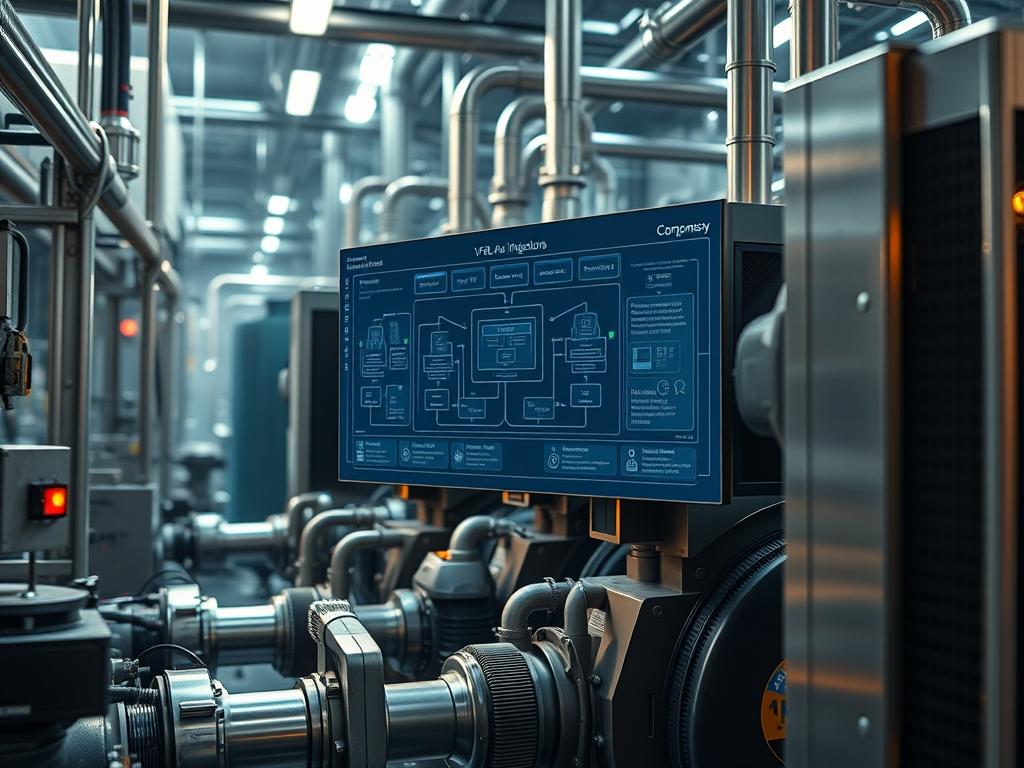
VFD Compressor Integration represents a critical evolution in industrial thermal management and energy infrastructure. In traditional fixed-speed systems, compressors operate on a binary basis: they are either fully engaged or entirely dormant. This lack of granularity introduces significant inefficiencies during part-load conditions, which typically account for over 90 percent of a facility’s annual runtime. By implementing a Variable Frequency Drive (VFD), systems architects can modulate the rotational speed of the compressor motor to match the instantaneous cooling or heating demand. This integration exists at the intersection of power electronics, thermodynamic modeling, and digital control logic.
The problem-solution context is centered on the mitigation of energy waste and mechanical wear. Fixed-speed cycles result in “short-cycling,” where frequent starts and stops increase thermal-inertia lag and introduce mechanical stress. VFD Compressor Integration solves this by providing continuous, modulated output. This achieves higher throughput efficiency and reduces the parasitic overhead of high in-rush currents. Within a broader technical stack; such as a Tier IV data center or a large-scale industrial chilled water loop; VFD integration serves as the physical execution layer for the logic-driven energy management system.
TECHNICAL SPECIFICATIONS
| Requirement | Default Port / Operating Range | Protocol / Standard | Impact Level (1-10) | Recommended Resources |
| :— | :— | :— | :— | :— |
| Logic Controller | 0-10V DC / 4-20mA | Modbus TCP/RTU | 9 | PLC CPU with 512MB RAM |
| Input Power | 480V AC (3-Phase) | IEEE 519 (Harmonics) | 10 | Copper Busbar Class F |
| Carrier Frequency | 2 kHz – 15 kHz | Pulse Width Modulation | 7 | Insulated Gate Bipolar Transistor (IGBT) |
| Communication | Port 502 (Modbus) | Ethernet/IP or BACnet | 8 | Cat6e Shielded / STP |
| Cooling Media | -20C to +50C | ASHRAE 15 / 34 | 6 | High-Density Thermal Paste |
THE CONFIGURATION PROTOCOL
Environment Prerequisites:
Successful deployment requires strict adherence to international electrical and data standards. The hardware environment must comply with IEEE 519 guidelines for controlling harmonic distortion in power systems. On the software side, the integration gateway requires Node-RED or a proprietary BMS (Building Management System) framework with administrative privileges. Ensure all RS-485 communication lines utilize shielded twisted-pair cabling to prevent signal-attenuation in high-EMI environments. The technician must possess a Level 3 Infrastructure Access certificate and a calibrated fluke-multimeter for voltage verification.
Section A: Implementation Logic:
The theoretical foundation of VFD Compressor Integration is rooted in the Affinity Laws for centrifugal loads. Power consumption is proportional to the cube of the motor speed; therefore, a 20 percent reduction in speed can yield nearly a 50 percent reduction in energy usage. The integration logic utilizes a Proportional-Integral-Derivative (PID) loop to bridge the gap between the digital setpoint and the physical mass flow. The payload of the control packet contains the frequency command, while the drive returns metadata regarding current draw and torque. By maintaining a constant suction pressure rather than a binary temperature threshold, the system minimizes latency in response to load fluctuations and ensures that thermal-inertia does not lead to overshoot or hunting.
Step-By-Step Execution
1. Physical Interface and Power Rail Installation
Begin by mounting the VFD Chassis within 3 meters of the Compressor Motor to minimize cable capacitance. Connect the main three-phase feed to the L1, L2, L3 terminals.
System Note: Using a fluke-376-fc clamp meter, verify that the line voltage is balanced within 2 percent. This step prepares the physical layer to handle the high-amperage throughput required during peak ramp-up.
2. Communication Bus Encapsulation
Route the RS-485 or Ethernet cable from the PLC to the VFD communication module. If using Modbus, configure the device ID and parity settings on the drive’s local HMI.
System Note: This step establishes the transport layer for the control payload. Ensure the termination resistor (120 ohms) is engaged to prevent signal reflection that might cause packet-loss in the data stream.
3. Software Gateway Initialization
Access the control server via SSH and navigate to the configuration directory, typically /etc/bms/drivers/. Edit the vfd_config.json file to map the register addresses for Frequency Command (40001) and Output Current (40002).
System Note: Run systemctl restart bms-gateway to apply the changes. This action initializes the software hooks that allow the kernel to interact with the industrial hardware via an idempotent configuration script.
4. PID Loop Calibration and Tuning
Enter the PID Tuning Interface within the PLC software. Set the proportional gain (Kp) to 1.2 and the integral time (Ti) to 30 seconds as a baseline.
System Note: Monitor the system for oscillation. Proper tuning ensures that the latency of the refrigerant cycle is compensated for by the logic controller, preventing mechanical surging and optimizing part-load stability.
5. Final Safety Interlock Verification
Wire the Hard-Wired E-Stop and the High-Pressure Cutout into the VFD digital input terminals designated for External Fault.
System Note: Use chmod +x /usr/local/bin/safety_check.sh to run a diagnostic script that simulates a fault condition. This ensures the system maintains physical fail-safe logic regardless of the software state.
Section B: Dependency Fault-Lines:
Integration often fails due to a mismatch between the VFD carrier frequency and the motor insulation class. Older motors may suffer from Corona Discharge if the VFD output is too aggressive. Another common bottleneck is the concurrency of polling; if the PLC requests data from too many drives simultaneously, the Modbus RTU bus may experience collisions and timeout errors. High signal-attenuation in long cable runs can also lead to intermittent drive trips.
THE TROUBLESHOOTING MATRIX
Section C: Logs & Debugging:
When a fault occurs, the first point of inspection should be the VFD fault queue, accessible via the HMI or the file path /var/log/vfd/error.log on integrated systems.
Error Code O.L (Overload): Indicates the motor is drawing current beyond its nameplate rating. Check for mechanical seizure or excessive thermal-inertia* in the evaporator.
Error Code U.V (Under Voltage): Suggests a drop on the DC bus. Inspect the input contactors and verify there is no significant voltage drop during high throughput* periods.
Error Code CE (Comm Error): This points to packet-loss* or incorrect baud rate settings. Verify the Modbus mapping and check for electromagnetic interference near the signal wires.
Visual Cue: If the VFD display flickers, check the ground loop. A floating ground can cause substantial signal-attenuation* and lead to phantom trips.
OPTIMIZATION & HARDENING
Performance Tuning:
To maximize efficiency, implement a “Skip Frequency” band. Every mechanical system has a resonant frequency where vibration is maximized. By identifying these ranges (e.g., 22Hz to 25Hz) and configuring the VFD to transition through them rapidly, you protect the Compressor Crankshaft from premature failure. Additionally, adjust the V/Hz Curve to “Variable Torque” mode to further reduce overhead during extreme part-load conditions.
Security Hardening:
Industrial networks are increasingly targets for exploit. Ensure the PLC and VFD Gateway are behind a dedicated firewall. Disable all unused ports such as Telnet or HTTP on the VFD communication card. Use iptables to restrict access to the Modbus Port 502 only to known IP addresses of the control server. Physical hardening includes locking the VFD enclosure to prevent unauthorized manual overrides of the frequency setpoints.
Scaling Logic:
For facilities with multiple compressors, implement a “Lead-Lag” strategy. Instead of running one compressor at 100 percent and another at 0 percent, use the VFDs to run both at 50 percent. Due to the cubic nature of the Power Law, two compressors at half-speed consume significantly less power than one at full-speed. The concurrency logic in the PLC should manage the rotation of the “Lead” unit to equalize run-hours across the fleet.
THE ADMIN DESK
How do I handle VFD-induced harmonic distortion?
Install an Active Harmonic Filter or a Line Reactor on the input side of the VFD. This reduces the total harmonic distortion (THD) to under 5 percent, ensuring compliance with IEEE 519 and protecting sensitive electronics.
What causes the “Motor Hunting” effect at low speeds?
This is typically caused by poorly tuned PID gains or high latency in the pressure transducers. Reduce the Proportional Gain and increase the Integral Time to dampen the response and stabilize the compressor RPM.
Can I run a standard motor on a VFD?
Standard motors lack “Inverter Duty” insulation. High-frequency voltage spikes can degrade the winding insulation over time. For long-term reliability, always specify NEMA MG-1 Part 31 compliant motors for VFD Compressor Integration projects.
What is the maximum distance for the control signal?
For RS-485, the limit is 1,200 meters at lower baud rates. However, signal-attenuation becomes a factor beyond 300 meters in industrial environments. Use Signal Repeaters or transition to Fiber Optic to maintain data integrity.
How does VFD integration impact the lubricant cycle?
Low-speed operation reduces refrigerant velocity, which can hinder oil return to the Compressor Sump. Implement an automated “Oil Recovery Cycle” where the VFD ramps to 100 percent speed for 60 seconds every hour to clear the lines.