
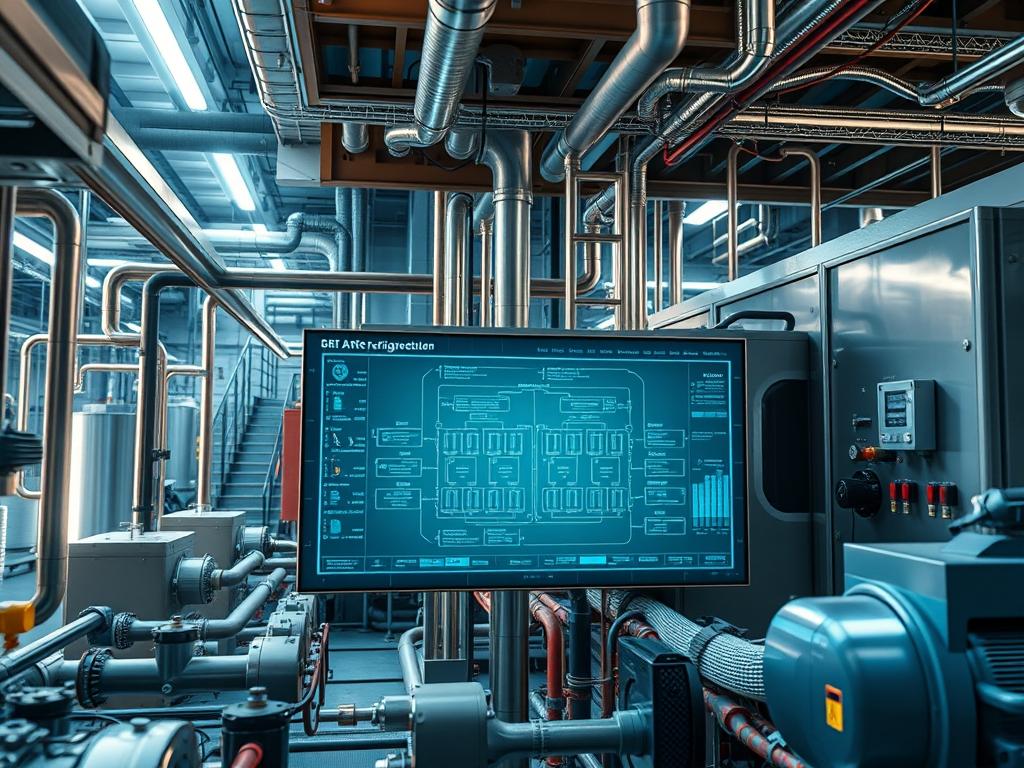
Industrial Refrigeration SCADA (Supervisory Control and Data Acquisition) systems function as the operational backbone for large scale thermal management in environments such as cold storage, chemical processing, and pharmaceutical manufacturing. These platforms reside at the intersection of mechanical engineering and high availability computing. Their primary role is to orchestrate the vapor compression cycle across a distributed fleet of compressors, condensers, and evaporators. By integrating real time sensor data with automated control logic, a well architected SCADA solution ensures that thermal setpoints are maintained with minimal energy consumption. Within the modern technical stack, these systems bridge the gap between field level Programmable Logic Controllers (PLCs) and cloud based analytics engines. The fundamental problem addressed by this orchestration is the management of fluctuating thermal loads while avoiding the high costs of peak demand energy usage. The solution involves a centralized monitoring framework that treats the entire refrigeration fleet as a single, programmable entity; this allows for synchronized load shedding and optimized defrost scheduling.
TECHNICAL SPECIFICATIONS
| Requirement | Default Port/Operating Range | Protocol/Standard | Impact Level (1-10) | Recommended Resources |
| :— | :— | :— | :— | :— |
| PLC Communication | Port 502 (Modbus) | Modbus TCP/IP | 10 | 4GB RAM / Dual Core CPU |
| Field Bus Connectivity | 9600 to 115200 Baud | RS-485 / Profibus | 8 | Shielded Twisted Pair |
| Telemetry Ingress | Port 1883 (MQTT) | MQTT v5.0 | 7 | 100Mbps Throughput |
| Operating Temperature | -20C to +60C | NEMA 4X / IP66 | 9 | Stainless Steel Enclosure |
| Sensor Accuracy | +/- 0.1 Degree Celsius | 4-20mA Analog Loop | 9 | NIST Traceable RTDs |
| Database Storage | SQL / NoSQL Hybrid | T-SQL | 6 | 500GB SSD (RAID 1) |
THE CONFIGURATION PROTOCOL
Environment Prerequisites:
Before initiating the deployment, verify that all hardware complies with NEC (National Electrical Code) Article 110 regarding electrical clearances and IEEE 802.3 standards for Ethernet connectivity. The administrative user must possess sudo privileges on the primary SCADA_SERVER and read/write access to the PLC_REGISTRY. Ensure that the OpenSSL library is updated to version 3.0 or higher to facilitate secure encapsulation of data packets during transmission between the site and the cloud.
Section A: Implementation Logic:
The engineering design of a refrigeration fleet relies on the principle of distributed autonomy. While the SCADA system provides the high level orchestration, each individual Logic-Controller must be capable of maintaining its specific cooling loop if network latency spikes or connectivity is lost. This design prevents a single point of failure from causing mass product spoilage. We employ an idempotent command structure; sending a “Start Compressor” signal multiple times will not cause a fault if the machine is already running. Furthermore, the system must account for thermal-inertia, recognizing that changes in valve position or motor speed do not result in instantaneous temperature shifts. The logic must calculate the delay between execution and feedback to prevent oscillation in the cooling cycle.
Step-By-Step Execution
1. Initialize the Gateway Service
Run the command systemctl start scada-gateway.service on the master node.
System Note: This command initializes the background daemon responsible for polling field devices. It triggers the kernel to allocate memory buffers for incoming data packets and starts the listener on Port 502.
2. Provision the PLC Network Interface
Access the hardware configuration via ip link set eth0 up followed by assigned static IP mapping.
System Note: Activating the network interface at the physical layer ensures that the logic-controllers can begin the three way handshake required for TCP based communication. This step is critical for minimizing packet-loss in high electrical noise environments.
3. Calibrate the Suction Pressure Transducers
Use a fluke-multimeter to verify the 4-20mA signal at the Analog-Input-Module.
System Note: Hardware calibration ensures that the digital value inside the SCADA software accurately reflects the physical pressure in the suction header. An incorrect reading here leads to improper VFD (Variable Frequency Drive) modulation and excessive energy overhead.
4. Configure MQTT Payload Encapsulation
Edit the configuration file at /etc/scada/mqtt.conf to define the payload structure for cloud reporting.
System Note: Standardizing the JSON structure for telemetry allows the cloud analytics engine to parse data from different fleet nodes without additional transformation logic. This improves the overall throughput of the monitoring pipeline.
5. Establish PID Loop Tuning Parameters
Set the Proportional, Integral, and Derivative constants via the SCADA_CONSOLE using the command set_pid_constants –node_id 001 –p 1.5 –i 0.05 –d 0.1.
System Note: These constants dictate how the Logic-Controller responds to deviations from the setpoint. Proper tuning accounts for the thermal-inertia of the refrigerant, preventing “hunting” where the system overcorrects and causes mechanical wear.
6. Implement Firewall Hardening
Execute iptables -A INPUT -p tcp –dport 502 -s 192.168.1.0/24 -j ACCEPT to restrict access to the control port.
System Note: Restricting the IP range that can communicate with the Modbus stack is the first line of defense against unauthorized command injection. This ensures the concurrency of commands remains within the authorized administrative scope.
Section B: Dependency Fault-Lines:
A frequent bottleneck in large fleets is the signal-attenuation found in long RS-485 cable runs. If the distance between the SCADA headend and the furthest Evaporator-Controller exceeds 1,200 meters without a repeater, data corruption is inevitable. On the software side, library conflicts often arise when the Python environment used for custom automation scripts interacts with legacy C++ drivers. Ensure that all dependencies are isolated within a virtual environment using venv to avoid breaking the system-wide glibc reference. Finally, mechanical bottlenecks such as fouled condenser coils can masquerade as software sensor errors because the system will fail to reach setpoints despite 100 percent throughput from the compressors.
THE TROUBLESHOOTING MATRIX
Section C: Logs & Debugging:
When a node fails to respond, the first point of inspection is the runtime log located at /var/log/scada/communication.log. Look for error strings such as “Timeout secondary response” or “Illegal Data Address.” These indicate that the SCADA master is attempting to poll a Modbus register that does not exist on the physical PLC. For physical sensor verification, check the Diagnostic-LEDs on the I/O-Module: a blinking red light typically signifies a broken wire or a short circuit in the 4-20mA loop.
If the system experiences high latency in the HMI (Human Machine Interface) updates, check for network congestion using nload. If the throughput is saturated, verify that no other services are using the dedicated OT (Operational Technology) bandwidth. For persistent connection drops, inspect the RS-485 termination resistors; an unterminated bus will cause reflections and significant signal-attenuation, leading to erratic behavior in the lower tiers of the stack.
OPTIMIZATION & HARDENING
Performance tuning in an industrial refrigeration context centers on reducing the cycles of the Ammonia-Compressors. By increasing the deadband in the SCADA configuration, you allow for more significant temperature float, which reduces the frequency of motor starts. This extends the lifespan of the hardware and reduces the electrical overhead of the facility. Concurrency management is also vital; the system should be configured to stagger the startup of large motors to prevent a massive voltage drop across the local grid.
Security hardening must involve the implementation of a “Fail-Safe” logic at the PLC level. In the event of a total SCADA server failure, the logic-controllers must revert to a local control mode based on hard wired pressure switches. This physical fallback ensures that even if the network is compromised or suffers total packet-loss, the refrigeration plant remains within safe operating pressures. Administratively, utilize chmod 700 on all sensitive configuration directories to ensure that only the scada-admin user can read the industrial logic files.
The scalability of the system is achieved through “Node-Cloning.” When adding a new warehouse to the fleet, the SCADA configuration should be deployed as an idempotent containerized image. This ensures that the environment variables, driver versions, and communication protocols remain consistent across the entire geographic footprint of the organization.
THE ADMIN DESK
How do I reset a “Communication Fault” on a specific compressor?
Verify the physical link between the Gateway and the PLC. Once the link is confirmed, use the command scada-cli reset-node –id [NODE_ID] to clear the software latch and resume data polling.
Why is there a discrepancy between the HMI and the local gauge?
This usually stems from signal-attenuation or lack of calibration. Check the scaling factors in the SCADA database; ensure the 4mA and 20mA values correctly map to the physical range of the Pressure-Transducer.
What is the safe threshold for network latency?
For industrial control, latency should remain under 100ms. Anything higher can cause the PID loops to become unstable, as the feedback payload arrives too late for the logic to make accurate adjustments to the VFD speed.
Can I run the SCADA host on a virtual machine?
Yes; however, you must ensure “High Availability” is enabled and the VM has direct “Passthrough” access to the physical Serial-Ports or NICs to minimize communication overhead and prevent hardware abstraction errors.
How do I handle a “Disk Full” error on the logging server?
Implement a log rotation policy using logrotate. Configure it to compress files older than seven days and delete logs older than thirty days to ensure the SQL database has sufficient room for real time telemetry.