
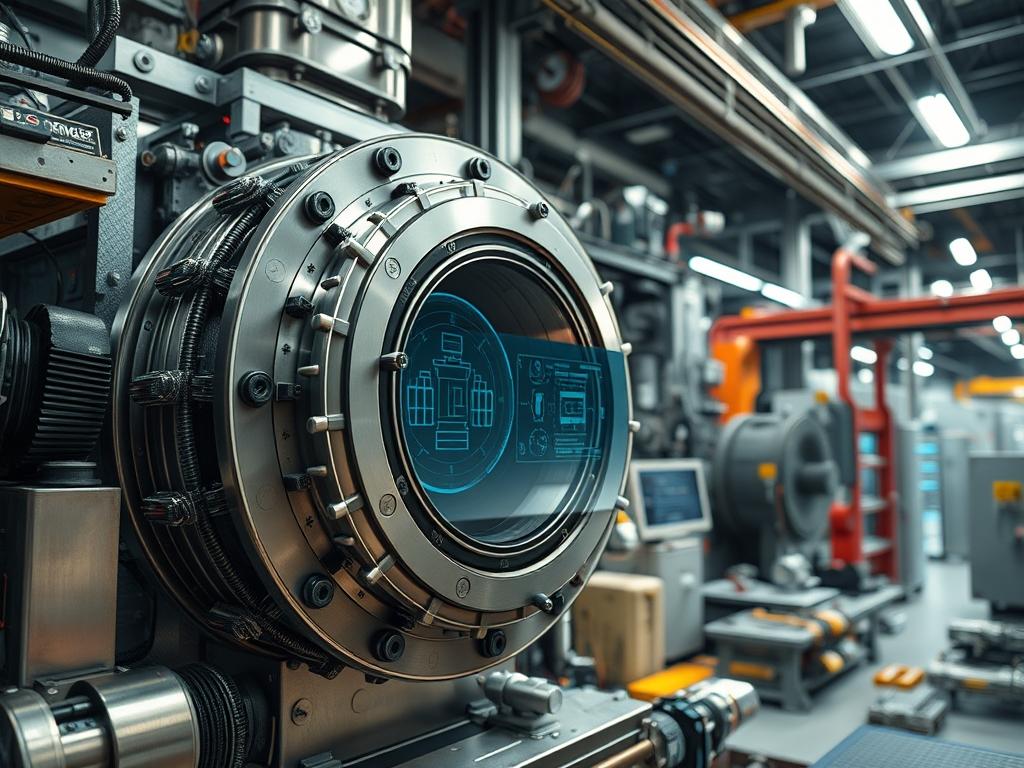
Magnetic Bearing Centrifugal compressors represent a paradigm shift in high-capacity mechanical systems by eliminating physical contact between the rotor and the stator. This technological leap addresses the inherent latency and mechanical degradation found in hydrodynamic or hydrostatic bearing systems. In mission-critical environments such as cloud Tier-4 data centers or municipal water treatment plants; the elimination of oil-lubricated circuits reduces system overhead and maintenance complexity. The primary problem solved by this configuration is the high thermal-inertia and friction-based energy loss typical of traditional centrifugal designs. By utilizing an Active Magnetic Bearing (AMB) system; the infrastructure achieves unprecedented throughput with minimal acoustic signatures. This manual defines the operational parameters required to achieve near-zero friction through the deployment of digital control logic; high-frequency power electronics; and real-time sensor feedback loops. The objective is to stabilize the rotor at high angular velocities while maintaining system-wide idempotency across long-duration duty cycles.
TECHNICAL SPECIFICATIONS
| Requirement | Default Port/Operating Range | Protocol/Standard | Impact Level (1-10) | Recommended Resources |
| :— | :— | :— | :— | :— |
| DC Bus Voltage | 300V – 650V DC | IEEE 519 | 9 | High-Capacity Capacitors |
| Control Loop Frequency | 10 kHz – 20 kHz | PWM (Pulse Width) | 10 | Quad-Core DSP |
| Communication Interface | Port 502 | Modbus TCP/IP | 7 | Shielded CAT6A |
| Backup Power (UPS) | 2-5 Minutes | SEMI F47 | 10 | Flywheel or Li-ion |
| Sensor Accuracy | < 0.001 mm | Analog 0-10V / Digital | 8 | Eddy Current Probes |
| Ambient Temperature | 0C - 40C | IEC 60068 | 6 | NEMA 4X Enclosure |
THE CONFIGURATION PROTOCOL
Environment Prerequisites:
Successful deployment requires adherence to IEEE C57.13 for instrument transformers and NEC Article 430 for motor installations. The control software must support RESTful API integration for remote telemetry. Users must possess Superuser/Admin permissions on the Master Logic Controller (MLC) and have physical access to the high-frequency drive (HFD) bay. All Eddy Current Sensors must be calibrated to a zero-point baseline with a tolerance of less than 5 micrometers.
Section A: Implementation Logic:
The engineering design relies on the principle of active levitation; where five degrees of freedom are controlled by electromagnetic actuators. Unlike traditional bearings; the Magnetic Bearing Centrifugal system uses an idempotent control loop to counteract gravity and aerodynamic loads. The “Why” behind this setup is the elimination of mechanical shear. By moving the payload (the rotor) through a magnetic field; we reduce the thermal-inertia of the system. This allows for higher rotational speeds without the risk of oil-film breakdown or localized overheating. The encapsulation of the control logic within a high-speed Digital Signal Processor (DSP) ensures that any deviation in rotor position is corrected within microseconds; preventing physical contact even during surge conditions.
Step-By-Step Execution
1. Verification of DC Bus Pre-Charge
Ensure the High-Voltage DC Bus is charged to the minimum threshold defined in the hardware manual using a fluke-multimeter.
System Note: This action ensures that the magnetic actuators have sufficient current available to overcome the static inertia of the rotor during the initial lift sequence.
2. Initialize Sensor Feedback Calibration
Execute the command mb-sensor-cal –auto-zero via the primary logic-controller interface.
System Note: This calibrates the displacement sensors; ensuring the controller has an accurate map of the rotor’s physical center within the bearing housing.
3. Establish Magnetic Levitation (Static Lift)
Activate the levitation sequence using the command systemctl start amb-levitation.service on the control node.
System Note: The kernel begins processing PWM signals at 15 kHz to energize the radial and axial magnets; lifting the rotor into a suspended state.
4. Configure Variable Frequency Drive (VFD) Parameters
Use the vfd-config –set-hz 600 –ramp-up 120s tool to define the acceleration curve.
System Note: Mapping the ramp-up speed prevents mechanical resonance and limits harmonic distortion within the power grid.
5. Deployment of PID Control Tuning
Load the Proportional-Integral-Derivative coefficients into the Active-Bearing-Controller (ABC) using an .xml or .json payload.
System Note: This step fine-tunes the stiffness and damping of the magnetic field; minimizing orbit vibrations as the compressor reaches its target RPM.
6. Integration with SCADA Telemetry
Map the Modbus registers to the SCADA head-end using the local IP address and Port 502.
System Note: Encapsulation of real-time data allows for monitoring of power consumption; bearing temperature; and vibration spectra.
Section B: Dependency Fault-Lines:
The most common failure point is signal-attenuation in the sensor cables. If the shielded twisted-pair cables are run parallel to high-voltage lines; EMI (Electromagnetic Interference) can induce packet-loss or noise in the position feedback loop. Another bottleneck is the “Drop-Down” event caused by transient power dips. If the UPS is not sized correctly; the rotor will land on its auxiliary “catcher” bearings; causing significant mechanical stress. Ensure that all Firmware versions for the VFD and the AMB controller are synchronized; as mismatched logic protocols can lead to erratic rotor behavior during high-load throughput.
THE TROUBLESHOOTING MATRIX
Section C: Logs & Debugging:
When a fault occurs; the system will log a specific error code to /var/log/amb/critical.log.
– Error E001 (Position Deviation): This indicates that the rotor has exceeded its orbital limits. Check the sensor readout at /dev/sensors/radial_pos. If the values oscillate; check for liquid slugging in the compressor stage.
– Error E042 (Over-Current): Usually signifies a short in the actuator coils. Use a megohmmeter to test the insulation resistance of the magnet windings.
– Error E099 (Communication Timeout): Signals a latency issue on the Modbus network. Verify network throughput and check for loose RJ45 connections.
Physical cues: If a high-pitched whine is heard; it usually indicates a high-frequency resonance in the PID loop; requiring a reduction in the “Gain” parameter.
OPTIMIZATION & HARDENING
Performance Tuning:
To maximize thermal efficiency; the system should be tuned for “Soft Levitation” during idle periods. This reduces power consumption by lowering the bias current in the magnets. During high throughput; increase the PID stiffness coefficients to handle increased aerodynamic payload. Reducing the latency between the sensor input and the PWM output is critical for stable operation at speeds above 40,000 RPM.
Security Hardening:
The control network should be isolated from the corporate WAN via a Firewall. Implement strict chmod 700 permissions on all configuration directories. Hardware-level fail-safes must include an “Emergency Stop” that is hard-wired to the DC Bus discharge circuit; bypassing the software layer entirely to ensure safety during a catastrophic failure.
Scaling Logic:
When expanding to a multi-compressor array; use a “Master-Follower” architecture. This ensures concurrency across the fleet. Scaling requires a robust load-balancing algorithm that accounts for the thermal-inertia of individual units; distributing the mass flow in a way that minimizes total energy consumption.
THE ADMIN DESK
Q1: What triggers an unplanned rotor landing?
Usually; this is caused by a total loss of DC power or a sensor feedback failure. If the system detects that it can no longer maintain levitation; it executes a controlled drop onto the ceramic catcher bearings to prevent contact with the stator.
Q2: How do I reduce acoustic noise in the bearing?
Noise is often a byproduct of high-frequency switching. Adjusting the PWM carrier frequency or fine-tuning the derivative (D) gain in the PID loop can dampen the vibrations that cause audible resonance in the compressor casing.
Q3: Is oil completely removed from this system?
Yes. The Magnetic Bearing Centrifugal design is 100% oil-free. This eliminates the need for oil pumps; filters; coolers; and separators; significantly lowering the maintenance overhead and the potential for process contamination.
Q4: Can EMI affect the bearing stability?
Absolutely. High levels of electromagnetic interference can cause signal-attenuation in the displacement sensors. Proper grounding and the use of shielded cables are mandatory to maintain the integrity of the high-speed control loop.
Q5: What is the lifespan of the catcher bearings?
Catcher bearings are designed for a finite number of “full-speed” drops; typically between 5 and 20. After any landing event; a physical inspection is required to ensure no flat-spotting or surface fatigue has occurred.