
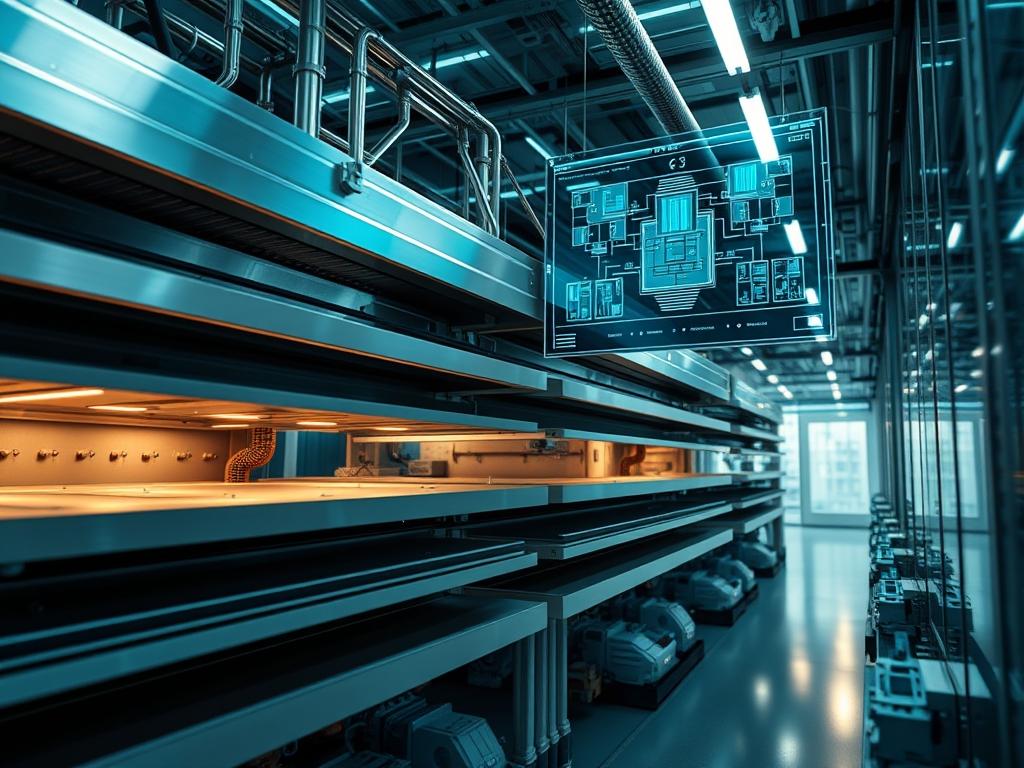
Passive Cooling Security Louvers represent a critical hardware-layer intersection between physical site hardening and thermal management. In high-density environments such as edge data centers, modular cryptocurrency mines, or sensitive telecommunications hubs, the primary technical challenge is the dissipation of high-wattage thermal payloads without compromising the physical perimeter. Traditional HVAC systems introduce significant operational overhead and potential points of failure; conversely, passive systems leverage atmospheric pressure differentials to drive airflow. These louvers serve as a high-throughput interface that maintains an idempotent state of security while facilitating massive air exchange. By utilizing specific blade geometries, these components minimize static pressure loss while successfully mitigating the risk of unauthorized physical penetration or “backdoor” entry via exhaust ports. The engineering goal is to maximize the volumetric flow rate while ensuring that the physical encapsulation of the internal technical stack remains inviolate against forced entry or ballistic threats.
TECHNICAL SPECIFICATIONS
| Requirement | Default Operating Range | Protocol/Standard | Impact Level | Recommended Resources |
| :— | :— | :— | :— | :— |
| Volumetric Throughput | 500 to 5000 CFM | ASHRAE 90.1 | 9 | Grade 6061 Aluminum |
| Static Pressure Drop | 0.05 to 0.25 in. w.g. | AMCA Standard 500-L | 7 | Aerofoil Blade Profile |
| Security Rating | Level 1 to 3 Ballistic | UL 752 / NIJ 0108.01 | 10 | Hardened AR500 Steel |
| Operating Temp | -40C to +85C | ASTM E119 | 6 | Thermal Break Gaskets |
| Logic Integration | 0-10V or 4-20mA | BACnet / Modbus RTU | 8 | PLC / Logic-Controllers |
THE CONFIGURATION PROTOCOL
Environment Prerequisites:
Successful deployment requires a structural load-bearing analysis of the mounting substrate to ensure it can support the weight of heavy-duty security louvers. Minimum version requirements include compliance with NEC Article 110.26 for working space and ASHRAE thermal guidelines for equipment intake. User permissions must include “Certified Installer” status for physical assembly and “Root/Admin” access to the Building Management System (BMS) for sensor integration.
Section A: Implementation Logic:
The logic of Passive Cooling Security Louvers is rooted in the Bernoulli Principle and the management of thermal-inertia. By constructing an inverted-V or Z-blade profile, the louver creates a non-linear path for incoming objects while allowing air packets to maintain laminar flow trajectories. This configuration reduces the signal-attenuation of airflow while providing a physical payload block. The engineering intent is to minimize “vortex shedding” at the blade tips, which otherwise creates turbulence and increases the latency of heat dissipation away from the server racks.
STEP-BY-STEP EXECUTION
1. Site Calibration and Ambient Delta Mapping
Begin by measuring the baseline static pressure inside the facility versus the external atmosphere using a Fluke 922 Airflow Meter. System Note: This action establishes the pressure gradient that will drive passive cooling; failing to document this prevents accurate calculation of the required louver surface area.
2. Structural Substrate Preparation
Drill mounting points into the concrete or steel frame using High-Torque Impact Drivers. Ensure all holes are treated with anti-corrosive agents to prevent oxidation. System Note: The physical chassis of the louver acts as a heat sink; poor contact with the substrate can lead to resonant vibrations that degrade high-frequency hardware components nearby.
3. Blade Angle Configuration
Adjust the adjustable louver slats to the calculated “Optimal Flow Angle” (usually 35 to 45 degrees) and lock them using Security-Torx Fasteners. System Note: This step determines the balance between security (visual occlusion) and throughput (air volume). Narrower angles increase safety but introduce significant overhead in air resistance.
4. Logic-Controller Sensor Integration
Connect the PT100 RTD Thermal Sensors located at the louver intake to the PLC-Controller via shielded twisted-pair cabling. Path: /dev/ttyUSB0 or Modbus Address 0x01. System Note: This allows the BMS to monitor for “Thermal Bypass” scenarios where hot exhaust air is recirculated into the intake louvers due to external wind patterns.
5. Perimeter Seal Audit
Apply Industrial Grade Weatherstripping and RTV Silicone around the perimeter of the Louver Housing. System Note: This prevents “Air Leaking” which bypasses the louver’s intended path, ensuring all air entering the facility is filtered and directed through the intended cooling aisles.
6. Ballistic Shield Verification
Install the secondary Gratings or Mesh Screens on the interior side of the louver. System Note: This reinforces the physical security layer, providing a fail-safe against smaller projectiles that might penetrate the primary blade gaps.
Section B: Dependency Fault-Lines:
Installation failures typically stem from a mismatch between the louver’s “Free Area” and the cooling requirements of the internal hardware. If the louver is undersized, the server fans will increase RPM to compensate for the static pressure, leading to high power consumption and potential fan motor failure. Another bottleneck is “Galvanic Corrosion” where dissimilar metals (e.g., aluminum louvers against a steel frame) lead to structural degradation over time. Use Dielectric Spacers to mitigate this conflict.
THE TROUBLESHOOTING MATRIX
Section C: Logs & Debugging:
When diagnosing thermal issues, administrators should first inspect the BMS Event Log for “High Delta-P” alerts.
- Error Code 0x44 (High Static Pressure): Indicates the louvers are obstructed or the intake-to-exhaust ratio is unbalanced. Check for debris in the blade gaps.
- Error Code 0x92 (Thermal Recirculation): Hot air is looping back into the intake. Review sensor data at path: /var/log/thermal_audit.log to identify external wind pressure issues.
- Physical Symptom (Whistling/Acoustic Resonance): This is caused by high-velocity air passing over sharp edges at specific frequencies. Use a Sound Level Meter to identify the resonant blade and apply Damping Dampers or adjust the blade angle by +/- 2 degrees.
Verify sensor readout accuracy by comparing the Modbus Register 40001 (Internal Temp) against a handheld Infrared Thermometer reading. Discrepancies greater than 2 degrees Celsius require re-calibration of the idempotent sensor offset in the controller firmware.
OPTIMIZATION & HARDENING
Performance Tuning:
To increase throughput without expanding the physical footprint, implement “Vane Axial” fans in a “Pull” configuration behind the louvers. This reduces the reliance on passive pressure and allows for higher concurrency in air-packet movement during peak thermal loads. Ensure that the blade surfaces are coated with a hydrophobic finish to reduce dust accumulation and skin friction, which can marginally improve laminar flow characteristics.
Security Hardening:
Physical security is hardened by integrating “Intrusion Detection Sensors” (IDS) directly onto the louver frame. These sensors should be wired into the facility’s Alarm Partition 02. For critical infrastructure, utilize “Non-Line-of-Sight” (NLOS) blade designs that prevent the use of fiber-optic scopes to peek inside the facility. Ensure all external fasteners are Tamper-Proof and recessed into the frame to prevent removal with standard tools.
Scaling Logic:
Scaling a passive cooling setup requires a modular approach. Rather than increasing the size of a single louver, which can introduce structural weak points, deploy “Parallel Louver Arrays.” This maintains the structural integrity of the wall while increasing the total “Free Area.” When scaling, monitor the “Stack Effect” in tall buildings; louvers at lower levels may experience higher intake pressures than those at the top, requiring differential blade tuning to maintain uniform internal pressure.
THE ADMIN DESK
How do I clean louvers without bypassing security?
Use high-pressure compressed air from the interior to push debris outward. For stubborn buildup, use a long-reach soft brush through the slats. Never remove the Security Grills while the facility is in an “Armed” state.
What is the “Free Area” and why does it matter?
Free Area is the total unobstructed space between blades where air can pass. A louver might be 10 square feet, but have only 4 square feet of “Free Area.” This metric is the primary variable for calculating cooling throughput.
Can these louvers stop 7.62mm rounds?
Only if they are rated for UL 752 Level 4 or higher. Standard aluminum louvers are for “Security” (prevention of entry) only. For ballistic protection, specify Hardened Steel or Armored Aluminum variants during the procurement phase.
How do I prevent snow or rain ingress?
Ensure the louver utilizes a “Drainable Blade” design. This features a small gutter at the edge of each blade that directs moisture to the vertical jambs and out the bottom, preventing liquid from reaching the internal payload.
Why is my facility experiencing negative pressure?
Your exhaust fans are likely pulling more air than the intake louvers can provide. Increase the louver “Free Area” or decrease exhaust fan RPM. Sustained negative pressure can make doors difficult to open and pull unfiltered air through small cracks.