
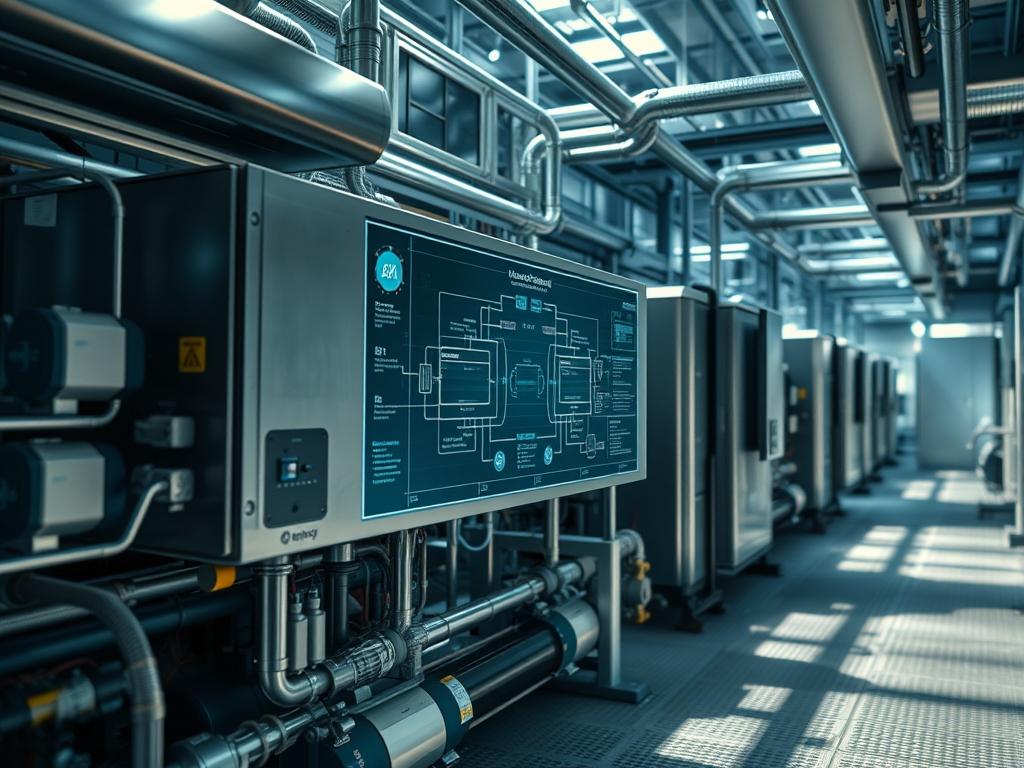
ASHP Refrigerant Recovery Protocols represent the critical convergence of thermodynamic management and environmental governance within the modern energy infrastructure stack. As Air Source Heat Pumps (ASHP) become the primary heating and cooling nodes in high-efficiency building grids; the management of their chemical payloads becomes an architectural priority. These protocols address the physical extraction and containment of high Global Warming Potential (GWP) fluorinated gases during system maintenance, upgrade, or decommissioning. The problem centers on the volatile nature of refrigerants like R-410A and R-32; which exhibit high vapor pressures and rapid expansion rates when released from pressurized circuits. If these substances escape, they contribute significantly to ozone depletion and climate forcing. The solution provided by these protocols is a multi-layered extraction framework that ensures near-zero venting, utilizing specialized hardware and software-driven monitoring to maintain system equilibrium while transitioning the fluid from a liquid or vapor state into a certified recovery vessel.
Technical Specifications
| Requirement | Default Operating Range | Protocol/Standard | Impact Level | Recommended Resources |
| :— | :— | :— | :— | :— |
| Vacuum Depth | 500 Microns or lower | EPA Section 608; ISO 11650 | 10 | 2-Stage Vacuum Pump; 4CFM Minimum |
| Recovery Rate (Liquid) | 2.5 kg/min to 6.0 kg/min | AHRI 740 Standard | 8 | 1.0 HP Oil-less Compressor |
| Pressure Tolerance | 0 PSI to 600 PSI | UL 1963 / ASME Section VIII | 9 | DOT 4BA or 4BW Recovery Cylinder |
| Temperature Range | -10 C to 45 C | ASHRAE 15-2022 | 7 | K-Type Thermocouple Sensors |
| Logic Interface | RS-485 or Bluetooth LE | Modbus / BACnet | 6 | 8GB RAM / Quad-Core ARM Controller |
Environment Prerequisites:
Successful execution of ASHP Refrigerant Recovery Protocols requires strict adherence to regulatory and hardware dependencies. Personnel must possess valid EPA Section 608 Type II or Universal certification; or the regional equivalent such as F-Gas Category 1. Physical dependencies include a fluke-multimeter for electrical safety checks, a calibrated digital-charging-scale, and a high-throughput refrigerant-recovery-machine. Soft-layer requirements include access to the Building Management System (BMS) with admin-level permissions to toggle the unit into Service-Mode via the local HMI-controller. Ensure all manifold-gauges are calibrated to the specific pressure-temperature (PT) chart of the refrigerant in use; preventing inaccurate readings and potential over-pressurization of recovery vessels.
Section A: Implementation Logic:
The theoretical foundation of these protocols relies on the principle of mass balance and thermal-inertia. Effective recovery is not merely a suction process; it is a controlled phase-change management logic. By monitoring the sub-cooling and superheat variables in real-time, the system architect can predict the behavior of the refrigerant as it moves from the high-pressure condenser to the low-pressure recovery cylinder. The logic-controllers within modern ASHP units utilize a series of thermistor-arrays and pressure-transducers to report the current state of the refrigerant. The goal is to maximize throughput while minimizing the risk of “slugging” the recovery pump with liquid refrigerant. By utilizing the “Push-Pull” method for large-volume systems; the engineer leverages the pressure differential created by the recovery machine to move liquid faster, significantly reducing the downtime and latency of the maintenance window.
Step-By-Step Execution
1. System Isolation and State Verification
The initial step requires the electrical isolation of the ASHP system while maintaining logic-power to the BMS-controller. Use a fluke-multimeter to verify that the high-voltage mains are disconnected; then navigate to the service menu to engage the Electronic-Expansion-Valve (EEV) in a 100 percent open position.
System Note:
Opening the EEV via the firmware-interface eliminates physical bottlenecks within the refrigerant circuit; ensuring the vacuum can reach every internal capillary without being blocked by a closed solenoid.
2. Connection of High-Side and Low-Side Manifolds
Standardize the connection by attaching the manifold-gauge-set to the liquid line and suction line service ports. Ensure all hoses are equipped with low-loss-fittings to prevent residual venting during connection.
System Note:
This action creates a physical bridge to the internal refrigerant-loop; allowing the pressure-transducer on the gauge to synchronize its readings with the internal sensors transmitted over the RS-485 bus.
3. Execution of the Recovery Sequence
Activate the refrigerant-recovery-machine and monitor the digital-charging-scale. For liquid recovery; the “Push-Pull” method should be used by connecting the recovery machine vapor side to the system vapor side and the system liquid side to the cylinder liquid port.
System Note:
This process utilizes the compressor-logic of the recovery machine to displace the liquid refrigerant into the cylinder; maintaining a high mass-flow rate while protecting the recovery pump from thermal-overload.
4. Final Vapor Extraction and Deep Vacuum
Once all liquid is removed; switch the recovery machine to direct vapor extraction. Run the machine until the manifold-gauge displays a vacuum of 0 PSI; then wait for five minutes. If the pressure rises; residual refrigerant remains.
System Note:
The dwell time allows for the thermal-inertia of the oil in the compressor crankcase to release trapped refrigerant; preventing “ghost” pressure spikes that indicate incomplete recovery.
5. Deployment of Micro-Vacuum Micron Gauge
Connect a digital-micron-gauge to the system and activate the two-stage-vacuum-pump. Target a vacuum depth of 500 microns to ensure all non-condensables and moisture are removed from the ASHP-piping-network.
System Note:
Reaching 500 microns triggers an idempotent-state for the internal copper surfaces; effectively neutralizing any potential for chemical reaction with new refrigerant payloads.
Section B: Dependency Fault-Lines:
The most common point of failure in ASHP Refrigerant Recovery Protocols is the mechanical degradation of the recovery-machine-seals. Over time; exposure to acidic oil and pressurized vapor causes the internal gaskets to fail, leading to air ingress and potential contamination. Another significant bottleneck is the “slugging” effect; where liquid refrigerant enters the vapor-only chamber of a recovery machine, causing the logic-controller of the machine to trip its high-pressure cutout. Library conflicts in the software layer often occur when the BMS-interface uses an outdated version of the Modbus protocol; causing a “packet-loss” in communication with the ASHP’s internal sensors. This prevents the engineer from seeing accurate high-side pressures, leading to a risk of cylinder overfill. Always verify that the recovery-cylinder is at less than 80 percent capacity by weight; as excessive liquid accumulation leaves no room for thermal expansion.
Section C: Logs & Debugging:
Physical fault codes on the ASHP display; such as “E3” for high-pressure protection or “L1” for low-refrigerant-charge; should be correlated with the digital logs. Navigate to the directory /var/log/hvac/recovery.log on the building’s server to review historical pressure trends. If a “Signal-Attenuation” error appears; check the shielding on the RS-485 communication cable. Log entries showing a “Vacuum-Decay-Failure” typically point to a physical leak in the Schrader-valves or a loose flare-nut on the indoor coil connection. Use an ultrasonic leak detector to pinpoint these failures when the vacuum pump is running. If the HMI reports “Sensor-Out-Of-Range”; use a fluke-multimeter to check the resistance of the thermistor; standard values should be approximately 10k ohms at 25 degrees Celsius.
Optimization & Hardening
To optimize the recovery process; apply thermal blankets to the ASHP evaporator or use a heat gun to increase the vapor pressure of the refrigerant; which accelerates the throughput of the recovery machine. Performance tuning can also be achieved by minimizing the length of the 1/4-inch-hoses or upgrading to 1/2-inch-vacuum-rated-hoses to reduce friction loss and maximize volume flow.
For architectural hardening; implement fail-safe physical logic by using “Lock-Out Tag-Out” (LOTO) procedures on all electrical disconnects. Security hardening involves changing the default BACnet passwords on the HVAC-controller to prevent unauthorized remote access to the service modes. Furthermore; establish a scaling logic for multi-split systems by treating each branch of the VRF-manifold as an individual node; allowing for parallel recovery in large-scale infrastructure without overloading the main refrigerant-header. Ensure the concurrency of recovery operations across multiple units does not exceed the power capacity of the service branch-circuit.
The Admin Desk
How do I handle a recovery machine that keeps tripping the breaker?
This is often caused by a high thermal-inertia in the compressor or a faulty start-capacitor. Ensure the machine is on a dedicated 15-amp or 20-amp circuit. Check for liquid in the vapor port; which increases the overhead on the motor.
What is the “standing vacuum test” time requirement?
Regulatory compliance suggests a minimum of 10 to 15 minutes for the standing vacuum test. If the pressure rises above 1000 microns during this period; it indicates either a physical leak or the presence of moisture/refrigerant in the oil.
Can I mix different refrigerants in a single recovery cylinder?
No. Mixing refrigerants like R-410A and R-22 is a major protocol violation. It makes the payload unclaimable for reclamation and increases recovery costs exponentially. Always use a dedicated cylinder for each specific refrigerant type encountered in the system.
How do I bypass a locked Service Mode on an ASHP HMI?
Most systems require a specific jumper or a holding-pattern on the logic-controller buttons. Refer to the manufacturer’s technical manual for the specific EEPROM-reset code. Be aware that forcing a bypass may trigger a permanent fault code in the BMS.
What triggers a recovery cylinder high-pressure alarm?
This usually occurs when the cylinder is exposed to direct sunlight or when it exceeds the 80 percent fill limit. The internal liquid expands; reducing the vapor space and causing a rapid pressure spike. Immediately move the cylinder to a shaded; cool area.