
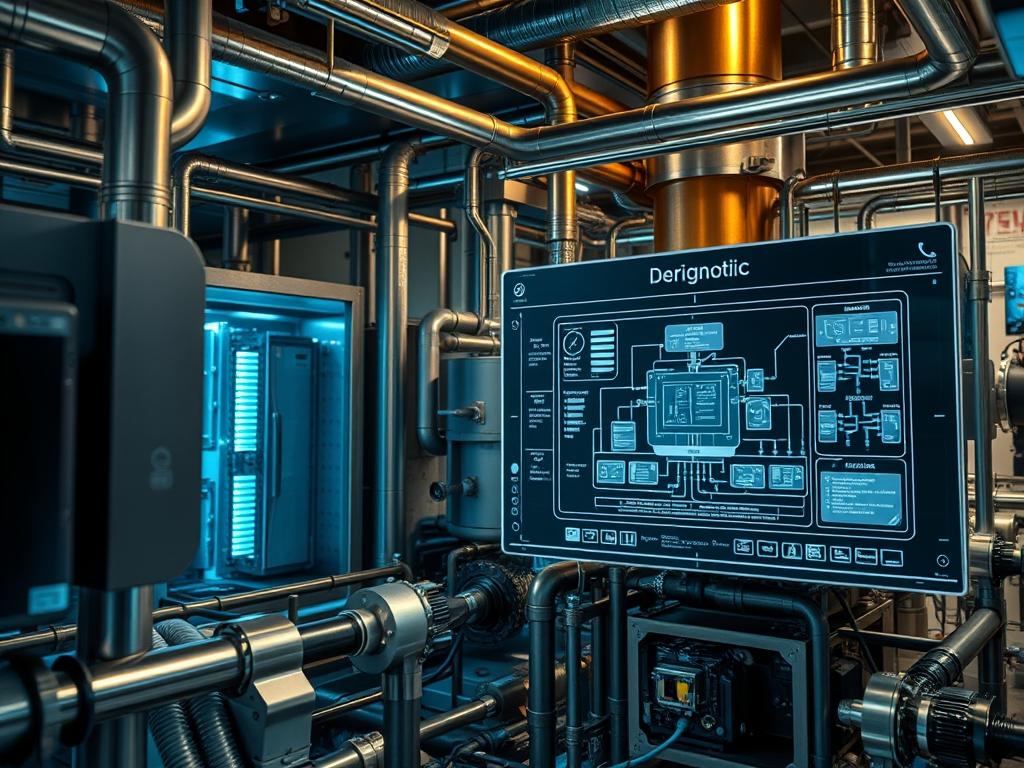
Refrigeration Oil Separator Logic functions as a critical abstraction layer between the lubricant management system and the thermodynamic core of an industrial cooling architecture. In high capacity systems; the migration of compressor oil into heat transfer surfaces constitutes a significant form of thermal-inertia. This intrusion creates a film that degrades heat exchange efficiency; effectively acting as an insulator. The logic dictates how a dedicated separator vessel isolates oil from the high pressure discharge gas; ensuring minimum oil carry-over into the condenser and evaporator coils. By maintaining clean heat transfer surfaces; the system reduces the electrical overhead required for a specific cooling payload. This manual provides the architectural framework for implementing automated separation logic within a Programmable Logic Controller (PLC) or moving toward a Distributed Control System (DCS) to optimize system throughput and prevent equipment failure. This is particularly vital in cloud infrastructure cooling where consistent latency in thermal rejection is required to maintain server uptime and performance.
TECHNICAL SPECIFICATIONS
| Requirement | Default Port/Operating Range | Protocol/Standard | Impact Level (1-10) | Recommended Resources |
| :— | :— | :— | :— | :— |
| Discharge Monitoring | 150 to 450 PSI | Modbus TCP/IP | 9 | Industrial Transducer |
| Level Sensing | 4-20 mA Analog | HART Protocol | 10 | Shielded 2-Wire Cable |
| Solenoid Control | 24V DC / 110V AC | PWM or Digital Out | 8 | DIN-Rail Relay |
| Log Aggregation | Port 502 / 443 | MQTT / JSON | 7 | Edge Gateway (4GB RAM) |
| Oil Diff. Pressure | 10 to 30 PSID | ASHRAE 15 | 9 | Differential Sensor |
| Logic Execution | 10ms to 100ms | IEC 61131-3 | 8 | PLC / Logic Controller |
THE CONFIGURATION PROTOCOL
Environment Prerequisites:
Successful implementation requires adherence to several hardware and software standards. All pressure vessels must comply with ASME Section VIII Div 1 for unfired pressure vessels. The logic controller must support IEEE 802.3 for network-based telemetry and NEC Class 2 for low-voltage signal wiring. User permissions must be elevated to Level 3 Admin for PLC logic modification or Root access for Unix-based edge controllers to modify service files. Necessary tools include a fluke-multimeter for signal verification and clinical-grade sensors for measuring refrigerant properties.
Section A: Implementation Logic:
The engineering design behind Refrigeration Oil Separator Logic is rooted in the principle of flow velocity reduction and centrifugal action. When the high-pressure discharge gas enters the separator-vessel; its velocity drops. This rapid deceleration; combined with internal baffle impact; causes the heavier oil droplets to fall out of the refrigerant stream. The “Why” of the execution is to prevent oil from reaching the expansion valve and evaporator where it would increase the fluid viscosity and create a boundary layer on the internal pipe walls. This boundary layer increases thermal resistance; leading to higher compressor discharge pressures and increased energy consumption. The logic must be idempotent; ensuring that the oil return valve only opens when a specific differential exists; preventing the bypass of high-pressure gas into the low-pressure crankcase. This prevents “short-circuiting” the thermodynamic cycle; which would otherwise cause a massive loss in system throughput.
Step-By-Step Execution
Hardware Validation and Sensor Mapping (Step 1)
Verify that the oil-level-float or optical-sensor is correctly mapped to the input registers of the logic-controller. Use a fluke-multimeter to check that the 4-20 mA signal corresponds exactly to the physical fluid level inside the separator reservoir.
System Note: This action ensures that the signal-attenuation over long wire runs does not lead to false “Dry” or “Full” readings in the kernel space of the controller.
Port Configuration and Protocol Handshaking (Step 2)
Configure the Modbus-TCP-Gateway to pull data from the pressure transducers. Use the command telnet [IP_ADDRESS] 502 to verify that the port is listening and capable of transmitting data packets without excessive packet-loss.
System Note: Establishing a stable handshake prevents the logic from entering a “Fault-Safe” state where it might prematurely vent high-pressure gas.
Defining the Hysteresis and Deadband Logic (Step 3)
Access the PLC-Logic-Editor and establish a high-limit and low-limit threshold for the oil return valve. Set the high-limit (Open) at 70 percent reservoir capacity and the low-limit (Close) at 20 percent capacity.
System Note: Implementing a deadband prevents “chattering” of the solenoid valve; which reduces mechanical fatigue and prevents high-frequency oscillations in the suction-line pressure.
Pulse-Width Modulation for Precise Return (Step 4)
For systems requiring fine-tuned oil management; implement a PWM (Pulse-Width Modulation) cycle for the oil-return-solenoid. Configure the logic-controller to pulse the valve for 2 seconds every 15 seconds when the level is above the setpoint.
System Note: Controlled pulsing reduces the thermal shock to the compressor and prevents the sudden ingestion of oil which could lead to high-current-draw or mechanical slugging.
Service Activation and Monitoring (Step 5)
If using an edge-based controller; restart the logic collector service using systemctl restart refrigeration-monitor.service. Verify the output using journalctl -u refrigeration-monitor.service -f to see live status updates.
System Note: Restarting the service forces a re-read of the configuration file; ensuring all changed variables are loaded into the active runtime memory.
Section B: Dependency Fault-Lines:
The most frequent point of failure in this architecture is the mismatch between sensor output and software scaling. If the transducer-payload is scaled for 0-500 PSI but the logic expects 0-1000 PSI; the separator will operate outside its safety envelope. Another common bottleneck is the physical strainer or filter located before the oil-return-orifice. If this becomes clogged; the logic may command the valve to open; but no oil will flow. This creates a state of “Commanded Action vs. No Result;” which must be caught by a secondary pressure-delta check. Software-wise; ensure that no other service is blocking Port 502; as this results in a complete loss of visibility into the oily-gas-mixture state.
THE TROUBLESHOOTING MATRIX
Section C: Logs & Debugging:
When a failure occurs; the first point of audit is the logic controller error log; typically found at /var/log/oil_logic_errors.log or within the SCADA “Event History” screen.
1. Error: OIL_RETURN_FAULT_01 (Time-out)
This indicates that the valve was commanded open but the level sensor did not detect a drop in volume.
Instruction: Check the oil-strainer for debris or verify the power supply to the solenoid-coil. Use the command lsusb or lspci if using an integrated hardware controller to ensure the I/O card is still polled by the system.
2. Error: HIGH_DISCH_TEMP_WARNNING
This suggests that oil has already bypassed the separator and is coating the condenser.
Instruction: Manually force the oil-separator-bypass logic to “True” to clear the reservoir and check the sight-glass for foaming. Use a sensors command via the CLI to check the temperature offset between the intake and exhaust.
3. Visual Cues:
If the separator tank is cold to the touch; it indicates liquid refrigerant is flooding the vessel. This suggests a failure in the pre-heat-logic or a stuck float-valve. Logic should be adjusted to close the return line if the temperature falls below the saturation point of the refrigerant.
OPTIMIZATION & HARDENING
Performance Tuning:
To maximize thermal efficiency; the logic must minimize the amount of high-pressure vapor that escapes during the oil return cycle. This is achieved by tuning the “throughput” of the return valve. Use a PID (Proportional-Integral-Derivative) algorithm to modulate the return valve based on the crankcase-pressure-delta. By maintaining a steady flow rather than large bursts; you reduce the overhead on the compressor’s cylinder heads. This ensures the encapsulation of the refrigerant remains consistent; preventing the expansion of gas where it is not wanted.
Security Hardening:
In networked systems; the Modbus protocol is inherently insecure. Use an iptables rule to restrict traffic to the Logic-Controller from only authorized Admin-Workstation IPs.
Command: iptables -A INPUT -p tcp –dport 502 -s 192.168.1.50 -j ACCEPT.
Additionally; encapsulate the Modbus traffic within a VPN tunnel if the data traverses a public-facing network to prevent unauthorized manipulation of the oil-return setpoints.
Scaling Logic:
As the thermal load increases; such as in a data center during peak traffic; the system must scale the separation effort. Implement a “Lead-Lag” configuration for secondary separators. If the discharge-pressure-concurrency exceeds a specific threshold; the logic should prepare the secondary separator and open the cross-connect-header. This prevents the primary vessel from becoming overwhelmed and allowing oil-carryover during high-load scenarios.
THE ADMIN DESK
How do I verify the oil separator is actually working?
Check the temperature of the oil return line. It should be significantly higher than the suction line. In the logic controller; verify that the level-sensor-variable fluctuates in a sawtooth pattern as the valve cycles.
What happens if the logic controller loses power?
The oil-return-solenoid should be a “Normally Closed” model. Without power; it remains shut; preventing high-pressure gas from flooding the compressor sump; which would cause a catastrophic mechanical failure upon restart.
Why is there still oil in my evaporator?
The logic may be too “loose;” meaning the deadband is too wide. Decrease the high-level setpoint in the PLC-Logic-Editor. Also; ensure the flow-velocity through the separator does not exceed the manufacturer’s maximum SCFM.
Can I run this on a standard Linux server?
Yes; provided you have a Modbus-to-USB adapter and a service like Node-Red or a custom Python script to handle the loop. Use chmod +x on your control scripts to ensure they have execution permissions.
Does oil type change the logic?
POE (Polyolester) oils attract more moisture than mineral oils. If using POE; the logic should include a “Moisture-Sensor” check that triggers a filter-drier-alarm if the parts-per-million (PPM) threshold is reached.