
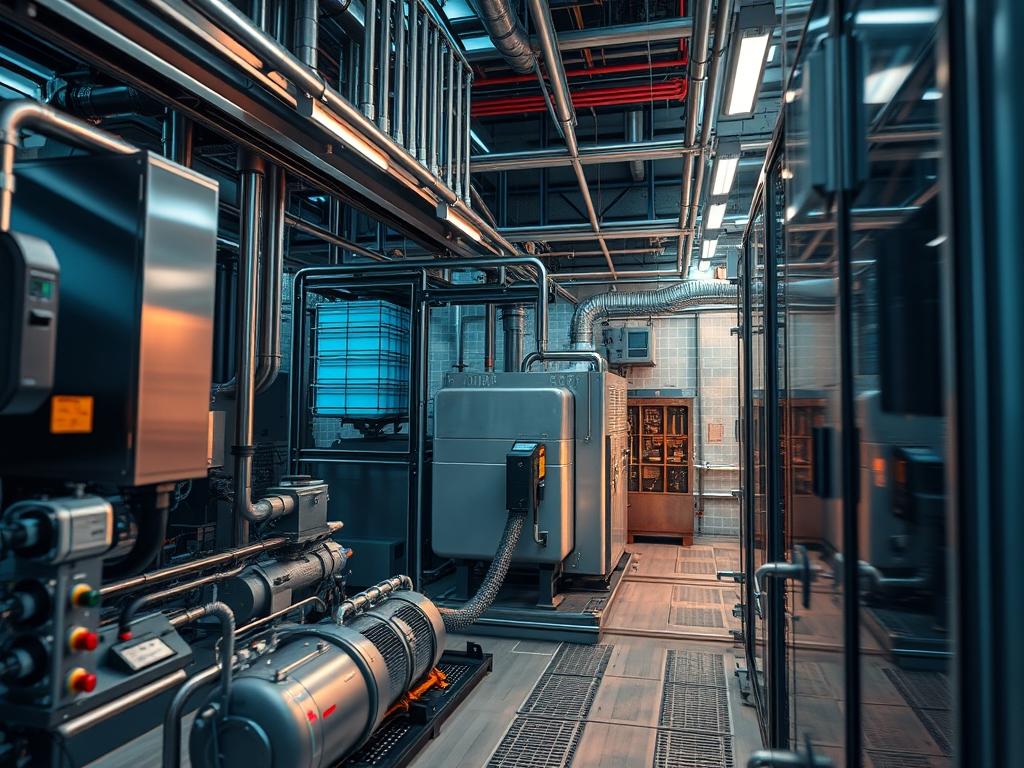
Refrigeration Heat Recovery Systems represent the critical intersection between thermodynamic efficiency and infrastructure sustainability. In a standard vapor compression cycle; significant thermal energy is rejected into the atmosphere via the condenser as waste. By implementing a recovery stack; this low-grade heat is intercepted and repurposed for domestic hot water; space heating; or industrial pre-heating. This system functions as a secondary energy layer; sitting between the primary mechanical refrigeration plant and the facility water distribution network. The central problem is the thermodynamic loss inherent in typical cooling operations; where up to 1.4 units of heat are rejected for every unit of cooling provided. The solution lies in the strategic installation of desuperheaters and heat exchangers that capture high-quality sensible heat before it reaches the condenser. This reduces the total energy overhead of the facility; lowers the thermal-inertia of the cooling water loop; and improves the overall Coefficient of Performance (COP) of the cooling plant.
Technical Specifications
| Requirement | Default Operating Range | Protocol/Standard | Impact Level (1-10) | Recommended Resources |
| :— | :— | :— | :— | :— |
| Discharge Gas Temp | 65C to 110C | ASHRAE 15 | 9 | 316L Stainless Steel |
| Water Flow Throughput | 2.5 to 15.0 GPM | ASME BPVC Section VIII | 8 | Schedule 80 Copper |
| Control Logic Latency | < 500ms | Modbus TCP/IP | 7 | 2.0GHz Quad-Core / 4GB RAM |
| Thermal Exchange Rating | 15kW to 500kW+ | TEMA Class C | 10 | Brazed Plate Exchanger |
| Sensor Accuracy | +/- 0.5C | NIST Traceable | 6 | PT1000 RTD Sensors |
| Signal Attenuation | < 3dB | RS-485 / Twisted Pair | 5 | Shielded Cat6 or 18AWG |
The Configuration Protocol
Environment Prerequisites:
Technical deployment requires adherence to ASME B31.5 for refrigeration piping and NEC Article 440 for electrical safety. The supervising hardware must run a kernel version equivalent to Linux 5.10 LTS or higher to support real-time industrial I/O modules. Ensure the user has sudo privileges on the logic controller and “Master Technician” physical access to the mechanical room. All Brazed Plate Heat Exchangers (BPHE) must be pressure tested to 1.5x the maximum operating pressure of the refrigerant side before integration.
Section A: Implementation Logic:
The engineering design relies on the principle of sensible heat extraction. Refrigerant gas leaving the compressor is in a superheated state. The Recovery System inserts a heat exchanger between the compressor discharge and the condenser inlet. By utilizing a counter-flow configuration; the system achieves maximum thermal gradient efficiency. The goal is to drop the gas temperature significantly without causing premature condensation within the recovery heat exchanger; which would result in liquid slugging risks for the main condenser. This approach ensures that the recovery process is idempotent: it does not fundamentally alter the refrigeration cycle’s primary cooling mission; it merely captures the thermal-payload that would otherwise be lost to the environment.
Step-By-Step Execution
1. Physical Integration of the Desuperheater
Mount the Brazed Plate Heat Exchanger vertically as close to the compressor discharge as possible to minimize heat loss through piping. Use Silver Solder (15% min) for all refrigerant-side connections.
System Note: This physical modification alters the high-pressure side volume. The physical asset now has increased thermal-inertia; requiring a recalibration of the refrigerant charge to maintain the correct sub-cooling levels at the expansion valve.
2. Configure the Logic Controller Interface
Access the edge gateway via SSH and navigate to /etc/opt/hvac/sensors.conf. Map the PT1000 RTD sensors to the correct GPIO pins. Execute systemctl restart hvac-monitor.service to initialize the polling loop.
System Note: The service restart clears the volatile memory of the logic controller; forcing a re-read of the sensor calibration tables. This ensures that the data throughput from the thermal sensors is accurate before the circulator pumps are engaged.
3. Establish Water-Side Circulator Logic
Initialize the pump control sequence using a PID loop. Set the target setpoint for the water storage tank to 60C. Use the command chmod +x /usr/local/bin/calc-delta-t.sh to ensure the script calculating the temperature difference is executable.
System Note: This action enables the software to manage the concurrency of the refrigeration cycle and the water heating cycle. By controlling the pump speed based on Delta-T; the system prevents the over-cooling of the refrigerant gas; which would negatively impact the head pressure.
4. Calibrate High-Pressure Safety Cutouts
Connect a Fluke-718 Pressure Calibrator to the high-pressure port. Adjust the mechanical high-limit switch and sync it with the software failsafe via the set-safety-limit –hp 350psi command on the logic controller console.
System Note: This step adds a layer of encapsulation to the safety protocols. If the software fails to detect an over-pressure event; the physical mechanical switch provides a hard-cut to the compressor contactor; protecting the infrastructure from catastrophic failure.
5. Verify Modbus Communication Path
Run mbpoll -m tcp -a 1 -r 100 -c 10 [Controller_IP_Address] to verify that the energy meter is reporting the reclaimed kilowatt-hours correctly.
System Note: Verifying the Modbus registers ensures that the packet-loss across the RS-485 to Ethernet bridge is zero. High signal-attenuation here would lead to inaccurate energy reporting; masking potential inefficiencies in the heat transfer process.
Section B: Dependency Fault-Lines:
The most common failure point is the accumulation of non-condensable gases in the heat recovery loop. If the vacuum was not pulled to 500 microns during installation; the thermal-inertia will be inconsistent; and high-side discharge pressures will fluctuate. Another bottleneck is “scaling” on the water side of the heat exchanger. If the water hardness exceeds 50 ppm; the heat transfer throughput will degrade over time; leading to a “High Head Pressure” error on the primary refrigeration unit. Finally; library conflicts in the PLC software (specifically between the PID library and the Modbus stack) can cause high latency in pump response times; leading to thermal spiking.
THE TROUBLESHOOTING MATRIX
Section C: Logs & Debugging:
Diagnostic analysis begins with the inspection of /var/log/hvac/error.log. Search for the string ERR_THERM_GRADIENT_OFF_SET. This specific error indicates that the temperature difference across the heat exchanger is insufficient to justify pump operation.
If the physical sensors show a reading of -99C or 850C; this indicates a “Sensor Open” or “Sensor Short” condition. Inspect the terminal block for moisture ingress or loose wiring. Use the command journalctl -u hvac-monitor -f to view real-time log streaming while manipulating the sensor wires to identify intermittent signal-attenuation.
For physical fault codes:
– Code E04 (High Head Pressure): This occurs if the recovery pump fails while the refrigeration system is under peak load. Check the circulator_relay status in the logic-controller.
– Code E11 (Low Flow): Often caused by air pockets. Bleed the air-purge-valve on the highest point of the recovery loop and verify that the water-side strainer is not clogged with debris.
OPTIMIZATION & HARDENING
– Performance Tuning: Implement a Variable Frequency Drive (VFD) for the circulator pump. By adjusting pump throughput based on real-time refrigerant discharge temperature; the system maintains an optimal temperature gradient. This minimizes the energy overhead of the pump itself while maximizing the heat payload captured.
– Security Hardening: On the logic controller; disable all unnecessary services using systemctl disable. Configure the local firewall to allow incoming traffic only on Port 502 (Modbus) and Port 22 (SSH) from authorized subnets. Set the iptables policy to DROP by default for all other ingress packets to prevent unauthorized access to the cooling infrastructure.
– Scaling Logic: To expand the system for multiple compressors; use a “Common Header” design. The control logic must be updated to handle concurrency; ensuring that the recovery pump speed scales linearly with the number of active compressors. Use a master-slave software architecture where the primary controller aggregates data from all compressor nodes via the Modbus network to calculate the total available thermal energy.
THE ADMIN DESK
How do I reset the thermal calibration?
Access the controller via terminal. Navigate to the /etc/hvac/calibration directory and delete the last_cal.json file. Restart the monitoring service to trigger an idempotent recalibration routine that syncs the RTD sensors with the current ambient references.
Is there a way to bypass the recovery system?
Yes. Locate the Three-Way Diversion Valve. Set the manual override to “Bypass” and then execute the set-mode –bypass-active command on the PLC. This ensures the logic loop ignores thermal-gradient errors while the recovery sub-system is offline for maintenance.
What causes high latency in heat capture?
High latency is usually the result of excessive pipe length between the compressor and the desuperheater. This leads to sensible heat loss to the room. Insulate all discharge lines with 1-inch thick closed-cell elastomeric foam to preserve the thermal payload.
How do I update the control firmware?
Upload the new binary to /tmp. Verify the checksum against the manufacturer’s provided hash. Run hvac-flash –file /tmp/firmware.bin. The system will reboot; and the kernel will re-initialize the I/O pins for the recovery sensors and valves.